I booked myself into a dead plush hotel for the four days over Christmas I’d be spending in Siem Reap, Cambodia. I say dead plush, it was only $30 a night but it was about 5 times the price I’d paid anywhere else in the last five weeks. By British standards, the cost of the 4 nights combined would get you a cobwebby single room in a below par B&B with a disappointing breakfast and a grumpy patron, if you were lucky. Here though, it meant a huge room complete with mini bar, an actual functioning AC system, bath tub and a flat screen telly (which of course I didn’t watch because everything was in Khmer) but still, it was there!
I spent Christmas morning alternating between reading on a sun lounger sipping a cold Angkor beer and taking a cooling dip in the shaded pool. With a tour of a local floating village and Tonle Sap lake organised for the afternoon I had license to be as lazy as I wanted to be in the morning.
I ambled out of the hotel in the early afternoon for a bite to eat and chose an eco friendly cafe just next door for my Christmas lunch. I ordered a bowl of Khmer Chicken noodles and patiently waited for them to arrive while thirstily glugging a glass of iced sugar cane juice in the 32 degree heat. Blissful! However, what arrived was less ‘ah bliss’ and more ‘oh bloody hell what IS that?’ My hues-of-grey Christmas lunch was filled with whole chicken feet, boney fragments of a mutton like meat and topped with huge chunks of some sort of greyish purple offal. The gag reflex jumped into action and I eventually gave in and chose to pick around the lumps and fill up on the rice noodles lurking below the oily orangey liquid. So Christmas lunch hadn’t gone to plan, but I still had the tour! With that in mind I didn’t allow my Facebook friend’s pictures of golden roasties, boneless meat and gravy soaked Yorkshire puds get me down.
Not quite what I had in mind for my Christmas lunch!
I waited patiently in the hotel lobby for my tour pick up. And waited. And waited. And waited some more. Until, I eventually decided it had gone passed the point of endearing Cambodian laid back lateness and had began eating away at my inherently British desire for punctuality. If there’s one sure way to piss a Brit off its lateness (that and people pushing to the front of a queue you’ve been stood in for too long). The hotel rang the company and I was plainly informed ‘yes, they’ve forgotten you’. I was bundled into a tuk tuk and told the driver would race to catch up with the bus. And race he did. Overtaking trucks and motorbikes on the highway before veering right onto a bumpy, dusty lane towards the lake. Every time we hit a pothole he glanced around, presumably to check I was still onboard. ‘First time I ever drive this fast on tuk tuk’ he proudly exclaimed when I ungracefully disembarked on wobbly knees at the dock.
Taken from the back of the tuk tuk during our race to catch the bus.
With still no sign of my tour group I was briskly ushered to a boat about to leave and dragged aboard by the skipper. The french family of five onboard glared suspiciously at the bewildered British girl who was to photo bomb their family Christmas Day selfies for the next 20 minutes. Offering to take a picture of them all together (usually always a winner) was greeted with a steely frown so I gave in and relaxed into the journey, watching the stilt houses rising precariously but elegantly from the ground to the sky.
Stilt houses along the riverbank, built tall enough to withstand the high water levels during the rainy season.
A local navigating through a watery suburbia.
At the next dock, or muddy embankment rather, I was worryingly aware that I only had $5 on me and if I needed to get back to Siem Reap alone the 20 minute boat ride and hour in a tuk tuk would cost far more than that. It was paramount I found my tour group. A muddy barefoot child beckoned me and I followed him into the village where he pointed at a mathered looking man sporting a lanyard and an only slightly apologetically embarrassed expression. I had found my tour guide!
The next hour of the tour was what you’d describe as a bit of a rip off. The $5 extra we paid for a ‘relaxing half an hours row through a flooded forest’ was actually a ten minute clumsily navigated row through some trees whose lower branches were adorned with the occasional stray plastic bag. I felt bit like a pinball being banged from tree to tree and started to dread the inevitable ‘tip, tip, tip’ when it came to disembarking. Turns out I wasn’t the only one who found this part of the tour more than a little disappointing. On the floating restaurant where we alighted I was greeted by a disgruntled chorus of fellow day trippers demanding their $5 back. The tour guide was looking more mathered by the second while more people joined the angry protest. Instead of joining in I awkwardly twiddled my thumbs at the waters edge secretly agreeing with the mob but also certain that no amount of ranting would yield a refund.
Next, the final part of the tour. To watch the sunset over South East Asia’s largest lake, the Tonlé Sap. We watched in awe as the huge yellow, to orange, to red glowing sphere melted into the horizon in a very typically beautiful Asian sunset. About 30 boats all bobbed around on the periphery of the lake and for a couple of moments I had a strange feeling inside as I realised our joint purpose was to watch the sun set, like some sort of pilgrimage. After the curvature of the red glow vanished, the warm fuzzy feeling was quickly replaced by guilt at the sight of acrid black smoke billowing from each of the 30 boats as they raced back up the mouth of the river. My Finish day trip companion commented that the scene reminded him of a time he visited the UK… and was stuck in a huge traffic jam on the M5 towards Bristol for three hours. It felt like a laugh or cry moment.
What we’d all come to witness, the sun setting over the vastness of Tonle Sap Lake…
…which soon lost its magic when all the boats sped to the river mouth.
Desperate for something recognisable for dinner I opted for a pizza at a very western looking establishment in the city before heading back to the hotel to call my Mum, Dad and Granny. One way or another, it had definitely been a Christmas Day to remember!
The town of Sapa sits 320km from the city of Hanoi, nestled somewhere between cascading rice fields and prodigious peaks boasting Indochina’s highest reach. The town itself clings perilously to a mountainside before plateauing out onto a murky lake. Lushly rounded hillocks envelope the town while evanescent mountain faces cocoon its outer perimeter. Its considered one of the best places for trekking in Vietnam and as soon as you step from the bus women dressed in their vibrant traditional tribal attire approach you in a chorus of ‘trekking, trekking, trekking?’
There must be thousands of options for trekking in Sapa. Women on the streets, hostels and agencies are all vying for your business and push their tours. Whether you’re looking for a challenging week of hiking or an easy going stroll through rice fields, someone in Sapa will have a trip for you.
I debated long and hard about what sort trip to take, torn between a strenuous three day hike to the summit of Fansipan Mountain, Indochina’s highest peak or a relaxing amble to some local villages with some epic views along the way. I rather lazily opted to indulge in a trip up Sun World’s cablecar to Fanspian’s 3143m summit and decided I would find a local day trek for the following day.
The top of Indochina is an impressive place. We arrived later in the afternoon and enjoyed the expansive vistas largely to ourselves. Though the horizons were draped in cloud, they moved swiftly and majestically over the contours of the mountains while we watched in awe. The sun was just setting as we made our way up the final few steps of the 700 between the cablecar drop off and the trig point. The trip was well worth the 700,000 dong we paid ($30us) to reach the top.
Next I had to decide what day trek to take, with a thousand options its hard to know where to start. However, I’d read about a local company who are championed as an ethical and sustainable business supporting local woman and was keen to learn more.
Sapa Sisters was established back in 2009 by a group of 6 friends. Two Europeans and four women from the H’mong hill tribe. Having learnt about the difficulties H’mong women face in finding decent jobs with fair salaries Swedish/Polish artists Radek and Ylva began a collaboration with their local friends to address the issues faced. Their idea was simple, a trekking company run by the local women who know the landscape inside out and who work directly with travellers. Thus, Sapa Sisters, the only all female and all H’mong trekking company in Sapa was born.
H’mong women face so many complex cultural obstacles throughout their lives, all simply a byproduct of their gender. Men hold more power socially and once married women are considered as belonging to their husband’a families. Though the practice of arranged marriage is declining, it still happens in the region and martial abuse against women is still widely acceptable. Due to the social stigma associated with divorce or separation, many women remain in unfulfilling and abusive relationships. Economically, it’s difficult for H’mong women to support themselves and their families. In fitting with local customs, it’s only men who inherit land from their families and boys are favoured to continue secondary education over girls, resulting in high levels of illiteracy among H’mong women. As if this isn’t enough hardship, the last ten years has seen a huge increase in female trafficking across the Chinese border for the purposes of prostitution and sold marriages.
What Sapa sisters offers is an escape from some these hardships. Their guides earn a decent wage, which their husbands recognise as a positive way to support a family. In turn they will take care of the children, the home and any kept animals so that their wives can work. This is a hugely significant step, a recognition of a woman’s independence and value. The enterprise is changing attitudes towards women in a society where they are continually downtrodden.
The tours are more expensive than the prices you’ll find in hostels or on the streets but you can rest assure that you will receive a friendly, informative guide whose (often self taught) English is excellent and most importantly you’ll know that they are receiving a fair wage and changing perceptions of women in their society. This positive social chain reaction is something that will outlive any travel memory, souvenir or photograph. So in my mind, worth every buck.
I learnt so much from my guide, Sy on my one day trek. She told me about her life, her husband and children and what it means to be a 25 year old H’mong womanwith two young children in Vietnam today. Dodging hawkers was a challenge, as with many places in northern Vietnam but the trek itself offered stunning vistas and an eye opening look at local life.
I’d urge anyone looking to do a trek in Sapa to check out Sapa Sisters’s website, or pop in to their office opposite the central station for a chat.
It’s taking me a while to get used to Vietnam. Solo travel always takes a little adjusting to, any travel does I’m sure, but I’ve only ever experienced it solo. It’s getting used to sharing a bedroom again, to having to lock your possessions away every time you leave the room, to making conversation with strangers and to, in my case, being alone. Suddenly every decision you make, from what you’ll have for dinner to where you’ll spend the night is completely down to you. And it’s easy to let that swallow you up for a moment. Until you realise you really do need to make a decision or you’ll be sitting on the kerb hungry all night.
Across the river along the ancient temples of the Le and Dinh Dynasties
Adjusting to solo travel is one thing and I’m doing alright. It’s the place that’s making it difficult right now. So far, Vietnam feels like such a tourist trap. So much so that I feel like it lacks authenticity. This is unfair. It’s very authentic, but as a tourist and a white face I’m somehow on the peripheral of that authenticity. Always destined to pay ten times the price for anything and simply a $ sign to the people here. Nothing more or less. I’ve been in countries who depend on tourism in the same way before, like Nepal for example. Yet the people there saw you and asked questions; where are you from? What brings you here? How is it different from your country? Do you like it? I lost count of the number of times I was invited into shops and homes for a free cup of tea and wasn’t pressured to buy a thing. They just wanted a chat. If I did buy something, bonus!
This feeling really came to a head after a day trip to Tam Coc, Vietnam’s ancient capital a couple of hours south of Hanoi. We hopped on the minibus and weaved out of Hanoi’s traffic ridden streets. Our first stop was the ancient temples of the Le and Dinh Dynasties. As soon as we stepped from the safety of the minivan a crowd of women ambushed us selling traditional Vietnamese hats. ‘One dollar one dollar one dollar miss’. A straight forward ‘no’ comes nowhere near as they jam the hats onto your head hoping to make a sale. Once you’ve battled through them there’s the men and women with cameras taking your photograph, in the hope they can sell the printed and laminated picture to you when you leave. Also for a dollar. I fix a grim expression on my face so that any photograph taken of me will be horrific and they won’t bother trying to sell it back to me. Our next stop promises some peace at last. An hour and a half being rowed down the Tam Coc River.
Entering a cave along the Tam Coc river
Picture this. You’re rowing through an albahaca green river with karst rocks towering above you and limestone carved caves ahead. The craggy faces of the rock are steeped with lush vegetation and the sun is beaming down as you duck to paddle through a natural arch. A few pelican like birds circle above and no one is trying to put a hat on your head. Sure, there’s like a hundred boats ahead, but you begin to relax into the splendour of the landscape you’re gliding through. Suddenly you emerge from the darkness of Hang Chateau cave to be greeted by a barricade of women selling beer, snacks and hats from their own boats. They purposefully crash into your boat to get alongside. Once there, they grab on with a vengeful grasp and begin trying to put beers and bags of crisps into you hand. No. No thanks. Not now. I’m good. Not for me. No! How many other ways can I say it?! Which one works!?
A floating shop along the way
I’m thankful to get back into the safe haven of the minivan and away from the incessant selling. So what’s next on the agenda? Halong Bay. Sold as THE best place in the whole of Vietnam. THE must see location. THE place not to miss.
The place where the tours seem to be triple the price as to anywhere else, the place where you’re forewarned travelling to independently will mean getting hoodwinked by local buses leaving after the tourist boat arrives, the place where bargaining for everything is vital so as not to leave bankrupt. Every other traveller I spoke to in Vietnam told me that they too were considering skipping Halong Bay so as to avoid the ultra touristic experience. After a day in Tam Coc the very thought of spending two whole days in the same environment made me want to retreat to the sanctuary of my bunk bed and stay there indefinitely.
So, after little debate I decided that I was prepared to forgo a trip to Halong Bay in order to avoid the feeling of being a pawn in a game of Vietnamese monopoly. Instead I would make the six hour bus journey south to Phong Nha, the setting for the World’s largest cave system in the hope of finding some Vietnamese authenticity I can feel part of. Only time will tell!
Boats ready to ferry tourists down the Tam Coc river
An amazing landscapes tainted by an uncomfortable experience
I rather ignorantly hadn’t realised until recently that part of my Mum’s job as a district nurse was performing the last offices procedure, meaning washing and dressing patients who had passed away at home. I was taken aback but, although I can’t articulate it here with the eloquence mum did, she explained to me that preparing someone in keeping with their final wishes is the last act of kindness, care and respect you can show a person and is therefore quite a special thing.
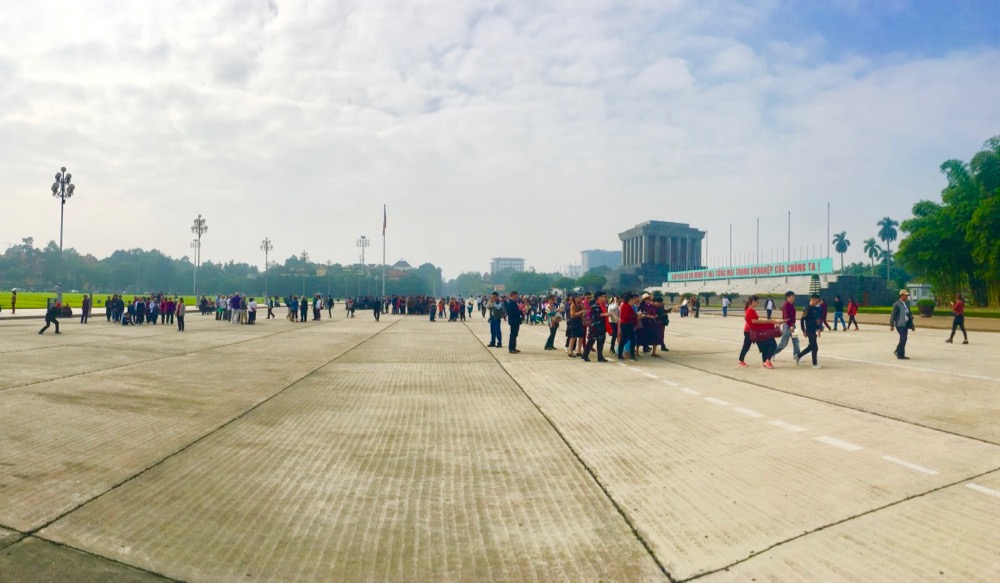
This idea floated through my mind as I queued with thousands of others to see the preserved body of Vietnam’s most celebrated president and founding father, Ho Chi Minh. It was his final wish to be cremated and his ashes scattered across his beloved country, from south to north. Instead, the government ignored his wishes and built an obtrusive mausoleum where his frail, lifeless form would forever lay waiting to be gawped at by millions of locals and tourists.
The regulations spoken oven the tannoy, printed on signs and enforced by at least a hundred strict security personnel are not to chew gum or smoke in the grounds and to dress modestly with long sleeved tops and knee length skirts or trousers for the occasion. You’re reminded that when entering the mausoleum you must keep your hands out of your pockets, you mustn’t smile and you mustn’t make any sudden movements. All of this in order to show respect. As I fixed my face to its most severe expression I wondered what the point of all these formalities were when Ho Chi Minh has surely already endured the biggest act of disrespect possible having had his final wish disregarded so fiercely. I found the lines of hot dog selling vendors and shops selling ‘I love Vietnam’ t-shirt’s that we were herded through afterwards less than respectable. It was as if I’d been transported to the gift shop of a zoo.
People gather for group photographs outside the mausoleum.
The whole experience felt so juxtaposed with that it was supposed to be celebrating. After visiting his body in the mausoleum we once again lined up to view Ho Chi Minh’s stilt house, a simplistic structure where he had preferred to reside over the grand presidential house. Over eager middle aged women elbowed their way to front to get a better look at the minimalistic study and bedroom while families held up the impatient queue by stopping for selfies. All this chaos hardly felt like a representation of his famously favoured simplistic lifestyle and apparently humble personality.
I found the whole experience macabre and depressing. Not because the main attraction is looking at a corpse, it could have well been a realistic wax work figure laying there illuminated as we all trudged around silently. It was depressing because it’s so far detached from what he wanted. Perhaps because I’m not Vietnamese the experience lacked a certain poignancy but still; I can’t imagine Ho Chi Minh looking down on this charade with much dignity and pride left in his heart.
I took solace in constructing my own conspiracy theory; that his family did in fact cremate him and scatter his ashes amongst the cascading rice terraces, across turquoise beaches and down the lush mountainsides of his Vietnam. In spaces where children can laugh and play freely without being scolded, where community and culture is rife and where the country’s serene beauty comes to life. As I drifted into my day dream I imagined his family paying millions of Dong to commission the most lifelike waxwork figure of his body. The fact that the mausoleum is closed for two months annually so that his body can be flown to Russia for preservation is a rumour they started in order to abate conspiracies like my own. Just then, a boy of about six years old strutted by sounding a rubber chicken bought in one of the gift shops, bringing me right back to reality.
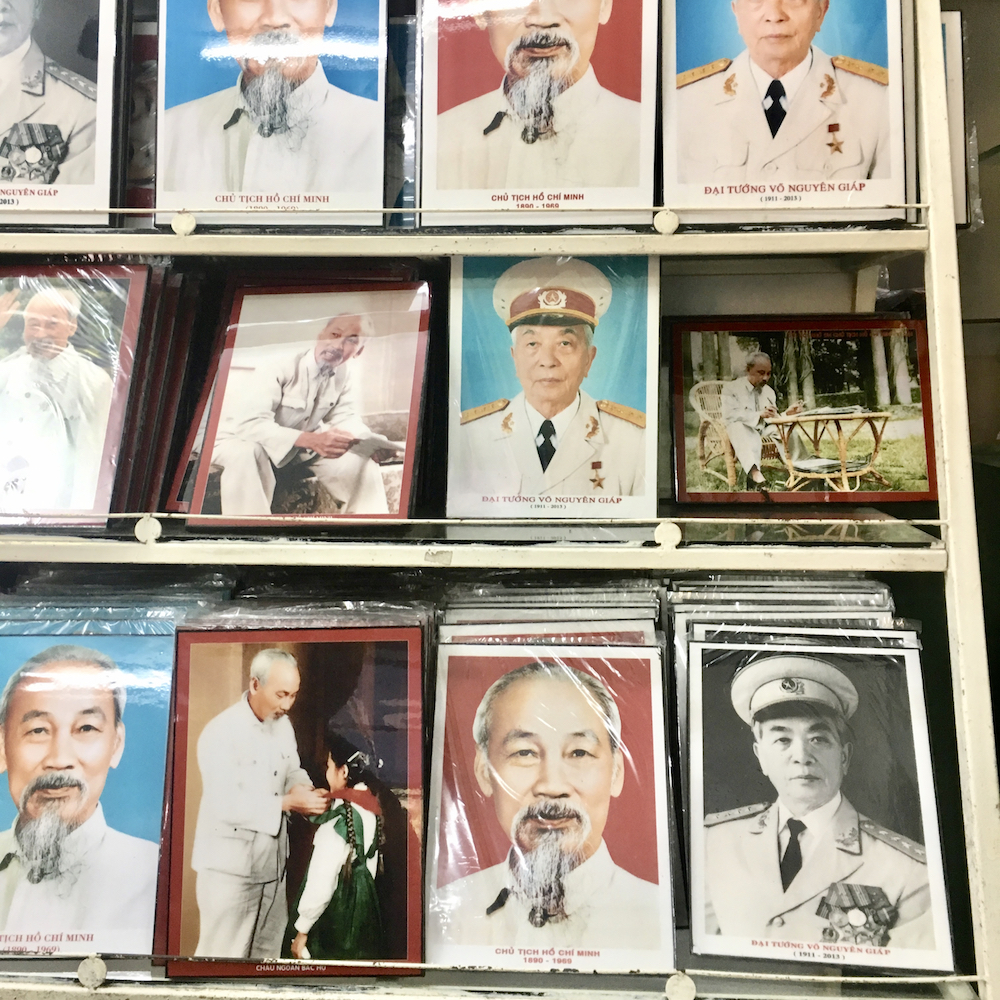
Possibly every photograph ever taken of Ho Chi Minh is available for purchase so you can create your own shrine at home.
Australia is notoriously an expensive country to travel in, especially for backpackers who have been tramping around South East Asia for a few months before arriving. I guess this is what makes the working holiday scheme so inviting; The opportunity to travel and then sooth your weeping bank balance with a well paid casual job. There seems to be no escape from the expense of Australian travel; Prices are high in outback towns because getting any produce to these remote locations is a pain in the arse, city prices are even more extortionate and buying a pint means taking out a mortgage, while the touristy areas capitalise on the opportunity to drain enthusiastic day-trippers of every cent. So finding free stuff to do becomes not only a fun challenge but also a kind of necessity. With that in mind, here are a few free or practically free things you can do along the East Coast of Australia!
1. Feed wild wombats and parakeets on Magnetic Island: Just off the coast from bustling Townsville, Maggie is full of wonderful wildlife experiences. Bush walks where spotting koalas is pretty much guaranteed, hostel rooms where possums make late night visits and snorkel spots teeming with fish makes this island a wildlife haven. Head to Geoffrey Bay with a $2 bag of feed (available at the YHA and other shops) and rustle your bag until a curious wallaby hops down to feed straight from your hand. With little fresh water on the island the wallabies get much of their hydration from the food they consume so often just a cup of water will do the trick. It is important however to mention that you must never feed the wallabies human food, whilst we were leaving a group of over eager Australian tourists were about to feed a wallaby an oreo before we offered them some of our left over feed.
2. Bull Riding practice in Rockhampton: PBR (professional bull riding) is an iconic Australian sport. The aim of the game is to hop onto an aggravated bucking bull and attempted to stay on, with only one hand to support yourself for a whole 8 seconds. There’s little doubt about the animal cruelty factor of the sport; A strap is pulled tightly around the bulls abdominal area which makes it buck uncontrollably in a futile but desperate attempt to rid itself of the constriction. If you’re happy to overlook the questionable ethics of the sport for a one-off cultural Aussie sporting experience its worth heading to the Great Western Hotel in Rocky to watch a practice session. Riders as young as 11 hop onto bulls and attempt to stay onboard. With an arena style seating area you can bypass the bar and just watch for free, or if you’re feeling plush get a couple beers in and a prime steak in the place regarded as ‘the beef capitol’ of Australia.
3. If animal cruelty isn’t high on the agenda, head to Rocky’s Botanical Gardens: Lounge around the lake while curious parakeets blatantly attempt to steal your lunch. These free-to-enter Botanical Gardens are dotted right the way up the East Coast (Brisbane, Rocky, Mackay, Cairns to name a few) and are a great place to chill out for the day. Most also have a cafe/restaurant and often boast either another attraction alongside or hold events such as craft markets on weekends. Take a book, grab an ice cream with the money you saved and spend a couple hours wandering aimlessly around lush tropical gardens. I shamelessly fell asleep under the shade of a palm tree for 2 hours up in Rocky’s gardens; It’s a hard life this backpacking.
4. Go for a swim: Forget paying for swimming like at home, a lot of seaside cities have lagoons where you can wallow on the manmade beach and cool off in the danger-free water. Brisbane, Airlie Beach and Cairns all boast these free swimming spots but its best to avoid them at weekends and school holidays, unless you’re keen on a barrage of constant splashing, floating plasters and incessant screaming. Even better than the free lagoons is the actual ocean. You’re constantly told that swimming in the ocean in Northern Queensland is a fools game because of the risk of crocodiles (and in season killer jellyfish) but most beaches have designated netted areas for swimming and the locals are usually always up to date with recent sightings and the impending arrival of jellyfish.
5. Whale watch from the beach in Mooloolaba: This part of the East Coast is world famous for its whale watching and you don’t need to pay for a boat trip to see these magnificent mammals. For a start, they are huge (up to 16 metres and about 30 tons) which means they’re even impressive from a distance. Set up for the day with a packed lunch at Point Cartwright and wait to see what comes by. Patience is key when it comes to this type of wildlife watching, but sitting out in the pleasant 25ish degrees that the whale watch season provides with a beautiful view alone the Sunny Coast is hardly strenuous.
6. Watch the flying Foxes come in to roost in Hervey Bay (and lots of other locations on the East Coast). These bats boast an absurd wingspan of up to a meter (3.3ft) and can weigh up to a kilo. Their name is so apt. The flying fox’s furry dog-like head protruding from its angular Halloween-esk cape really accentuates its mammalian order and is oddly quite adorable. Head down to the Pialba leg of the Hervey Bay esplanade just before dusk and wait for the raucous show to begin. There’s a small area set back slightly from the road with an information board and seating area for you to enjoy the spectacle comfortably. However, I opted for lying on the grass to watch the bats fly overheard in their hundreds. If you’re more of an early bird, head down at dawn and watch the trees come alive as they come in to roost.
7. Hire a bike in Agnes Waters and cycle to the Town of 1770 to watch the sunset at one of only three points along the East Coast where you can see the sun set over the ocean. The sleepy little town hosts loads of hostels that also offer bike rental for next to nothing, as do many along the East Coast. The most I paid anywhere was $10 for the whole day. The esplanades in the cities and towns are perfect for a nice easy-going, scenic cycle and you can google further routes if you’re up for a more strenuous ride.
8. Grab a snorkel mask and explore North Stradbroke: If you’ve got room in your rucksack to carry a mask its definitely worth buying one, although you can rent them at most hostels for a few bucks. Just a couple of meters off loads of the East Coast’s beaches a whole new world of weird and wonderful fish are waiting to be spotted. Theres hundreds of snorkelling trips you can pay to do, many of which are well worth the cash, but with your own snorkel you can turn a quick splash around in shallow waters to a David Attenborough worthy experience. Its incredible what you can see in waters no deeper than half a meter, literally just a few steps off the beach.
Deciding you quite fancy living and working in Australia is the easy part, it’s orchestrating the whole shebang that’s the hard bit. Or so you’d think… Australia is so backpacker friendly to organise that it’s actually pretty much as easy as making that first decision. It can be a bit arduous researching all the components of how of make it happen; So here’s a straightforward, honest list of what you need to do;
So the working holiday visa itself is your first priority. Do this directly though the gov page. Don’t go through an agency, they will rip you off and it’s so easy to do on your own. Mine was really quick to come back (about 24 hours) but it can take a while so do it plenty in advance. You have a year to enter the country from the day it’s granted, so keep that in mind. It’s current cost is $450 AUD, that’s just under £250 (2018) and contrary to popular belief there isn’t masses of paperwork to fill out, just a simple online form.
Next is your TFN (tax file number). This is their equivalent of a National Insurance number and required legally for work. You can’t do this until you arrive in Australia, but I was a little concerned as it requires an Australian address for them to send it to and I wasn’t going to be in the same hostel for the 28 days (thats how long they say it’ll take to arrive). So; I opted to go with a company who you can apply with before you leave, give them your arrival date and as soon as you’re on Australian soil they will process the application and email you the number- just means you don’t need to stay in the same place until it arrives and it’s one less thing to think about when you get there. If you know you’ll be in the same place for your first month then save yourself some money and do it directly through the gov page. I went though Go Work About but there’s lots of companies that offer a similar service, just google them. It’s the only thing I paid to be sorted for me because logistically it made more sense. The rest you can do alone and save money.
The view from my Staff Accommodation in Wye River on the Great Ocean Road
Next is your bank account. Dead easy; I went with Commonwealth Bank, but they’re all much the same. You can open your account from the UK up to three months before you arrive, then you just need to go into a pre chosen branch with ID and they’ll give you your bank card. It then takes about 5 working days to move money from your UK account to your Australian account. Move a few grand because it costs about £30 in fees each time or use a service like Transferwise for cheaper rates. Take enough money to see yourself through your first two weeks while you get your bank account sorted (it won’t take that long). You can preload a Post office card with a couple of hundred dollars. Leave the log in details of your post office account with someone at home and they can top it up for you in an emergency too. You can use your British card but you’ll get charged quite a lot. Take about $200-300 cash to start you off for airport stuff/taxis/first hostel.
Enjoying chilling out on Brisbane’s South Bank on day three of being in Australia with all the official bits sorted!
I booked my first hostel before I arrived, only 5 days but it’s nice to know where your going from the airport and not have to hunt for somewhere with a bed. I always use booking.com for hostels. YHAs are always really nice (usually with a pool), BASE and NOMADS are good but proper party hostels so don’t expect too much sleep. Those are the most well known three but there’s thousands to pick from!
I always book my flights through Sky Scanner. Generally Tuesdays and Wednesday are the cheapest days to fly. You need to do this with plenty of time because the prices will go up closer to the date. I usually book mine about 2-3 months in advance. Just make sure you delete all of your history on your computer before you do you final search and payment because if they know you’ve been looking for those flights the prices will be higher (sneaky I know!)
Dunes in Mungo National Park, New South Wales.
The last of the important pre departure stuff is travel insurance. Just go on a comparison website and see which policy suits you best. I had all my camera equipment so needed a higher amount on my personal luggage. Other people don’t bother at all, especially as there’s a reciprocal health care agreement between Australia and the UK (see below). This covers you for doctors appointments or emergencies but of course doesn’t cover your personal belongings, passport, money and so on. You can also find insurance specifically intended backpackers. I used Nomads, unlike other companies they allow you to extend your policy while you are abroad- so if you decide to go somewhere after Australia you can easily extend it on your online account.
One of the things you’ll want to do pretty soon after you arrive in Australia is get a Medicare card. This is incase you need to make use of that reciprocal health care deal I mentioned earlier. You just need to go to the nearest Centrelinks wherever you are (it’s sort of like their equivalent of the jobcentre) take your passport and they’ll give you a form to fill in. You’ll need an address for the card to be sent to, hostels are usually happy for you to use their address but check with them first. My card didn’t arrive before I left the address I’d given them, however when I went to the hospital for an X-ray they gladly accepted the Medicare number I was given in Cetrelinks.
And thats pretty much it! Simple right? Now the boring bits are out of the way you can get back to googling pictures of Australia’s beaches and boasting about the temperatures you’ll be flying into.
Normanby Island, part of the Frankland Island Group around 45km south of Cairns.
After Fraser I continued north with a one night camping trip to Kinkuna National Park along with the Aussie I’d met in Hervey Bay. It wasn’t the most successful camping trip ever. Quite ominously everyone else was packing up and leaving when we arrived and the baby blue sky was rapidly turning steely grey. But believing locals know best, I trusted the Aussie that said “it’ll be foooine”. By 1am the interminably torrential rain and roaring wind had ripped our woefully inadequate tarpaulin from its bearings. At 3am I gave into the increasing gale and sat on the beach drinking a beer resigned to the fact that I may never be dry again. By 4am we succumbed to sitting in the ute waiting for first light when we could safely head for Bunderberg, some 20 miles up the coast.
Part of a whale vertebrae on Kinkuna Beach, before the gale hit us. The few hours we had exploring the Kinkuna area of the Burrum Coast National Park was actually great, it would be a beautiful place to camp in fair weather so despite my damning report, I’d definitely recommend a visit.
Perhaps I’d gotten used to being on my tod (or more likely it was the incessant moaning from the Aussie about how terrible the weather was) but I could not wait to be rid of my temporary travel companion and on my way north again; to the point were I politely declined an offer to pop to their friend’s house for a hot shower and insisted that I really did want to I wait 9 hours in Bundy for my bus up to Agnes Waters in the pissing down rain.
I’d been in Bundy earlier in the year looking for farm work towards my 88 days. The town is notorious for its poor treatment, often crossing the line into exploitation, of backpackers. But it’s also a hotspot for picking jobs during harvest months so young travellers still flock there. I booked into a working hostel there back in April for four nights and hated it with such ferocity that I left after the second night. There was three main reasons I hated it. The state of the hostel, complete with holes in the cubicle walls of the showers and what must be the grimiest kitchen in existence. How unwelcoming and downright rude the locals were towards backpackers and the straw that broke the camels back; The Israeli man openly masturbating in the bunk directly opposite me in our otherwise empty 12 bed dorm. Nice.
The horrible hostel where I stayed back in April(‘Federal Backpackers’ if you’re wondering). There was a bar attached to the hostel, I popped next door for a beer one night only to be asked ‘Are you a backpacker? Well you’ve got to use the back then”. The back. Where a tiny stretch of the outdoor bar had been cordoned off for us to have a beer in, next to the dustbins and out in the rain. Lovely!
So when I found myself back there I was adamant I wouldn’t spend another night in Bundy. I’d gladly wait all day for a bus out of there. With the rain continuing to worsen and flash floods reported right up the coast it was touch and go as to whether I would make it out. Although I didn’t realise until I was nearing the end of my east coast trip, it was this fateful day in Bunderberg that my passport got so wet and soggy that it was completely unusable and I had to negotiate applying for a replacement while still abroad (thanks Bundy). Anyway, a couple of hours later on that fateful day I was stepping off the coach into a bizarrely dry Agnes Waters where I’d spend the next few days.
The only photograph I managed of the torrential rain and flash floods from the dry safety of the Greyhound bus. Strangely, everyone else on board was bone-dry and took great pleasure in watching me wringing my hair out when I got on in Bundy.
The next part of my East Coast adventure would take me to Fraser Island. It’s the world’s largest sand island stretching a preposterous 120km along South Queensland’s coast. At its widest point the colossal island reaches 22km and naturally, being a sand island, is surrounded by golden beaches. The natural wonder is the product of hundreds of thousands of years worth of sand moved by wind and tidal currents from Queensland’s eastern river systems which has been deposited onto the continental shelf off the coast. While the currents and wind coming inland helped create the island’s zig zagging outline.
Its interior hosts over 100 freshwater lakes, comprising of window, barrage and perched types. Around 40% of Fraser’s lakes are perched and therefore oligotrophic, meaning there is very little nutrients present to support fauna or flora. This goes some way to explain why many of these lakes are so pure with mesmerisingly transparent water. These high dune lakes were my first real taste of the lush tropical paradises the East Coast had to offer.
I had originally booked a three day self trek across Fraser Island but the persistent high winds and increasing temperatures meant the risk of bush fires was high and many trails across the island had been closed to walkers. I got the call to say the trip was off while chatting to a local fisherman. It had been years since he’d been to Fraser and if I was keen he was up for a couple of days on the island while he waited for his dry-docked trawler to be ready for her next voyage.
There was an inherent wildness about Fraser as soon as we disembarked the ferry. A tannoy announcement reminded everyone on board to reduce the pressure in their tyres to cope with the island’s soft sandy tracks and that was it, we were off. No more, no less; Pretty much goodluck and get on with it. It was refreshing for once not to have to endure some boring health and safety spiel; Although perhaps we could have done with a brief pep talk as we experienced a sketchy moment when the 4wd came what felt like millilitres away from tipping on one sandy embankment. The split second when our ute teetered on two wheels before clattering back onto four felt like long minutes and it took a while for my heart to vacate my mouth and settle comfortably back into my chest.
We headed to the island’s most well known lake early in the morning to avoid the half term crowds. We practically had Lake Mackenzie to ourselves and wallowed in the indescribably clear water for a while. The sand was so brilliantly white it was actually blinding to look at without sunglasses, in the same way a blanket of fresh snow is. We made a second visit to the lake on our last day but the beach was overrun by 4wd tag tours and half term day trippers so I’d definitely recommend an early start to experience the popular lake in all its magnificence without people around!
We also walked through the dunes to Lake Wabby, where the sand rapidly drops off into a deep emerald void. Laying in the shallows with our feet dangling into the depths hoards of tiny fish appeared, eager to nibble on our waggling toes. So, no need to visit the 4* Kingfisher Bay Spa this time! Lake Birrabeen and Boomanjin were impressive sites whilst also much more tranquil in comparison to the mahem that Lake Mckenzie became by mid afternoon. We camped our one night at Central Station with a very make-do-and-mend tarp tied from a tree to the ute under which we slept in typically Aussie Swags. I’d love to return one day, perhaps steal a glance of the infamously pure Fraser Dingo and explore more of the island’s geologically fascinating lakes. But for now it was time to return to the mainland and continue north along the east coast.
According to google maps, the distance between Brisbane and Cairns is 1048 miles, that’s 209 miles longer than the distance between Lands End and John O’Groats (the most southerly and northerly tips of the UK). In my ‘Pommy’ wired brain this distance seemed colossal, it is however only a small fraction of the vast Australian coastline. For September and October last year my only purpose was to get from Brisbane to Cairns and see the famous East Coast of Australia on my way.
I returned down under in early September having travelled home to celebrate my sisters’s wedding. It was great to catch up with family after five months abroad but the typically grey UK skies and cold summer drizzle soon had me pining for the cobalt blue skies and cyan waters that the east coast promised.
I bypassed Brizzy (Brisbane) having spent some time in the city earlier in the year and headed straight for Mooloolaba on the Sunny Coast (Sunshine Coast; Prepare yourself for plenty of affectionately abbreviated Aussie place names during these next few posts). I spent ten days in Mooloolaba adjusting once more to Australian backpacker life. From a full fridge, my own room and Mum’s home cooking back to rooting around the communal fridge for my groceries (often to find they’ve miraculously vanished anyway), an overpriced bunk bed in a shared room and a diet largely centred around super noodles. I paint a dire picture, but what comes with all that is freedom, adventure and quite a lot of fun. Swings and roundabouts hey!
The first two weeks of my 1048 mile journey was centred around one thing; The famous Humpback Whale and their 6,000+ mile annual migration. These incredible cetaceans migrate from their icy Antarctic feeding grounds to the warm sheltered waters off Australia’s east coast in order to mate and give birth to their young. And they don’t half make a song and dance about it. These rorqual whales are famous for their lively acrobatic behaviour and are renowned for impressive displays which include slapping their knobbly pectoral fins and huge flukes repeatedly on the surface of the water. The piece de resistance of their routine is their breach; thirty five tonnes of blubbery whale fully exiting the water in a spectacular leap and crashing to submersion seconds later.I became somewhat obsessed with whale watching at about fourteen years old after reading Mark Carwardine’s ‘On the trail of a Whale’. I later learnt about this epic journey and since then, witnessing the phenomenon of the migration along the Aussie coast was a bucket list activity for me, so a whole ten years later (gosh I am getting old) I was finally ready to tick the box.
Humpbacks surfacing and pec slapping off of Point Cartwright, Sunny Coast.
I began with a couple of hours boat trip out of Mooloolaba where the whales surfaced against the slightly bizarre backdrop of a heat-hazed cityscape. During this three hour trip we were also fortunate enough to witness a Humpback calf mischievously chasing a pod of Bottle-nosed Dolphins close to our bow. Usually on a natural history excursion the protocol is to be as quiet and unobtrusive as physically possible, however, our skipper encouraged us to cheer, clap and woop while the whales were in our vicinity assuring us that the noise would draw the curious mammals closer.
Playing with dolphins off the coast of Mooloolaba.
My second trip out to see the whales was even more unusual. The aim wasn’t to just watch the whales from the safety of the boat, but to jump in the water and snorkel with them. We set out from Mooloolaba Wharf early morning and headed out to find the whales with SunReef, the first company to offer this experience in Australia. The idea is to cut the engine 100 meters or more from the action, jump in and keep your fingers crossed that a whale will be curious enough to come and say hello. After frolicking in the waves of Mooloolaba beach, the temperature of the water deep out in the Coral Sea was rather a shock to the system. I was also feeling quite green but was concerned that if I was labelled ‘seasick’ I wouldn’t be allowed in the water, so I breathed deeply and swallowed my breakfast back down a few times. I was adamant I didn’t want to be the one wth my head in the toilet while everyone else went whale snorkelling! However, the whales we encountered that day weren’t quite playing ball. Despite seeing a pectoral fin gliding through the water towards me above the surface, which was disconcerting enough really, the whales dived and disappeared. Snorkelling with Humpbacks (and actually seeing them below water!) has been added to the bucket list. I believe the South Pacific islands of Tonga are a great destination to give it another go so despite ticking one bucket-list box, I’ve stumbled upon another to add to the list.
The first group of snorkelers from out boat getting out amongst the whales. Eventually, as a last ditch attempt to see the whales underwater both groups got in at the same time.
Preparing to jump off the back of the boat, feeling greener than ever. The right hand photo was taken in the water on my GoPro, that tiny little triangle on the far left before the people’s heads is the whale’s dorsal fin- it felt a lot closer in the water believe me!
You can see the whales right up the East Coast from June through November, but Hervey Bay is the location you hear about most over all others. This is because of the shelter that both the bay itself and the World Heritage listed Fraser Island, just off the shore, provides. This unique part of the coast gives the whales a safe haven to frolic around in with their young and is thus the best place to view the whales during their migration. So, naturally Hervey Bay was my next stop!
The town itself felt a little modest after leaving the continually sprawling urbanisation that is the Sunny Coast. It was more understated, maybe shabbier… and for those reasons I quite liked it. The stores along the esplanade were spread out over a couple of kilometres so it didn’t feel like there was a real ‘centre’ to the town. Having spent 10 days in Mooloolaba I was aware that I needed to get a shifty on up the coast; if I kept spending ages in each place I’d need to stop to work before reaching Cairns. But… the wind was up. There would be no boats leaving the marina for a good few days whilst they waited for the wind to calm down. “You’d be hard pushed to see anything out there right now” the woman at the booking office assured me. ARRGH! I toyed with the decision of continuing north and waving goodbye to watching Humpback Whales from Hervey Bay, after all, I’d seen them from Mooloolaba. But something in me niggled away and a determined voice in my head kept saying, “But this is Hervey Bay! This is THE place to watch Humpbacks. Give it two more days and see.. gooo on”. Three days later, the wind subsided and we were on!
It was far from a wasted couple of days though, the hostel where I stayed was beautifully sheltered and laying in a hammock reading my Lonely Planet Aussie guide was nothing short of blissful. I also hired a bicycle and cycled the 6 miles from Urangan Pier to just beyond Point Vernon and back and watched Flying Fox bats at dusk on the Pialba leg of the Hervey Bay esplanade. Their wingspan can reach an astonishing 1.5 meters and their strangely fox like bodies look bizarre hurtling through the air. Witnessing these bats coming into roost at dusk is a must whilst along the East Coast. As the sky melts into a slate blue your ears fill with raucous screeches and the sky seems to blacken further while hundreds of Flying Foxes sweep from tree to tree. I decided to lay on the grass below and watch the spectacle unfold until the night’s darkness had engulfed the bats.
Flying Foxes on the esplanade and our $5 a day rental bicycles on the beach, Hervey Bay.
The wind eventually died down so after biding my time for a few days I was finally able to take a boat out to watch Humpback Whales in Hervey Bay. This time the whales came so close to the boat that I had to ditch the Nikon and film with my iPhone on more than one occasion. The clarity of the Coral Sea meant we could see the whales gliding through the water as they came to investigate our bow. At one point a calf made a very half arsed attempt at a breach while the main activities seemed to be pec-slaps and rolling.
A Humpback dives against the Northern tip of Fraser Island. Some came very close to the boat in their renowned curiosity.
There’s something about witnessing cetaceans in the wild. Something thats captivated me from a young age. Its hard to describe. Its sort of a magnificent swelling inside that makes you feel so inferior and inadequate in comparison to what Mother Nature has to offer. It’s an incredible feeling. A feeling that reinforces a massive admiration and respect for our natural world. Thats why, although seeing Humpback Whales from Australia’s East Coast has always been a bucket list activity for me, it’ll never be the last time I do it. When I eventually return to Australia for my second year visa I will plan it entirely around those magnificent creature’s migration. Plus, I still have to see that full adult breach!
The 28th of December. A brilliantly sunny day in the sweltering Country city of Mildura, north Victoria. A backpacker stands amongst thousands of grape vines, beads of sweat running down her furrowed brow. She removes her ragged gloves and unsightly high-vis sun hat, tossing them at her worn boots on the dusty ground. She turns to her equally exhausted colleague and…
HIGH FIVE. WE’VE FINALLY FINISHED OUR FUCKING 88 DAYS REGIONAL WORK.
Copious beers, ouzo, vodka and tequila shots ensue. Excuse the dramatic opening sentences, but after months of pursuing my 88 days regional work to qualify for a second year visa in Australia the act of throwing down your gloves for a final time is rather dramatic and elating.
It feels like I’ve been tantamount to a dog with a bone trying to complete my 88 days regional work since I arrived in Australia back in March 2017. My plan was to start on my 88 days soon after I’d arrived, I’d heard so many stories about backpackers who’d decided to do their 2nd year visa work at the very end of their stay and ended up tantalisingly short of the whole 88 days. I didn’t want to risk it. Even though the jury was still out on whether I even wanted to be in Australia for 2 years I knew I wanted the option. So after a few weeks exploring Brisbane, the Gold Coast and Noosa I made the decision to chase a 2nd year visa job all the way down in Victoria. After confirming the job details I booked my flight down south. Whilst in the airport at Brisbane I phoned the contractor with whom I’d been in contact, ‘could I have the address of where I’ll be staying to give to my family?’. ‘No’ came the response, ‘for security reasons I don’t give that out’. I politely argued that it was due to security as a lone female traveller that I needed the address to give to someone so they knew where I was. I was told that knowing the address was out of the question and I didn’t have to come if I didn’t want to. About to board the plane I hastily agreed to meet the contractor at 10pm from my connecting Melbourne train. As the train pulled into Shepparton station I shoved my penknife in one pocket and my phone in the other ready to dial 000, just incase. Why didn’t I ask the address before I booked the $200 trip there? It hadn’t even occurred to me that the address might be a secret!
When I arrived there were two other British girls meeting the contractor from the train and although still wary I stowed my penknife in my backpack and hopped in feeling less on edge. So, It was decided! I would apple pick my way to my 2nd year visa. Little did I know that I was infact coming to the end of apple season, so instead of working the 7 day week promised we were actually looking at about 3 days a week. With those maths we would be lucky to complete our 88 days in 6 months. We were also on piece rate and although contractors and famers will tell you ‘you can make more on piece rate than hourly if you’re hard working’ its very rarely true. Often we’d be on track for a $150 day and end up being sent home before eleven because there was no more trees to pick. As the season become more and more fruitless, in every sense of the word, we were put onto colour picking. This means you can only pick the apples which are red enough, often equating to about 10% of the tree. You’d climb up a rickety ladder to pick 3 apples and repeat the process over and over until you finished an 8 hour day having only made about $50. No matter how hard you worked, you’d be lucky to make $10 an hour.
Picking at the top of a Granny Smith tree
My last day apple picking (hence the enormous grin)
Running out of money and desperate to find a 2nd year visa job where I could work every day I applied for countless positions across Australia. When all seemed lost I received a phone call from an advert I’d applied to on Gumtree; Could I start work on a cattle station in West Queensland outback next week? My accommodation and food would be included, and I was guaranteed $450 weekly after tax, which was far more than we were getting in Shepparton. The station was 40km from the nearest town of Cunnamulla and I would be doing a variety of jobs needed on the farm. I hastily booked my flight back to Brisbane and a 12 hour bus journey towards the small town of Cunnamulla. I was told to let the bus driver know whose farm I’d be stopping at and I would be met there when the bus was due. Along the journey I marvelled at the empty vastness of the landscape I was hurting through, but during the tenth hour the reality of what I was embarking on dawned on me. The plan was simply to meet a man I’d only had a 7 minute phone conversation with off the bus, in pitch darkness, in the middle of the Aussie bush. The middle of bloody nowhere. ‘This is exactly what they tell you not to do’ I thought as the bus ploughed on. I once again shoved my penknife in my coat pocket (the 000 ready option on the phone was a no-go having not had any signal for the last 8 hours) and reassured myself I was doing the right thing, after all he’d told me on the phone he’d just had two hip operations so how much of a threat could he be? ‘Farmers have guns’ said a small voice in the back of my mind… I ignored it and prepared to meet the mystery man off the bus .
The first 2 weeks were great, I went mustering with the farmer and his Aboriginal farmhand, looked after the four farm dogs and scurried around doing household chores. However, the farmer I was working for seemed to become more critical by the day; I wasn’t doing things the right way (aka the ‘Australian way’, which from experience is rarely the right way I’ll have you know) and he began pulling me up on every tiny thing I did or said. As it was only him and me living in the farmstead there was no escape from the constant barrage of criticism and insults.
He was definitely what you’d describe as ‘a character’. He had moments of real kindness and generosity for which I was hugely grateful, but could also be impossibly difficult, critical and ungrateful at times. Although its easy to look back and see the funny side (there were plenty; My favourite has to be when he insisted that Wales was north of England no matter what I said) but in the moment, when he’d moan about the food I served or the order in which I’d watered the garden plants, it was hard to shrug it off and laugh. There were times when he was cruel and personal with his retorts yet I kept in mind the stories I’d read about backpackers being sexually harassed whilst working on cattle stations and felt thankful I wasn’t one of them. With no sounding board to bounce off and no internet to call home I relied heavily on muttering to myself while alone or having full blown conversations with the farm’s four dogs. Both of these tactics subsequently made me feel like I’d lost my mind more than a little. I can honestly say I’ve never felt lonelier in life than the 7 weeks I spent on that farm outside Cunnamulla. In hindsight I’m both incredibly amazed and also proud of myself for putting up with what I did.
Docking in the yards at the farm (cutting the lambs tail off)
Mustering with farm dog Lucy
My original plan was to endure a whole 12 weeks at the cattle station and complete my days, however, when a couple of jackaroos from a local farm, a shearer and a contract muster came to stay while the boss was off for the weekend I got a little carried away. We devoured three cartoons of XXX lager and for reasons still unknown to myself I decided it would be a great idea to take the farmer’s favourite buggy out for a spin. In my somewhat tipsy state I managed to roll the prized buggy whilst taking a corner far too quickly. I have no idea how I came away from the accident with nothing but a couple of grazes and bruises but I was sure that when the farmer returned I’d be a goner. I packed my bags and was strangely eager to get the sack as soon as he returned. It wasn’t long before I was out on my ear; Oh, it was also the day of my 25th birthday when I was left homeless and jobless in Cunnamulla town. My predicament was pretty diabolical it must be said, but at that moment I couldn’t have felt happier at the prospect of having escaped the farmer and that terrible job. While sitting on a park bench in Cunnamulla wishing my self a Happy Birthday and pondering my predicament I was fortunate enough to get chatting to a decorator from Charleville, a town 200km north of Cunnamulla. He called around some friends and managed to find me a job and a place to stay in his home town and promised me a lift back with him in a couple days time. He subsequently introduced me to his lovely family and we enjoyed several beers on several occasions in his backyard during my six weeks in Charleville. Brock and his family have to be the nicest people I’ve met during my whole time here in Australia and I’m forever grateful to them for their kindness when I was down on my luck.
My next farm job came a few months later, having travelled up the East Coast I was in desperate need for extra funds so decided to stop for a few weeks in the North Queensland town of Tully and kill two birds with one stone; Farm days and some extra travel cash. Tully is known only for a handful of things. Having one of the highest rainfalls in Australia, bananas and sugarcane. That’s about as far as it goes. I managed to secure a place at a working hostel with the promise of full time work and that promise was fulfilled only 12 hours later with a job sorting bananas in the shed of a farm about 30 minutes from town. Talking to other backpackers I realised just how lucky I’d been, many of them had waited upwards of 5 weeks for work to begin. The hostel was… grim. A semi outdoor kitchen with two ovens for over 100 people and a built in bar downstairs made for a less than enjoyable stay. Knowing I was only there for a couple of weeks kept my morale just high enough to continue. The work was also hourly, something I’d began to realise was difficult to come by with 2nd year visa jobs so I ploughed on and managed to rack up another 12 days towards my visa in Tully. The work itself was far beyond mind numbingly boring. For 8 hours a day I stood beside a conveyer belt of banana hands (bunches to the rest of us) tossing bruised or damaged fruit and neatly organising them to be transported down to the sorters.
Banana Shed where fruit is sorted and packed
Personal lockers in the staff area
After another few weeks of travelling around Victoria it was once again time to get back to the farm work. I assured myself that this would really be the last second year visa job I would have to endure and headed off on an 8 hour train journey to Mildura, north Victoria, to work on a vineyard. At this point I couldn’t get a definitive answer from anyone, least the immigration department of the Australian Government, as to whether my weeks in Cunnamulla counted as 5 days a week or 7 so I made the decision to count them as 5 and complete 88 individual days work. Woe-betide I applied for my visa and got denied based on the fact that the cattle station work was infact only worth 5 days a week rather than the 7 promised. The work in Mildura was hourly paid for four weeks whilst the last week went to piece rate. It was probably my favourite farm job. The hostel wasn’t anything to write home about, but what made it was the people I was fortunate enough to spend the unfortunate work time with. We shared in our combined frustration about the contractor and hostel and had a scheduled ‘Friday sesh’ which lifted everyones spirits (though depleted our bank accounts a fair bit). I finished my 88 days in Mildura and cannot even begin to articulate the feeling of completing that final days work.
Clearing vines at Nangiloc, south of Mildura
The original team from the hostel
Pursuing my farm days has largely shaped my first year visa here in Australia. When you think of it logically it seems insane that I’ve spent nearly 5 months chasing after another 12 months in Australia when I could have simply used that time to travel but chasing visa days took me to the depths of the drought stricken South-West Queensland outback, North Queensland’s tropical banana plantations, Central Victoria’s sprawling orchards and North Victoria’s blisteringly hot vineyards. I feel I’ve seen a little bit more of Australia with every expedition. If it wasn’t for that farm job in Cunnamulla I would also have never spent time in Charleville, the tiny outback town I grew to love and make friends for life in. And now the jury’s back, I love this country (please let me stay forever!) There’s so much room for improvement regarding the formality and legality of the second year visa process that I could go into and the governments attitude towards backpackers needs to change, but I’m glad I completed my 88 days. And I’m also very glad its over.
Useful Links:
www.harvesttrail.gov.au – Overload at times but a comprehensive guide to harvest times, labour requirement and produce type throughout the year in lots of specific locations across Australia. Checking this will mean you shouldn’t get caught out arriving at the end of a season.
www.gumtree.com.au – I found two of my visa jobs on Gumtree. Look for jobs in specific locations or have an overview of whats about. Search for the obvious ’88 Days/Regional Work/2nd year visa’ but also try things like ‘Farmhand/Jackaroo/Jillaroo/Shed Work/ Picking/Packing’
www.farmwork23.com – Lists working hostels across all states with contact details and website. Ringing around what felt like a million working hostels was how I ended up in the Banana Shed in Tully. Just don’t get downhearted when the first 10 you try say there’s no work or no beds left, keep trying new locations and before you agree to anything google some independent reviews of the hostel.
Facebook is of course a great place to look for 2nd year visa Jobs. All the usual ‘2nd year visa/ Farmwork Australia / Fruit picking Australia’ searches will provide pages were jobs are posted, however a must to join is ’Backpackers 88 days and counting’. The page is a means of sharing information about employers among backpackers. Mother of Mia Ayliffe-Chung who died in an Australian working hostel is the force behind the page, attempting to ensure that backpackers pursuing their 88 days are safe and not mistreated by sharing info about farms and hostels.
When I was at home for my sister’s wedding I upgraded my indestructible luminous pink text-talk only Samsung that I’d bought in Nepal for a couple of quid for a refurbished iphone6. Its the best phone Ive ever owned and with my track record of smashing screens in the most mundane of circumstances I was a bit worried about taking it backpacking across Australia with me.
However, an idiot proof case and a screen protector meant I was now (technologically at least) in the 21st century with my shiny new mobile device. The best thing about it has to be the camera. I’m taking more photographs than ever before and, for a photographer, thats saying something.
In a county as vast as Australia you find yourself gazing at sprawling landscapes at least once a day so the panoramic feature became my go to option every time I was stood before one of these epic scenes. So, as I’ve not posted in so long, here’s a simple post of panoramic images depicting my last four months here in Australia.
Starting with my 2 month jaunt up Australia’s beautiful East coast followed by a two week road trip from south to north Victoria, a farm job stop in Mildura and finally to where I am living and working now on the Great Ocean Road.
After Easter weekend we were once again granted unwanted days off from the farm. As many people in the house fled to Melbourne the rest of us counted our pennies and decided we’d better wait it out in Shepparton. I’ve mainly filled the last five day with numerous walks in and out of town (33 miles worth in fact) finding little unnecessary reasons to ‘pop in’ and have subsequently succeeded in killing many an hour on Shepparton’s endless streets. On Friday, however, I actually did some planning and organised to visit Shepparton Regional Salesyard to photograph the mornings sheep and lamb auction.
Typically, it was the first day in quite a while that its really lashed down. I set out for the 40 minute walk to the salesyard in my massively inadequate pac-a-mac and decided all there was for it was to get on with it and power walk the whole way. Five minutes later someone was honking and gesturing for me to get in their car, so I hitched a ride down the main road with them and managed to avoided most of the rain.
My unplanned ride meant that I arrived early so I sipped a coffee in the yard’s onsite cafe while enjoying the wonderful countryside livestock smell mixed with the equally wonderful smell of fresh hash browns; I watched trucks filled with sheep bump by while the television in the corner advertised high quality bull semen for sale. I then met co-owner Jack Ladgrove who kindly showed me around, explained the process of the auction and introduced me to buyers, sellers and agents. Having never been to anything like this before, I found the whole experience quite fascinating and enjoyed learning about the process of buying and selling sheep; The kind of ‘behind the scenes’ of what happens to the wool we wear and the meat we eat. Shepparton Regional Salesyard is primarily a cattle market but Jack explained that they hold a weekly sheep and lamb auction for the convenience of local farmers, who would otherwise have to travel out of town to sell their flock. I intend to visit and photograph the cattle market as soon as I can, work permitting. Until then, here are some images from the sheep and lamb sale.
If I was to tell you that I’m currently working on an orchard picking apples in Australia, it’d sound all romantic and quaint. It would sound wrong. If I was to tell you that last week I spent 8 hours a day for 7 days straight climbing up and down a rickety ladder, getting scratched and bruised to the point where people now take a quick intake of breathe whilst looking at me, inhaled thousands of dead arachnid eggs and tons of powdery pesticide residue and earned about £40 a day (yes your maths is right, that is £5 an hour), you’d have a bit more of an idea of what I’ve been up to.
At those rates I’m not sure why I’m smiling in this picture.
“But why are you working in such a shoddy job when there £10+ an hour bar jobs in the city!” I hear you cry.
Because I am working towards my 88 days regional farm work which, once complete, will give me the opportunity to apply for a second year working holiday visa in Australia, should I wish to do so. At the moment I’m unsure whether I’d like to be in Australia for another whole year but so many people I’ve met here have said that they too weren’t convinced by Australia from the off and for the first 6 months they were sure that after their 1st years visa expired they would happily fly home and never regret the decision not to try for a second year. Then it was between months six and nine that something drastic clicked and they realised that they absolutely could not bare to give up the opportunity of another year in this glorious country they’d taken so long to, but had eventually, fallen head over heels in love with. I’m quite a way off this yet.
When I’m 8 foot up a Granny Smith tree with bugs and branches in my face I have often questioned what on earth I’m doing when I’m not sure I even want to spend 24 months in Australia, but I quickly remind myself that once this is done the ball will be in my court and I can travel Australia and patiently wait for this hulking great country to seduce me into staying another year. I’m almost positive it’ll happen, its just a matter of waiting for that magic moment.
Full bins on the farm, each bin is worth $37 before tax- so in a team of 4 that’s $9.25 each. Yes, your maths is right again- about £5.40 .
For the time being though we have been given the whole weekend off. I think this may be the only job I’ve ever had where I have been given the whole Easter weekend off regardless of whether I want it or not. Ironically, I don’t want it off, I want to work every day in order to complete my 88 days as soon as possible but alas, apples are apparently unpickable on religious holidays. You’d think after 7 days straight of apple picking we’d be quite keen for a few days off but theres very little to do around the house where I, and 23 other apple-picking backpackers are living. It is set on the outskirts of Shepparton surrounded for miles by apple and pear trees so in order to actually do anything much on a day off you need to walk into the town centre which is less of a leisurely stroll and more of a tedious trudge.
Someone once described their hometown’s terrain to me as ‘the sort of place you could watch your dog run away for days’. This sort of sums up Shepparton too. Put it this way, I walked for 5 miles from the centre of Shepparton to the house yesterday and took only 2 turns. The directions went something like; Take a left, walk for 3 miles. Take a right, walk for 2 miles. And you’re there.
On a positive note, it would be quite difficult to manage getting lost with these instructions but they do make for a rather monotonous hour and a half’s walk, especially when you’re carrying your camera with you eagerly awaiting an exciting photo opportunity only to realise 2 miles in that the view LITERALLY has not changed. The excitement of taking a right was almost overwhelming as a new road stretched out endlessly in front of me completely bypassing the horizon and continuing on FOREVER.
See? FOREVER!
It’s after a few days off like this that you actually relish the idea of heading back into the orchard! I have been managing to find stuff to occupy me other than walking miles into Shepparton though; Reading on the kindle, watching documentaries (when the wifi permits it) and well… photographing the apples of course!
I’ve been a little quiet online for a while and that’s because I have decided to make a start on my 88 days regional farm work which will enable me to apply for another year’s visa in Australia, should I want to do so. I’m currently living in a shared house on a farm in Shepparton, about 2 hours north of Melbourne. I visited a few places after North Stradbroke but felt somewhat under pressure to get going on these 88 days as soon as possible. The whole process of finding a job, travelling to said job and ultimately working that job was an experience in itself (and is ongoing). It’s actually proved pretty hard to put into words and I currently have page after page of sarky/moany/angry notes shoved down the side of my bed ready to be compiled into an actual post (you may just get a blog of sarky notes in a couple of weeks!). As I’ve managed to connect to the (diabolically poor) wifi in the house today, for the second time since arriving 10 days ago, I thought I might aswell share a few photographs from before my imprisonment employment on the farm as a snippet of what I was up to.
I will do my best to post a couple of images over the next few weeks when the wifi permits it!
Main Beach and Deadman’s Beach on North Stradbroke Island. The colour of the sea was incredible while I was there, however because of recent storms that had hit the island the waves had really churned up the sand in places and the water looked rough which made some parts of the coast appear quite formidable. I was assured though that usually these gully’s and creeks are calm enough to swim in and you’ll often be joined by a Manta or a Turtle in the still turquoise waters.
Purling Brook Falls in Springbrook National Park. We did a circular walk through the rainforest to see Purling Brook falls from every conceivable angle. The weather was pretty damp which meant we couldn’t really see anything from the many lookouts in Springbrook but literally walking through clouds in the rainforest was great (until on the last leg leeches began to attack us and we ended up power-walking back to the car and then finding a pub where we could sit and nursed our bleeding angles!) We also saw a snake on this walk. Just an innocent tree snake which fell out of the canopy a couple feet from us so nothing deadly, which is a good job because my reaction was to stop, point and call “snake!”
Natural Bridge Glow-Worm Colony in Springbrook National Park. After our walk around Purling Brook Falls we drove around 40 minutes to another location within the National Park where a natural colony of glow-worms can be viewed after dusk in the waterfall’s cavern. As the sun went down thousands of huge fruit bats flew from the cave as though making room for the handful of spectators who were keen to get inside. I knew I was unlikely to manage a photograph with no tripod, but I took my camera along anyway and once there decided I wasn’t leaving until I had at least one image which showed the glow-worms! Balancing the camera on the handrail inside I managed one shot of the waterfall and glow-worms before darkness completely swallowed the cave and there was no hope!
Surfers Paradise Beach. We stayed one night in Surfers Paradise during our flying visit to the Gold Coast and spent the morning exploring the beach and town centre a little before heading to Tallebudgera Creek for a much needed swim in the blazing afternoon sun. What struck me about the couple days on and around the Gold Coast was the names of places- as if ‘Surfers Paradise’ isn’t unimaginative enough there is a lookout in Springbrook literally titled ‘Best of All Lookout’ , presumably because it is the best lookout? The place names in Australia are very telling of the countries newness (in European terms at least).
Storm passing over Brisbane by night. It was pretty strange to be sitting next to a pool in just my swimming costume feeling nice and warm watching fork and sheet lightening illuminating the skies over Brisbane. In this photograph, Storey Bridge is lit green in honour of St Paddy’s day.
After 5 nights in Brisbane I hopped on the train (or more hobbled with the weight of two rucksacks) and headed for North Stradbroke Island. The journey to Cleveland took around 45 minutes then the foot ferry over to the Island was a short 30 minute jaunt. I read about North Straddie in my Lonely Planet guide and booked the hostel at home hoping the island would provide me with a tranquil escape from a bustling Brisbane. I was not wrong! After 3 nights I extended my stay for another couple days to soak up that Straddie feeling.
The YHA hostel I booked online is a world away from the cut price Brisbane suburb hostel I was staying at last week (I’ve definitely learnt my lesson in going for the cheapest of the cheap; Not to). With clean rooms, space literally dedicated to chilling out and Home Beach just an 80 meter walk away its no wonder I booked an extra couple nights here. Oh, and theres a hammock out back! The staff and fellow hostellers here are brilliant, sharing food and beer and even bringing you a plate of aloe vera leaves when you turn up a little pink from a days snorkelling. It’s already on the list of places to return to.
Straddie seems to have been a very comprehensive introduction to Australian wildlife for me. I’ve managed to catch more than a glimpse of wild Koalas, Kangaroos, Iguanas, Turtles, Sharks, Sea Eagles, Ospreys, Dolphins and whole host of weird and wonderful birds and fish that I’ve never seen before. My GoPro has had its very first underwater outing and on her maiden voyage was filming Wobbegone Sharks and Indo-Pacific Bottlenose Dolphins at Amity Point.
I had the absolute pleasure of meeting someone on the North Gorge Walk who showed me around the island, introduced me to the resident dolphins and looked after me while I nervously snorkelled for the very first time (AND he caught a Wobbegone Shark with his bare hands!) Pete’s been coming to North Straddie for years now and his passion for this beautiful Island is nothing short of infectious. I owe him a massive thank-you for putting up with me for the last few days!
There’s so much that’s happened here worthy of a blog post that it’s hard to know where to start, so I thought I’d begin by sharing some images of the wildlife I’ve had the pleasure of watching over the last couple of days!
Other than hot and humid? (31°c today with 75%+ humidity)
It’s really quite quiet here, especially seeing as I’m staying about a 15 minute walk from the CBD. For example, its six thirty at night and the chirping of what I assume to be crickets (I hope its crickets) is louder than the sound of distant traffic.
Its clean. There aren’t gutter fulls of rubbish like you see in some cities. Even when driving in on the main roads from the airport, there was a distinct cleanliness about the streets.
The people are friendly. Never short of a g’morning or a nod and when you actually get chatting its like they’ve known you for a while.
What’ve I been up to?
Not allot. The journey knocked me for six a bit. In about 30 hours worth of travel I spent about 5 hours in and out of a sweaty, uncomfortable and restless sleep.
I have managed to sort out a few of the important bits. My Australian bank account for starters (I’ll do a blog on all those boring preparation bits once I know if what I’ve done actually goes smoothly- otherwise I’ll blog on what not to do!)
Yesterday I discovered South Bank’s Streets Beach; This really cool manmade beach pool is right on the river with the bizarre but magnificent backdrop of Brisbane’s skyscrapers, just a stones throw away. The whole idea of the Streets Beach area totally encompasses this notion that the Australian’s have a much better work/life balance than the rest of us.
Where am I staying?
In a hostel in West End is the short answer.
The area seems great, theres a whole street of shops just 5 minutes up the road. I can walk to Streets Beach in 10 minutes and like I said, its pretty quiet.
The hostel’s greatness is questionable. I’ve had years of friends telling me I’m ‘so tight’ and now I’m starting to wonder if they have a point. I booked the cheapest hostel I could find in Brisbane, quite possibly the cheapest hostel in Australia so perhaps I should have expected to have to use my imagination a little whilst here, you know for things like a blind over the window, a clean mattress or a pube-less sink. It’ll do for now though! And I have been assured by some well travelled fellow hostellers that it gets (much) better than this place!
How am I feeling in general?
Other than hot and sweaty?
I have just about got over the whole jet-lag-what-day-is-it-where-am-I-now flying thing and am still feeling just as excited (if not more so in fact) as I was in the UK about the prospect of spending the next few months here.
My pasty white legs have made a public appearance for the first time since 1996 and it was quite a liberating experience! I might even return to the UK a pleasant shade of magnolia as opposed to my current brilliant white!
Today is my penultimate full day in the UK. As of Wednesday I will jetting off to Brisbane, Australia to spend an initial 5 months traveling and working in the world’s 6th largest country. After 152 days in Australia I will make the long journey back to Llantrisant to be bridesmaid at my big sister’s wedding, then a couple of weeks later I’ll be traveling back down under on a one-way ticket to continue with my year’s working holiday visa.
The first 10 days is booked and sort of planned. Beginning with 5 days in Queensland’s capital with time to sort all the official bits (Bank Account/TFN number/Medicare) followed by another 5 days on North Stradbroke Island, a half hour boat ride from the Brisbane suburb of Cleveland. After that, is anyone’s guess. My first point of call will be to begin looking for a job, where or what this will be is as of yet undetermined.
The last month has seemed to have flown by at an exponential rate. I spent the first week in our family home adjusting to life away from Falmouth, the beautiful Cornish seaside town which I’ve called home for the majority of the last 7 years. During my second week I traveled to Liverpool to visit Aunties, Uncles and my amazing 91 year old Granny. I managed to meet up with three good friends, two of whom I got to know in University and one who I first met in 2014 in Bolivia during this last month too. We also managed to arrange an evening with the whole family together here at home.
This final week has been a balance between shopping trips for bridesmaid dresses and slowly but surely packing my hold luggage. As of Sunday evening, my packing had migrated from all over the lounge floor to tightly squeezed into a 50ltr rucksack. Next on the list is my hand luggage. As I’m bound to be packing and unpacking and repacking in a desperate attempt to quadruple check that I’ve not forgotten a vital charger or cable I’ll leave this until closer to the time!
I’ll be blogging regularly from Australia, some may be just a short update with an image or two while I will write the odd long’n too so keep checking back to see whats new!
Final check of the luggage before ramming in into my rucksack!
All the family together with soon to be brother and sister-in-laws too (and wicket).
Just a few photographs here alongside what I wrote in my notebook the evening following our visit to the Great Blasket Islands.
It’s amazing the remoteness a three mile stretch of open water can instill. Though this distance by land may seem insignificant to many, especially for those of us who enjoy the luxury of traveling by car, the nautical distance of three miles is quite significant. Something demonstrated beautifully on the Great Blasket Islands.
We’ve been granted a beautiful, warm and remarkably still day (for early October) to discover this three-by-one mile island off Ireland’s rugged South West coast, on Europe’s most westerly point in the fiercely unforgiving wild Atlantic.
From the soft, sandy shore of the Great Blasket beach that incessant hum of continuos traffic we’ve become accustomed to hearing is long gone. The sound of the atlantic waves rushing to the shore is surprisingly gentle on The White Strand beach. The cry of gannets, gulls and guillimots out to sea hang on the light breeze and the herd of atlantic grey seals basking in the afternoon sun chime in unharmonious, yet strangely relaxing howls.
Walking around the headland towards the north of the Island we’re watched by glistening ebony eyes from below the treacherous cliff edges. Whether due to curiosity or a want to protect their young, who flop aimlessly in the sheltered bays, the Blasket seals keep a close eye on us.
As we proceed along the boggy path towards the Island’s outstretch westerly arm, the sun illuminates every craggy outpost of rock, each meticulously and almost affectionately named by the community who once called the Great Blasket Island home. The sea, rougher now on the exposed coast, shimmers under bright rays. In places it seems as though the Island is surrounded by a never ending pool of mercury, further emphasising its remoteness from the hazy Kerry Peninsula which has now come into sight.
We walk east towards the Island’s modest harbour and the Dingle Peninsula is once again in sight. Slea Head road is just visible, as is the tapestry of farmland which sprawls across the mainland. The stripped bones of a rabbit evidence a kill, reminding us of the Island’s inherent wildness, a place where nature’s tale freely unfolds. While simultaneously, the skeleton of stone structures clinging to the grassy slopes reminds us that a community was once part of that tale.
As we begin the steep climb back down towards the coast the abandoned village, eventually evacuated in 1953, emerges. Some of the structures are nothing but a dilapidated wall whilst others bare all but a roof. The frame of a doorway leading to what must once have been a humble abode with a welcoming raging fire leads to a cold, stone shell. We meander through the village, stepping inside homes and peering through windows. Though all lie empty and untouched, that is to say by anything but the cruel atlantic storms, a sense of trespassing still lingers.
Our time on the Island draws to a close as we prepare to board our boat back to the mainland. Onboard, the Great Blasket Islands soon melt back into the hazy horizon; The village slowly, but eventually, becoming a pinprick on the vast landscape. One can only imagine what was felt by the individuals watching their home shrink into the horizon for the final time in 1953.
I’ve just been playing around with some landscapes I took during my trip to South West Ireland today and thought I’d share a couple with you. They’re a sort of series that I began collecting subconsciously for the first couple of days then, having recognised the pattern emerging during evening editing, purposefully sought for the rest of the week.
They are landscapes which include these metal structures which pepper the Wild Atlantic Way, marking places of interest and viewpoints. I originally began working with them in colour, believing that B&W would not do justice to the blissful blueness of the vast seascapes. However, I decided to try one frame in B&W and for me, it really works.
Theres a sort of bizarreness about the unchanging, defined and linear form of the letters against the forever changing, undefinable and rugged landscape it names. The contrast is quite jarring and for me is amplified with the use of B&W.
Some structures include the names given to particular natural elements such as ‘cliffs’ or ‘mountains’ and when in the field I homed in on these words because of the simplicity they encompassed, yet the landscapes they represented were anything but simple; Towering mountainous land dappled in continuously migrating moments of shadow and light with a seemingly still, snaking path of water wrapping around each rugged outcrop… When I took a minute to attempt to describe the sprawling landscape before me I realised just how inadequate this one word was. It’s the word’s incommensurate nature which evokes a sense of mystery though, and that’s what makes the image work.
I’ve included a couple of images in this post both in colour and black and white and would love to hear what other people think about not only the use of B&W but the composition of the images too.
It’s that time of year again, when a ‘year in review’ post hits the site and I promise to do all manner of things that are truthfully best stored in the pipeline-plans-pile. So lets break with tradition and leave new years resolutions out of this one and just take a look at some of my favourite images from 2016 and the plans that are airtight enough to mention!
I’m not ashamed to say that other than two main photographic trips this year, I really didn’t shoot that much in between. Other than the odd trip to the beach or a ramble through the Cornish countryside where my camera made an appearance, much of my time was consumed by working and saving towards a big trip in 2017. The determination and hard work throughout this year has paid off though and on the 1st of March I will be heading out to Brisbane, Australia on a working holiday visa. I’ll be back for my sister’s wedding in August and will be continuing the trip with a oneway ticket to Melbourne (854 miles south of my Brisbane starting point).
Regrettably, this trip means that Scott and I will be saying goodbye (for now) so we can both pursue our own individual ambitions. The plan is set in stone with my visa granted and flights booked but the rest is a mystery at the moment, though I have a sort of bucket list forming including a birthday skydive, watching Humpbacks in Hervey Bay in July and driving the Great Ocean Road (to name but a few). I’m also hoping to visit a couple of other countries ‘that side of the world in between further visa applications, although for now I will file these ideas with the new years resolutions in the ‘pipeline-plans-pile’.
So, photographically I suppose the year began with a five week trip to Nepal. During my time there I experienced watching wild rhinos, elephants and crocodiles in their natural jungle environment. I also worked on a story exploring the controversial topic of domesticated elephants in Sauraha. The project challenged me to be confident in my communication skills and controlling the process of capturing a portrait nonverbally, as the majority of those photographed spoke very little English. It was also a challenge to be confident enough to stand next to a three ton elephant!
I was also fortunate enough to be in Kathmandu when two major Religious festivals took place; Holi and Maha Shivaratri. Both were completely different from one and other yet equally unforgettable. Photographing during Shivaratri was an overwhelming and expensive experience (as every Holy man will ask for a donation for a photograph). The crowd was immense and the offers to watch Holy Men mutilate their genitals (for a large fee of course) was a little disturbing, to say the least. Despite the surreality of it all, it really was unmissable and those who I stopped to chat with were friendly and welcoming despite my obvious touristy appearance. Holi, however, was an unequivocal pleasure to photograph, other than worrying about ruining my camera with copious amount of powdered paint and water of course. People were willing to be photographed for free, the crowds were a little more dispersed throughout the city and everyone was fully clothed (mostly). The ease of photographing gave me the opportunity to head back to my hostel and devise a strategy for a different, less candid approach. I headed out later in the evening to collect more controlled portraits of Holi revellers in a bold, yet still playful style.
As part of my trip to Nepal I travelled to Phulkharka in the North Dhading Distrist where I explored the impact of the 2015 Gorkha Earthquake on rural communities. This was my first real experience of working alongside a ‘fixer’ and the process of organising the excursion. Although preparing for every eventuality, the proceedings went remarkably smoothly and before I knew it I was camping beneath the stars in rural Nepal. The people I met in the remote villages were the epitome of resilience. Spending time in their homes, some of which were temporary displacement camp tents, and in their villages was an absolute privilege and something I will never forget. It was fascinating to me, having researched the relief effort after the earthquake, to hear the story from the ground- and ultimately, from the people who matter most.
It was after Nepal that I took on my money-saving job as Head Chef in a local pub, this position brought up a whole array of new challenges which will undoubtably be invaluable to me in the coming years but as with most jobs I’ve undertaken since graduating, it came second to my passion for photography. So when my Father and I decided to embark on a photographic trip to Ireland I spent most days daydreaming about our upcoming adventure whilst juggling the demands that the busy summer months in Cornwall always throw at you. During our ten days staying on the beautiful Dingle peninsula we were granted almost perfect weather and explored the epic coast in Dad’s VW.
We took a day whilst in Ireland to explore An Bhlascaod Mor (Great Blasket Islands). A short but exhilarating boat trip from Dingle harbour took us to the main island which was inhabited right up until 1953. The island’s rich history was somewhat overwhelming, as was the feeling of walking around the ruined houses which, after 1953, had been left to decay at the mercy of the unrelenting elements. Learning about the island, through taking a trip the Visiting centre and visiting the island itself was a fascinating and moving experience.
Looking back, the highlights of 2016 have been just that.. high, lights; And they’ve left me wondering what 2017 will have to offer. Expect to see many posts of Australia and god knows what else while I embark on what has to be the biggest adventure of my life (so far). Oh, and a Happy New Year to everyone reading!
It’s been a while since I last posted; Lots has happened since The Power of a Portrait hit the web, most notably I was made redundant from my day job here in Cornwall. Before you all hurry to offer your sympathies on the loss of my income.. its a good thing, perhaps even the kick up the arse I need to start doing what I want to do… but lets not be hasty, its day three of my unemployment and right now I’m happy spending (most of) the day reading novels, pouring over a map of the world and listening to Gerry Rafferty sing about a baker or something. Anyway. Enough of that. I wanted to post a few pictures.
Last month, my Dad and I travelled to Ireland for a week long exploration of the Wild Atlantic Way. We spent most of our time on the Dingle Peninsula while also venturing to the Great Blasket Island and driving the Ring of Kerry. Dad and I used to go away camping together every year for my Birthday when I was younger, often it would be just for the weekend but the fond memories I have of hunkering down in a tent, getting attacked by midges and scoffing chicken supreme are vivid in my mind. During my teens we also spent time together on photographic excursions, most memorably for me, on the islands of Skomer and Skokholm, just off the coast of West Wales. This trip to Ireland, therefore, was a sort of throwback to those days.
Before a trip away, especially a photographic one, I usually spend hours googling the location I’m heading to and though I researched a little around the Dingle Peninsula I decided to resist the urge to over indulge in knowing what was in-store for us. Subsequently, on the ferry crossing from Fishguard to Rosslare I was looking forward to that element of surprise. That feeling of exploration and the blissful ignorance of adventure; I was not disappointed by what the Wild Atlantic Way had to offer. The peaks of the mountainous terrain that surrounded us seemed to tumble effortlessly into the rugged coastline as we wound our way through the wild landscape. I lost count of the number of times a ‘waw’ escaped my lips as we turned corner after corner and making progress along the costal road was difficult with a photo opportunity at every turn. I spent some time whilst in Ireland making notes, albeit rough notes, for blog posts so though there are many more posts to come on this trip, I wanted to share a couple of landscapes to begin with.
We’ve all had that feeling when you’re walking down the street and catch a glimpse of someone you recognise but can’t quite place. Their face seems familiar.. I know them well.. but where from? Then it clicks; I have photographed them. In my archive of thousands upon thousands of images, the contours of their face remain perfectly preserved. For some, I’ve spent hours staring into their eyes, making the slightest tweaks to their image. Through inadvertently studying the lines on their face, the shape of their eyes and the tone of their skin I feel like I somehow know that person sweeping past me on the high street. This is the power of the portrait.
As a Documentary photographer, portraiture features hugely in my work. Capturing a powerful portrait is more than just ‘point and click’. On behalf of the photographer, it requires great confidence and control. On behalf of the subject, it requires great trust and transparency. A strong portrait has the ability to create a connection, not only between the photographer and the photographed, but between the viewer and the viewed.
Visiting a remote Nepali village earlier this year, my objective was simple; To tell the locals stories… to an audience over 4,500 miles away, with no knowledge of their local language using the camera as my only form of communication. Such a momentous task highlighted the importance of the portrait and the exhilaration felt when capturing an image of such vitality.
Here are a few portraits of the women I met from Phulkhrka:
The town of Sauraha is regarded as the Eastern gateway to Nepal’s Chitwan National Park. Sitting on the shores of the Rapti River, the village welcomes thousands of tourists annually, many of whom hope to catch a glimpse of the National Park’s wildlife. However, a visitor to Sauraha need not venture out of the town at all in order to encounter one of area’s star attractions, because Sauraha is home to approximately 65 domestic elephants and 50 government/INGO project owned domestic elephants.
The elephant has always been an important Religious symbol for many across the nation and Sauraha’s domestic population are still used in ceremonies and celebrations today. The creatures were also once paramount in warfare, offered as gifts between dynasty rulers and used in big game hunting throughout Nepal. Today, the elephants are still used for a variety of tasks.
As well as touring visitors through the dense Chitwan Jungle and sharing a ‘bath’ with tourists they are also used in the conversation of the vital natural habitat within Chitwan National Park. Biologists and conservationists using an elephant as transportation are able to continue their work without disturbing the endangered species they wish to research. The domestic giants are also used to clear areas of the jungle, causing much less disturbance and damage than a motorised vehicle would.
The majority of the elephants living in Sauraha are privately owned by faceless individuals, with the task of caring for each animal given to individuals living in the town. Those that care for the elephant, known as Mahouts, are paid a monthly salary in keeping with the average income for work in the tourism industry in Nepal. The elephant industry in Sauraha therefore provides a much needed life line to the Mahouts and their families. To be a Mahout is a dangerous profession though and stories of them being killed by a suddenly aggressive elephant are not unusual, with a death occurring on average once every 2 years.
The industry is rife with controversy with many animal rights activists believing that domesticating wild animals is unjust and the training methods to do so cruel. Other’s believe that the positives of using an elephant for tasks such as conservation and maintenance outweighs the negatives. The topic is complex and the following images are but a glimpse into this controversial industry.
An elephant and her Mahout bathe in the Rapti River.
Araj and Elisa with their family; His wife Atikunisa and their two children, 15 month old Muska and 3 year old Asad. Despite spending a decade working as a Mahout, Araj is adamant that he doesn’t want Asad following in his footsteps. Asad will be the first in the family to attend school, beginning later this year and his father has high hopes for his future.
‘My name is Mohon and this is Gulap Kali. She is 50 years old. She had a calf but it died when it was young. I have been a Mahout for 15 years, my father before me was a rider and my son is now a rider too.’ The profession of Mahout being passed down through generations is not unusual in Sauraha, having grown up alongside elephants the transition to Mahout is natural for many.
At around 11am every morning Mahouts bring their elephants to the shores of the Rapti River to bathe, giving tourists the opportunity to experience an ‘elephant bath’. Prompted by their Mahout commanding them to chhop, meaning ‘spray water’ the elephants shower the tourists sat on their back with their trunks. The cost of this experience varies, but a foreign tourist can expect to pay around 500 Nepali rupee for the privilege ($4.50).
Mohon cleans Gulap Kali’s trunk in the Rapti River before retiring to the shore, leaving Gulap to explore the river freely. When called, Gulap immediately returns to her Mahout. A juvenile elephant, between the age of two and four, goes through intense training in order to prepare it for a working life. Animal welfare group PETA describe the main tools of training to be ‘intimidation, pain and harsh desensitization’. As part of the taming process, elephants are exposed to loud noises, fire and beatings. This is said to prepare them for exposure to forest fires, crowds of people and being ridden.
Mr Narendra Babu Man Pradhan (Chief Warden of Chitwan National Park in 2011) stated that ‘Elephants are the back bones of the overall operation the National Park Management. They are a crucial element of conservation, research and tourism’ he went on to state that ‘We have to make a choice between conservation and elephant welfare, and here it is of course conservation for us… Besides, the elephants are taken good care of. Welfare activists should understand this.’
Forty-five year old Billo Rani carries four tourists and her Mahout through the dense vegetation of Chitwan National Park. Billo, like the majority of elephants in Sauraha, is an Indian elephant brought from Asad. At sixty she will be ready for retirement. The area has come under criticism however for the lack of available retirement parks which activists claim leads many elephants continuing to work beyond their sixty years.
When there are no tourists are awaiting an elephant bath, the Mahout bathes his elephant himself, vigorously rubbing her thick skin with a rock from the river. The time set aside during the day for bathing is considered to be rest and relaxation time for an elephant after a mornings work and many Mahouts take their elephants across the river and away from tourists during this time.
Every Mahout is a member of one agency which divides the work evenly between the elephants. Whilst some are called on for tourism duties, others will be required to assist in conversation based research for example. This practice ensures fair work for Mahouts and fair prices for visitors. Mahouts are able to generate extra unofficial income however, by informally inviting tourists to feeding time at home with the hope of a tip.
Mahouts use their feet to guide the elephant, putting pressure behind their ears to signal direction. In other Asian countries well known for their captive elephants, such as India and Thailand, the elephant’s ear is pierced and a metal pole used to tug ears to signal direction. This practice is no longer widely used in Sauraha.
Tourist alight from their elephant following an hour and a half’s safari around Chitwan Nation Park. Elephant safaris are popular among the nearly 180,000 annual visitors to the park but is one of the most controversial aspects of captive elephants.
‘I am Sohan and this is Pinky Kali, she is 20 years old. I have been a Mahout for 19 years with different elephants.’
Elisa and her Mahout, Araj. Araj has been an elephant rider for ten years and earns a salary of 8,000 Nepali rupee a month (approximately $75). Though this is an average income for those working within the tourism industry in Nepal, it is below that of the nation average. Araj wakes at 4.30am every morning to tend to Elisa, preparing her daily feed of 80kg, mucking out her modest pen and preparing her for a days work ferrying tourists around the jungle of Chitwan National Park.
Owning an elephant was once a show of wealth in Nepal but these days Mahouts do not hold the same status as they once did. Organisations AnimalNepal and Elephant Aid International state that ‘Nowadays mahouts lack status in society, do not receive formal training and their working conditions are compromised. All these factors have an adverse impact on their relation with the elephants.’
The elephant industry in Sauraha is a vital attraction for visitors and as a result, not only supports Mahouts and their families, but hotel, restaurant and shop owners in the town.
Elephant and Mahout make their way down on of Sauraha’s main streets towards the elephant safari starting point at 6am.
When you search ‘Nepal Travel Advice’ online and scan the immediate results, it’s easy to see why Nepal may be on the bottom of some traveller’s lists. Many official government sites are still issuing ‘High Risk’ warnings for trekking routes following the Gorkha Earthquake in 2015. A number of trekking routes directly affected by the Earthquake were closed for some time after the Natural disaster struck however most are now reopened and safe to explore, while other beautiful trekking routes remained open and unaffected throughout.
Having travelled to Nepal earlier this year, I have nothing but positives to report and cannot recommend a trip to this diverse, beautiful and friendly country more. You can see from my pervious posts on the blog just how much I enjoyed my visit and how much there is to do in Nepal. Whilst travelling I noted down a couple of lighthearted, handy tips for those wishing to travel to Nepal and digging through the notebook yesterday I came across that list;
1. Always keep your head torch handy. You never know when the power might cut out, leaving you in complete darkness staring at your book wondering what ever happened to Harry in the chamber (the Harry Potter books were my chosen novels for the trip!) In the same way, always charge batteries when the power is on, even if at home you’d count on them being full enough. When you’re waiting to charge your laptop or camera batteries, the unmistakable hum of power returning is an uplifting sound- when you’ll hear that is often anyone’s guess. As a side note here, don’t panic about adaptors like I did. Being unable to find any definitive advice on which plug I could use, I ended up brining European, American and South African adaptors, all of which work here! The Nepali have ingenious plugs which take several different pins (apart from UK pins) so a standard US or Euro adaptor is perfect.
2. Eat with your hands; But only the right one. Having been old off for eating with your hands since you were old enough to remember, its a strange concept to now be shovelling rice and curry into your mouth using only your fingers. To use cutlery though is considered quite rude, especially when all those around you are eating with their hands. The right hand part is important, because the left is reserved for toilet duties. Irony of it is, when said time comes, my right hand is usually busier than the left. Either way, eating with your hands is surprisingly quite liberating and with such delicious food on offer it’s equally surprising how quickly you can shovel it in.
3. Talk to people, ask questions and open up. The Nepali love to chat and this is easily the best way to find out where’s good to go, bus times and any other advice for that matter. Many people have moved to the city from surrounding villages for work so ask where people are from and about their family and home. (Just be prepared for the taxi driver to whip out his mobile phone to show you pictures of his babies whilst he weaves in and out of traffic, glancing up a concerningly few number of times.)
4. Take the tea! It’s customary to be offered tea (and occasionally coffee) when you visit anyone, anywhere in Nepal and unlike at home, where people offer because they feel they have to then begrudgingly put the kettle on when you say yes, it’s rude to say no. If you’re offered, go for tea and if given a choice opt for Nepali tea or Masala tea. You will not be disappointed! At home, tea gives me a sort of heavy head and on a morning where the coffee pot is empty I am thrown into disarray and horrified at the suggestion of a cuppa tea instead but the tea in Nepal is delicious, refreshing and most of the time (unless you’re in a coffee shop) free!
5. Be sensible. If you’ve already decided to travel to Nepal despite the unrelenting (and often unfair) bad press chances are you’ve already looked into safety and are prepared to be quite sensible. Avoid the tourist related crimes reported by not going out late at night alone (if I needed to go out late one of the hostel workers would usually insist on coming with me whilst staying in Kathmandu), not carrying visible wads of cash (people will point at money in your pocket and urge you to hide it if its on show) and don’t overdo it on the cheap beer (obviously). No adventure is the same without taking a couple of risks, but never put yourself in a vulnerable position.
If you’re taking a trip to Nepal soon and have a few questions about what to take, where to go and what to see just drop me an e-mail at nia@nia-haf.co.uk.
For fear of being reminded of the trauma endured by many during the Gorka Earthquake of 2015, Holi wasn’t officially celebrated on Kathmandu’s Durbar Square in 2016 as it usually would be. This didn’t stop the resilient Nepali from celebrating though, far from it. Millions took to the streets of the country to celebrate the Hindu Spring festival. Locals and tourists alike spent the day playfully throwing powdered paint at one and other until every face was awash with the tell tale signs of a Happy Holi.
“In the mountains you’re always a little closer to death than in the plains: a little closer to heaven and therefore in more danger of falling into the abyss.” – Alan Castro, Bolivian Novelist.
Throughout history Bolivia’s mountains have been personified as Gods in literature. There are dozens of versions of each narrative, making it almost impossible to pinpoint the first. The majority of the tales though tell the story of the mountains engaging in battle. Human traits such as jealousy, arrogance and rebelliousness are used to describe and often justify the behaviour of the mountains whilst the relationships between each are familial.
One of the most infamous tales in Bolivian mountain folklore is the feud between brothers Mururata and Illimani, mountains that surround the city of La Paz. It is said that the young and aggressive Mururata envied the majesty of Illimani and despite the eldest’s attempts to reason with his younger brother, Murarata’s hatred and jealousy continued to grow.
Having witnessed the arguments between his sons, the creation God Wiracocha, took action in favour of his preferred son and presented Illimani with a sling to protect himself from his younger brother. At dawn the following day, as the duel between the two siblings was about to begin, Illimani used the sling to behead his brother and bring the feud to an end. Perhaps this explains why Illimani is considered to be the guardian of La Paz.
When in the shadow of many of Bolivia’s peaks, it is clear that each mountain possesses a unique personality, a face, an unmistakeable spiritual presence.
It was my last day in Nepal and my mind was elsewhere as I ran through my early morning flight the next day and the thought of finally being reunited with my family and boyfriend after five long weeks apart. I had, however, made plans to visit Bhaktapur and meet a friend of a friend there. (more…)
It’s been three weeks since I arrived in Nepal and I am looking back wondering how I’ve crammed so much into such a short space of time- and I still have 12 days of adventure ahead of me. The plans for these coming few days are still vague and try as I might, making a concrete arrangement in Nepal is somewhat of an art it seems.
My camera has been welded to me for the last 21 days, to the point where on more than one occasion I’ve fallen asleep clutching my beloved Nikon D7000 for dear life. In Chitwan, when I was offered an impromptu elephant ride, a friend of the rider took my camera as I ungracefully clambered on board and snapped a few frames. I’m not sure what I was more worried about, sitting on top of a hulking great elephant or being separated from my camera for more than a couple of minutes.
The camera has become an extension of myself whilst here in Nepal and being without it makes me feel strangely naked and uncomfortable. I have photographed every plate of Nepali food I’ve consumed, every willing person I’ve met and every unfamiliar scene, meaning I now have an archive of photographs tracking my journey through this beautiful country. To give you an idea, heres a few groups of images from the last few weeks.
The Children
I’ve found photographing the children along my travels great fun. Their eagerness to see their face appear on the camera’s display screen is only overshadowed by their eagerness to find the shutter release button and continuously stab at it until there’s a hundred photographs of their feet stored on my memory card. The first photograph above shows a young girl in Chisapani standing in front of a hotel, completely demolished and destroyed by last years earthquake. The above shows a small child in Mulkharka village having just polished off a bowl of Dhal Bhat, remnants of which were all over her face and sweater. The third shows a youngster in Goldhunga, a village within the Kathmandu valley which was also hugely affected by the 2015 natural disaster.
The Sun
The sunrises and sunsets here are just begging to be photographed. I remember in university once, when being told to think outside the box with our new project ideas, the lecturer scathingly said ‘we don’t want to see anymore sunsets’. I can’t ever imagine having seen enough Nepali sunsets or indeed sunrises and can’t picture myself not raising my camera to catch one. The perfect sphere of the sun here never seems to be the same shade twice as it silently emerges at dawn and disappears at dusk. The first photograph shows the sun setting over Chitwan Nation Park, the second shows a young boy intently watching the sunrise at Sarankot while the third depicts the sunrise from Nagarkot.
The Adults
Even the adults are happy to be photographed, though your window of opportunity is much smaller than with the ever curious children. So long as you ask nicely, the people will usually oblige and instead of posing and grinning will remain natural as they stare into the lens. The first frame here shows a man close to Changunarayan who although didn’t speak a word of English, came and sat with me whilst I took time to rest during a trek, the second frame shows two women enjoying Shivaratri Festival in Kathmandu while the third is a canoe driver in Sauraha.
The Landscape
From bustling cityscapes, to monstrous mountain ranges and vast jungle, the landscapes here in Nepal differ remarkably from one place to the next offering completely varied experiences and images. Firstly, we look at Pashupatinath Temple in Kathmandu on the Shivaratri festival when more than 1.1million people visited the sacred sight. Second, to Machhapuchhre (Fishtail) Mountain in Pokhara as the early morning sun illuminates its crevices and sharp angles. The third image shows the dewy morning grass on the boundary of Chitwan Nation Park towards the Rapti River.
Whilst working on specific personal projects as well working with a local NGO (projects which will appear on the website soon after my return) I will continue to capture my travels and attempt to keep the blog updated. With frustratingly slow wi-fi and the seemingly constant power cuts, this in itself is a challenge, but do keep an eye out for more posts!
My Dad says that theres no such thing as bad weather, only… weather. And as I have began to realise with most things over the last 23 years.. Dad is (usually) always right!
After returning from my three day trek a couple of weeks ago (Sundarijal – Chisapani – Nagarkot – Changunarayan) I was a little deflated to report that with the visibility so poor, we were unable to see what were promised to be spectacular sunrises and sunsets along our journey.
After a gruelling first day of trudging uphill through forest and farmland we finally reached the highest point of the trek. Here, I stopped for a moment to catch my breathe and my guide, Dawa (a Sherpa who didn’t need to catch his breath in the slightest) said “Ok.. so from here usually we can see the whole range, but today I’m afraid the weather is too bad”. For the next two days we continued to talk about the ‘bad weather’ as I plastered myself in factor 50 sun cream. The weather was actually pretty good, with the blistering sun beaming above us every day. It was only the thick cloud which seemed to hug the edges of horizon that obstructed our view.
Sitting at Chisapani on our first night I stared into the expanse of grey cloud before me, my eyes straining to make out the mountain range I knew was concealed behind. After the sun dipped down behind the blanket of clouds and I could no longer strain my eyes through the inky darkness I tucked myself into bed, hoping dearly that I would wake to an epic sunrise.
A disappointing attempt of a sunset in Chisapani.
However, it seemed that the suborn clouds had barely moved an inch when I woke in the morning and as the sun rose those lazy clouds became backlit by an orange glow. Setting off early for the 7 hour walk to Nagarkot, I could only imagine what the range would have looked like drenched in the marigold sunlight that shone through the clouds.
At Nagarkot the same could be said of the bank of clouds obstructing our view. Over my bowl of Buff Thukpa (Tibetan buffalo noodle soup) I watched as a thunderstorm began to brew in the blackness. Fork and sheet lightening illuminated the farming terraces below us and rain began to spit. With a fierce storm and a torrential downpour there was a good chance we’d wake up to a great view.
At 4am I suddenly woke and peered out of the window. It wasn’t looking good. Then, at 6am Dawa knocked on my door and called “Nia! The sunrise is coming. No mountains yet but it’s very beautiful!” I threw on some clothes and headed out onto the balcony. A beautiful lake of swirling clouds tickled the terraces and were caught in the light of the sunrise as it grew ever richer. He was right, there was no mountains but the view before us was still stunning. The clouds that I had so fiercely cursed over the last two days now elegantly shrouded the hills before us and the viewfinder become soldered to my eye as I captured their ever changing affect on the landscape. This could be described as anything but ‘bad weather’.During the sunrise we also caught a very small glimpse of the Himalaya, but like an apparition their milky outline vanished as quickly as it had arrived. Satisfied by the view from Nagarkot we set off on our final days trekking towards Changunarayan.
Sunrise in Nagarkot
Just a week or so later, arriving in the city of Pokhara I felt that familiar stab of disappointment I felt at Chisapani as I realised that the Himalaya usually visible from this lakeside city were hidden behind a barricade of black clouds. Remembering the view at Nagarkot, despite the ‘bad weather’ however, made the disappointment fade rapidly and I was whisked off by a keen hotel owner at the bus station to his “lovely place”.
Having unpacked in my basic but comfortable room I retired onto the balcony with an impossibly strong (8%) Nepali beer and watched the menacing clouds morph and move over the departing sun. Suddenly the sky seemed to split into two; one half a deep persian blue and the other a shimmering baby blue. Grabbing my camera and racing to the rooftop of the hotel I photographed as the luminous cloud scattered the sun’s escaping rays.
A split sky in Pokhara
These two experiences are enough to make me question if there really is such a thing as bad weather or if in fact, as Dad says, its all just… weather.
Earlier this week I rose to a fresh, peaceful Sauraha and decided to head down to the riverside for an early coffee. To my surprise, just a few meters in front of me was a huge Greater One-Horned Rhinoceros. I took the table directly opposite it and for the next two hours watched and photographed this fascinating creature bathing (and continually farting) in the Rapti River. (more…)
Today is my third full day in Sauraha Village and despite being peppered with grotesquely lumpy mosquito bites, I am wishing I could stay a little longer in this beautiful riverside village. Having spent Wednesday relaxing and taking in the sights and sounds of Sauraha, I began organised activities yesterday morning starting with a canoe ride down Rapti River and a jungle walk. The Rapti river begins its life high in the Himalaya and is eventually deposited into the Indian Ocean some 1000km away. Along our winding route we encountered countless Mugger Crocodiles (one of two species present here in Chitwan). The Mugger can grow up to an alarming 5 meters in length and is an ambush hunter, waiting silently in murky waters to attack its prey. Because of their colossal size and viciousness, these Crocodiles are considered a serious threat to humans. Along the way we also saw a number of birds, including the spectacularly blue White-Throated Kingfisher.
The misty morning I took to the Rapti River by canoe.
A White-Throated Kingfisher observes the river.
A Mugger lurks in the murky water, his camouflage making him almost undetectable.
Muggers are relatively sociable animals and will bask and feed together. This large male, however, basks alone on the banks of the river.
A male Spotted Deer sees us approaching through the foliage during the jungle walk.
After a quick lunch of traditional Nepali Dhat Bhat with Aubergine Curry I prepared to leave for my afternoon’s activity; a jeep safari into the Jungle. Starting a little later than scheduled (as per relaxed Nepali timekeeping) we, a group of ten riding together, set out for our 5 hour drive though Chitwan’s different habitats; grassland, riverine and forest. Just a couple of minutes of hurtling down the muddy track and for the first time here enjoying a refreshing breeze, we were stopped in our tracks. One of Chitwan’s Wild Elephants had torn a tree down across the road and was stood looking utterly guiltless in the trees parallel to the jeep. Reversing out of its way, the mammoth mammal ambled across the road and vanished into the Jungle, leaving the park rangers and passengers to dismantle and move the tree.
There are fewer than 50 Wild Elephants resident in Chitwan Nation Park, with the 2011 count estimating around 30 individuals. This wild Elephant leaves the scene of his crime unfazed by the commotion he’s caused.
Throughout the jeep safari we were also lucky enough to see all three types of deer resident in the park, two types of monkey, Sloth Bears, Rhinos, Wild Boars, Bison and with a trip to the Crocodile Breeding Centre, plenty more crocs too! Being a Documentary Photographer I havn’t really got the kit to photograph wildlife professionally here in Chitwan, but as any photographer will appreciate, its impossible not to give it your best shot!
A Gharial Crocodile in the Chitwan Breeding Centre. These animals are classifies as Critically Endangered and whilst crossing the river into the jungle to begin our jeep safari we were fortunate enough to see some basking in the midday heat.
A Spotted Deer through shot through the vegetation of the Jungle.
A Greater One-Horned Rhinoceros indulges in a mud bath in the Jungle before disappearing into the tall Elephant Grass.
So there’s a taster of what Chitwan has to offer and what I have been up to, there will be more blogs up soon and wi-fi permitting I will continue to upload single images to both facebook and twitter so keep an eye out! For now though, I am going to sit by the river as the sun begins to drop towards the horizon with a Gin and Tonic.
Today is my third full day in the city of Kathmandu and already I am beginning to wonder how I will cram everything into my one months stay. Despite only having been in the city for a few days, it feels like a lot has happened so in writing this blog, its hard to know where to start. To make it easier, I’ll break it up into five main points;
1. The Journey. Tearily leaving Scott at London Heathrow on Monday morning I prepared for the full 24 hours of travel ahead of me. A mixture of apprehension and excitement made it difficult to get much sleep on the first 8 hour flight from London to Delhi… the small child continuously kicking my chair from behind may have also played a small part! Arriving in Delhi, having lost almost 6 hours somewhere in the atmosphere, I was fortunate enough to be in the company of Jason, a Britt now living with his wife in Kathmandu. I asked a million questions about the city over a couple of beers in the airport bar and began to feel more at ease as time went on. Arriving in Kathmandu at 9.30am on Tuesday I realised that I did not have enough cash to purchase my visa, so Jason came to the rescue. Then outside of the airport the only cash machine in sight decided that it did not like my card, so Jason came to the rescue! Without the generosity of a stranger in unknown territory I may have still been in the airport now, crying in a dark corner somewhere. I hope one day I can do the same for a young, nervous traveller somewhere new.
2. Sightseeing. Over the past couple of days I have visited some famous sites in the city including Bouddhanath, Swayambhunath and Durbar Square. Heartbreakingly, it is at these infamous locations that the damage from the April 2015 Earthquake has been most evident to me. At the latter in particular, temples have literally been brought to the ground, their crowning features only visible on the information plaques that now stand higher than the holy space they describe. To hear my Neplai tour guide follow each explanation of a location with the death toll was sobering. Despite the evident damage, many people have said that the city was one of the least affected areas and that it is rurally, in Kathmandu’s surrounding villages that the people have been affected most. Though I have visited some of Kathmandu’s most famous landmarks, there is still so much left to see. Tomorrow I will begin my three day trek which will take me to Chispani, Nagarkot and Sankhu. Shorty after finishing the trek I will head to Chitwan National Park to enjoy a Jungle Safari on Elephant back and explore the village of Sauhara.
3. Food. I was really looking forward to trying the food here in Nepal and so far I have not been disappointed. First was a plate of momos; Nepal’s answer to fast food, so I am told. The momo parcel is made from what tasted like a thick ravioli with a curried chicken (or veg) centre and served with a spicy sauce. My second taste of Nepali cuisine was a sort of platter with chicken curry, steamed rice, pickled veg, soup, salad and yogurt, which came on one huge plate for a jaw-droppingly cheap $4. If we can all touch wood simultaneously, the food has not yet had any undesired affects and my loperamide still lies hidden in the depths of my first aid kit. On Monday evening I will have the opportunity to join a local family in their home for a Nepali feast, something I am eagerly awaiting.
4. Rickshaws. …And the traffic. To describe the traffic in Kathmandu as chaotic would be an understatement. It seems motorcycle is the chosen form of transportation here, I assume this is because they can weave in and out of the traffic in narrow streets with much more ease than any other vehicle. Then there are the Rickshaws and their drivers. Despite their bulkier, less nimble size they too attempt to weave in and out of traffic causing near collisions every few hundred feet. Every near miss or accidental obstruction of the vehicle behind is met by a piercingly loud ‘BEEEEP!’ which every vehicle around replicates one after the other creating a symphony of honking horns. On Wednesday I was coaxed into my first Rickshaw ride through the streets of Thamel to the nearby Bagmati River. You could describe my driver as… young at heart and the short journey was fairly relaxing. My second experience was much more white-knuckle, my driver both young at heart and young. He sped through the crowds at what I thought was an astonishing speed for a Rickshaw and left me staring at the right side wheel, wondering what my injury may have been if that taxi had been a millimetre closer.
5. The People. Many people commented on the warm hospitality of the Nepalese before I arrived, stating that they are the friendliest people in the world. After only a few days here in Kathmandu I believe this statement to be absolutely true. On my first day wondering the streets every nervous smile I threw in someone’s direction was met with a ‘Namaste!’ or a ‘Welcome to Nepal!’. Whenever I stopped to stare blankly at my map of the city people quickly offered help and pointed me in the right direction. It was only close to the more tourist orientated areas that the idea of ‘I help you, you help me’ came into play and I ended up spending 350 rupees on a box of powdered milk for a young man who insisted he did not want money for showing me the way, only milk for his little sister. I am a sucker for a sob story and although $3 is hardly breaking the bank I promised myself I would be firmer in refusing payment for 30 seconds of directions next time, especially as after a few hundred yards his directions held no correlation to the road I was on!
So there’s a breakdown of my first few days in Nepal. From here on in, there will be more specific blogs about the trip and my experiences. As always, please feel free to comment with any constructive criticisms, advice or pointers and keep checking back for more posts.
As some of you may know, in February this year I will be travelling to Kathmandu, Nepal to spend a month working photographically in the landlocked South Asian country. The trip has been on the cards for over a year now, with my original plan to arrive in the summer of 2015. A month before I was due to finalise my trip I, like the rest of the world, heard the horrendous news that a 7.8 magnitude earthquake had struck. I postponed my trip, believing that my presence in a country thrown into chaos may be a hinderance, rather than a help at that time.
During the year that followed a lot changed for me; I moved back to Cornwall, subsequently found a new job and eventually Scott and I moved into our first flat together. Despite so much happening, I continued researching the trip and in early December I made the plunge and booked my flight to Nepal. I will arrive in the capital city of Kathmandu on the 23rd of February and am beginning to form an itinerary and plan for my time there. I have a handful of photographic projects and jobs lined up and am looking forward to immersing myself in a new culture, be it only for 4 weeks.
As I did when I visited Bolivia for 3 months, I have complied a logbook of ideas and information over the past year (as seen in the pictures here). I am continuing to add to the book almost daily and invite anyone with any knowledge or experience of travelling in Nepal to get in touch with any travel advice or pointers.
During my time there the blog will be updated whenever I have access to wi-fi, so you can keep up to date with my travel and work.
This photograph, by Joel Goodman, went viral after Roland Hughes, Senior Producer for BBC World News and website came across the frame on Manchester Evening News’ website and tweeted the image, commenting; ‘So much going on this pic of New Year in Manchester by the Evening News. Like a beautiful painting’.
The image was bought to my attention on Facebook in an article by the Guardian. The following day, the Jeremy Vine Show on BBC Radio 2 dedicated a whole feature to the photograph.
The image has since been shared thousands of time across social media platforms. It seems that people’s reaction to the image differ vastly from one and other. Some compared it to the paintings of Hogarth, Caravaggio and Lowry. Many commented that the image had a perfect composition due to the light, colours and golden ratio applied to the frame. Some even suggested that this image may boost tourism in the English city. On the other end of the spectrum, people have expressed concern for the vulnerability of those photographed in such a state. Others have expressed disgust that the image is being openly celebrated whilst many are worried that the negativity of the image paints a terrible portrait of Britain today to the rest of the world.
Here’s what I think, personally.
Firstly, how refreshing for a single frame to receive such publicity and attention in the media, regardless of its content. As a photographer I have come across so many people who believe that photography is not a true profession and requires little skill because anyone and everyone can take a picture on their camera phone. Whilst listening to Vine’s feature on the radio my initial feeling was of optimism. The fact that a photograph and its creator was being discussed and debated in such a way meant that a photographer was being given recognition for achieving something that not just anyone with a camera phone could. It highlighted that to be a professional photographer required skill, intelligence and creativity.
However, because of the controversial nature of the photograph, its content is not something that I can or want to simply brush over. I spent a great deal of time studying the frame and was taken back to my university days when we were required to critically analyse the work of photographers. For me personally, the image isn’t anything spectacular or that different from what I’ve seen before (and there are certainly some of Goodman photographs I much prefer in terms of composition and content). For example, photographer Maciej Dakowicz’s ‘Cardiff After Dark’ series (shot between 2005 and 2011) contains equally embarrassing, awkward and shocking photographs, heres an example;
It is fair to say then that I do not have particularly strong feelings about the content of Manchester New Year’s Eve picture. I actually had stronger feelings towards other people’s reactions to the image, some of which I found absurd.
1. ‘The photograph is a negative portrayal of Britain to the rest of the world and should not receive such coverage!’ I’m not sure that anyone could argue that this is a positive image but unfortunately, it is reality. Baring in mind that alcohol misuse costs England £21 billion in healthcare, crime and lost productivity each year and that 9 million people in England consume more than their recommended daily intake of alcohol it is fair to assume that this image is not a one-off. Never mind that the image was taken in Manchester, we all know it could be any city in Britain today; be it Glasgow, Cardiff or Liverpool. This isn’t a photographer fabricating a story or setting up a scene. It’s a documentation of reality, exactly what a photograph by a News Photographer (as Goodman described himself) should be. What annoyed me more about this point of view is that the emphasis is upon the fact that because of the negative content the image it shouldn’t receive such coverage. So it’s okay that its happening, just so long as the rest of the world doesn’t know about it?
2. ‘You shouldn’t photograph and publish images of people who are in a vulnerable state without their permission!’ This is a tricky one, because the law states that ‘Photographers are free to use their photographs of people taken in public places as they wish’. It is clear though that this point of view is coming from a moral perspective rather than an issue of legality. One particular post I read on the blog ‘Stars and Spirals’ centres around this opinion and in the closing summary of the blog post, states that:“There could be a lot of reasons a person has ended up in that situation; alcoholism, spiked drinks, trauma”. This is an indisputable statement. It is, however, the nature of this genre of photography. We don’t know the life story of every person in every street photography image ever shot, if we did I believe it would somewhat ruin the magic of the genre. I am of course sympathetic to the issues outlined by the blogger but firmly believe that this, as a reason not to take the photograph, is being too sensitive. Should Goodman really have thought twice about lifting the camera just incase those people were alcoholics or had been spiked?
3. ‘I can’t believe people are celebrating the perfect composition of such a scene!’ This one really got me. The composition and content of a frame are two completely different things to be celebrated in completely different ways. There are images throughout history which have been celebrated for their originality, creativity and compositional merits which depict scenes of war, famine and death. In no way does that means that we are celebrating war, famine and death! Such a ridiculous comment requires no more dis-accreditation.
So there’s obviously plenty of negatives in regard to the content of the image, but what about the positives? It is fair to say that the image has drawn our attention to the huge issue of binge drinking in our society today. Whose to say that people haven’t looked at that image and seen themselves? It could be argued that the image will open people’s eyes to the ways in which they may be perceived when intoxicated and their vulnerability in such situations, thus educating a portion of the population about the risks surrounding their overindulgence in alcohol.
It’d be great to hear what everyone else thinks about the image and people’s reactions to it.
Does it remind you of a Renaissance Masterpiece? Are you offended that it received such coverage? Is it wrong to photograph drunken foolery on the streets because of the vulnerability aspect?
Today a break in the weeks awful weather came and we rose to an almost cloudless sky over Penryn. Making the most of the wintery sunshine we decided to venture north and made our way to Tintagel. A small village on Cornwall’s north coast, Tintagel is most famous for its association with the legend of King Arthur and the knights of Round Table. It was in Tintagel Castle that the infamous King Arthur was conceived, according to Geoffrey of Monmouth’s Historia Regum Britanniae. The tales surrounding the Cornish village and King Arthur are mythological, legendary … and vague. Despite this, Tintagel is one of the most visited places in Britain and the legend of King Arthur helps sustain the tourist industry in the small village.
Walking along the coast path towards the Castle it isn’t hard to see why this place became the setting for mythological characters; Kings and Wizards casting spells and fighting battles against the backdrop of the rough Atlantic coast is an image even the most unimaginative of people could conjure up here.
There was some stunning light during the day and the nature of the trip lent itself to landscape photography more so than anything else, so here are a few photographs from the day;
So it’s now 2016 and like millions all over the world I’m sure, I am looking back over the last year and wondering where on earth it went, something that makes these new year blogs so difficult to write!
I moved back to Cornwall in January and in with my boyfriend Scott. The early part of the year saw us gallivanting round Cornwall with the new found freedom of an Astra. We visited numerous National Trust locations and Scott was keen to show me the beauty of his Duchy. It was during the first few months of the year that my interest in Cornwall’s Industrial Past was born and thus a new project, which is still ongoing!
In May I received an e-mail from the AAVia Foundation asking me to be their official photographer during their annual trip to La Paz, Bolivia. I accepted, of course, and spent two weeks in the South American city during June of 2015. Visiting the projects the charity supports was an eye opening and touching experience and something that will be etched in my memory of 2015.
Moonlighting as a cook in a famous Falmouth pub this year, the Summer became a bit of a blur. In between working I stumbled upon another new project looking at Carp Fishing. The complex sport I knew barely anything about intrigued me and I began making regular trips with Scott to local lakes. This too is an ongoing project!
In September, Scott and I moved out of the (horrendous) shared house and found a flat of our own. Here I completed my ‘Sustainable Development For All?’ online course with Aberdeen University and became somewhat engrossed in the political landscape of East African Nations, past and present.
During the final few months of the year I began forging relationships with local charities, specifically ones focusing around homelessness in the county and hope to begin working with these charities in the New Year.
What can I say about the New Year, well of course there is those all important resolutions. I may as well recycle a few from last year; loose a few pounds, find a decent job and of course to more blog posts!
I will also be travelling to Katmandu, Nepal during February of 2016. Here I will work photographically with Charities as well as on some cultural stories of my own. I aim to keep the blog updated regularly with posts so keep an eye out!
After our visit to Ancocagua School with the AAVia Foundation to evaluate the progress of the ‘Clean Hands, Healthy School’ programme was coming to an end something quite special happened, that I felt must be shared on my blog.
Having watched the hand washing classes, demonstrations and distribution of hygiene packs we began saying our goodbyes. At that moment, one women in the centre of the school’s playing field unfolded an aguayo cloth. Like a game of pass the parcel she continued unfolding layers of the typically Bolivian material until a bundle of cooked potatoes revealed themselves.
A teacher at the school informed us that the local parents had prepared a lunch for the Charity’s visit. As the information filtered through the team another aguayo cloth had been unravelled, followed by another and another and another. We watched in awe as parents nudged their ways forward to deposit their contribution. Masses of different varieties of potatoes, broccoli, eggs, cheese, sauces and more began to stretch the whole length of the school’s yard. The teachers at the school, on the impoverished Bolivian high plains, had no idea that the parents had prepared such a feast for their foreign visitors.
Sitting down on the yard with the children, teachers, students and parents the smorgasbord of traditional Bolivian cuisine before us was incredible. Cholitas handed me different foods to try along with Mocochinchi (Dried Peach Juice) and we indulged in not only the food, but the atmosphere such a huge gesture had conjured.
It was an amazing show of gratitude that touched us all.
Earlier this year I was invited to join the AAVia Foundation on their annual trip to La Paz Bolivia as their official photographer. I spent ten days in the country with the charity as they visited projects they currently support and forged new relationships with Bolivian based organisations for the future.
Within such a whirlwind trip it is difficult for me to pick any one highlight, however, the couple of days we spent over towards Lake Titicaca stood out for me for a couple of reasons.
I visited the Lake back in 2014, when I spend 3 months in Bolivia. I stayed in a hostel in Copacabana overlooking the Lake for a couple of days and engaged in the tourist activities such as boat trips to local islands, sampling renowned Titicaca Trucha (trout) in bars and spending my Bolivianos on aguayo sun hats and jumpers. The excursion in 2015 felt detached from my earlier tourist experience of the Lake as we visited the rural villages of Cohana and Ancocagua from our base in the town of Pucarani. It is in these small villages on the shores of Lake Titicaca that the ‘Clean Hands, Healthy Schools’ programme, funded by the AAVia Foundation, is in motion. The purpose of the charity’s visit was to evaluate the success of the project and explore how they can further support the work being carried out by Pucarani Nursing School.
We left Miraflores early morning for the some 40km drive to Pucarani. As we wound our way up the streets the view of a waking La Paz became more magnificent with every twist and turn. As we mounted the head of the valley, La Paz disappeared behind us, landmarked only by the great peak of Illimani. Driving through the streets of the ever expanding El Alto we headed towards the Altiplano. The landscape around us morphed while unfamiliar peaks rose from the flat plain that now surrounded us.
Across the Altiplano
On the shores of Lake Titicaca
After stopping at the Pucarani Nursing School for a welcome breakfast we headed closer towards Lake Titicaca to the village of Cohana. Here, we visited a primary school to watch the children deliver presentations illustrating what they had learnt from the ‘Clean Hands, Healthy Schools’ initiative. Each class in turn stood on the school’s outdoor stage whilst we all listened intently in the heat of the Bolivian sun. They told us with a song, a sketch, a speech…why hand washing and hygiene is important and how to keep the highest personal hygiene possible. They also addressed issues such as how to purify water to make it suitable for hand washing. In communities where many do not have access to clean water, this information is vital.
Tim Malia, Medical Director of The AAVia Foundation with children from the Cohana School.
With handmade diagrams the youngest class of children show us how best to wash our teeth and hands.
A demonstration of good hand washing by the older children for everyone to watch
At the second school we visited, in Ancocagua, the ‘Clean Hands, Healthy Schools’ programme was in its first phase; Introducing the children and their parents to the importance of personal hygiene and providing each child with a pack containing a flannel, soap, a toothbrush and toothpaste. The classes were led by pupils of the Pucarani Nursing School and followed by a hand washing activity on the school’s yard.
It sounds simple, as often the best initiatives are, but teaching youngsters about the importance of personal hygiene can have a huge impact on the general health of a community. It can help to reduce the risk of children acquiring preventable bacterial infections and therefore alleviating pressure from a healthcare system already under great strain. By educating primary school aged pupils the information has the opportunity to be passed to many future generations.
Hand washing in Ancocagua
Pucarani Nursing Students teach a class about personal hygiene and health
Each child received soap, a flannel, a toothbrush and toothpaste.
Using their new kits the children washed their hands with the guidance of the Nursing students.
During the months that followed the trip, the AAVia have used the images in newsletters, on their website, during presentations and for exhibits and I am pleased with the feedback I have received from them;
“The images have been extremely valuable to us when introducing people to the AAVia Foundation. It’s one thing to describe the children we saw during our visit, and another to be able to show them! Even for people familiar with our work, the images are striking and powerful. I have not yet spoken to anyone who has not commented on at least one of the images when they are displayed, and I’ve found they draw people in, inspire them to ask questions. On the more practical side, the images also lend us credence, and I’ve found people to be more receptive to learning more about the AAVia Foundation when they see the framed photos before they see flyers or brochures. I’m especially grateful for that!” – Mackenzie Malia, President of the AAVia Foundation
So, as some of you may know, a couple of weeks ago I once again touched down in La Paz, Bolivia.
I spent 3 months in the country during early 2014, working for the Bolivian Express Magazine and local charities and organisations whilst also traveling to some of Bolivia’s most well known attractions, such as the Salar De Uyini and the vineyards of Tarija. (more…)
As my trusty twitter followers will be aware, I have recently started a project on carp fishing. This weekend, I spent my Saturday night at a Cornish lake with two anglers. For 24 hours I documented their catches, preparation and set up. This was my second ever trip to a carp lake. The first I treated as a kind of reccy, having no idea what to expect I went along with my camera, my ignorance and most importantly; my curiosity. (more…)
This weekend, my parents came down to visit me in Falmouth. With a stunning week of high temperatures and blazing sunshine, most of which I spent in work, it was the ideal time to show off Cornwall; My second home and though I will always be an ’emmet’ of sorts, somewhere very close to my heart. (more…)
The carolina-blue cloudless sky gave way for an effulgent sun that transformed the pale sands of Chapel Porth beach to a shimmering mirror as the persistent tide rushed in to conceal the shore. Silhouetted figures weaved through the formidable, rising waves of Cornwall’s North Coast. To the West, jagged, overhanging cliffs shaded the mussel engulfed rocks while to the East a truly and uniquely Cornish landscape stood; the old Towanroath Pumping Engine house of Wheal Coates Tin Mine clung to the cliff edge, framed against the vast expanse of the Celtic Sea. (more…)
Virtually penniless and impatiently awaiting pay day, last weekend we were searching for something fun and free to do when a friend suggested a trip to Heartlands. A World Heritage Site nestled between Redruth, Pool and Camborne, the centre is a homage to Cornish Mining, with an informative and interactive museum, community cafe, adventure playground and exhibit space for local artists. (more…)
Theses images come from a trip to the Gower Peninsula in Wales some time ago. When my Kentish friend came to visit South Wales for the very first time I wanted to show her more than only the city of Cardiff. So, we headed 60 miles West of the capitol to Rhossili Bay on the tip of the Gower Peninsula. (more…)
So, it’s been so long since I last wrote a post that WordPress has actually had another facelift. Despite having half a dozen posts on the cusp of being ready to publish, it seems none have quite made the grade and in a true creative-persons style, will sit unseen and unread in a metaphorically dusty file somewhere in the labyrinth that is my hard drive for some time, quite possibly, forever.
What with starting a new job, which I hope will go someway to helping fund my next trip, and preparing work for the website (up soon!) I have neglected the blog a little. So, I thought I’d post a handful of photographs from the 3 day trip I took through the Salar de Uyuni.
As well as their day centre Kaya also run a residential programme, where a number of the most vulnerable children are offered a place to call home. A semi detached house sat on the very outskirts of the city offers a tranquil and secure place for the children to begin reliving and rebuilding a true childhood. The first of the two homes house seven young boys whilst the second houses Kaya’s young teenage boys. Each casa is supervised by a specially trained Tio or Tia, a live in ‘Aunt’ or ‘Uncle’ who care for the children day to day. At the moment this housing is only available to boys, however, the charity are currently fundraising to create a similar housing system for the girls of Kaya.
“At Kaya, a child who enters our program with only the clothes on his back immediately becomes part of a family, and is treated the way each one of us would want our own child to be treated from day one.” – Kaya on their Residential Programme.
Kaya’s whole programme is divided into three key phases; transition off the streets, long term residency (seen here) and transition to independence or family reunification and each child is individually guided through these phases. Kaya’s ultimate aim is to reintegrate children with their families wherever possible, whilst ensuring that they will be cared for in a safe and secure environment.
Within the residential programme, Kaya ensures that each child has their own personal space in a bedroom shared with either one or two others. From their very first day in the house the children also have personal possessions such as clothes, shoes, blankets and toys. The children are immediately provided with these basics, things we often take for granted, and unlike some organisations are not made to earn these fundamental items.
During the first of the three phases, transition off the streets, the children receive intense services in a supportive and structured environment. The children are encouraged to addressed personal challenges such as drug abuse, anger management, emotion regulation, depression and anxiety, self-esteem, conflict resolution and guided to develop coping strategies. Whilst Kaya supports the children in these areas they also seek to rehouse the children with family members or prepare the children to enter a permanent Kaya home. The children you see in these images are all at different stages of life in a Kaya home.
“Living as families serves two main purposes. First, it fulfills the basic human need for a place to belong and offers the children a second chance at building familial relationships. And second, it serves as a model of a functional family, providing our children with a first-hand understanding of what it takes to build a healthy home” – Kaya on their Residential Programme
As with many family homes, the children are expected to complete daily chores such as setting the table, helping to wash clothes and cleaning the house. These tasks give the boys a degree of responsibility and encourages them to respect their home environment. As the boys get older, their responsibilities grow. Though a few simple household chores may seem insignificant its implementation highlights one of Kaya’s principle philosophies; to nurture independence and self sufficiency, characteristics which will prove invaluable as the boy’s make the transition from childhood to adulthood. This ethos is even clearer in the charities third and final house, where Kaya’s 16-18 year olds live. I will be blogging about ‘Casa De Juvinil’ later and taking a closer look at the ways in which Kaya prepare their children for a realistically independent and sustainable future.
One defining characteristic of the residential programme is that it serves as a home, not an institution or a ward and the children receive a healthy balance of both structure and freedom. With plenty of outdoor space to play, dedicated homework areas, communal living room and dining room the children work and live together as a family.
After photographing in both the young boy’s and teenager’s houses I’m invited to stay for dinner and it’s just like sitting around a table full of friends and family. After all their greens are eaten the youngest boys bound into the living room. They wrestle each other into the sofas and assure us they are allowed to play like this as long as no one ends up crying! I recall my older brother of 6 years teaching me to wrestle at home and my parents proclaiming ‘It’ll end in tears!’ Each casa is your typical family home, full of laughter, happiness and the occasional tantrum, but above all else, full of love.
Whilst in Bolivia I spent some time photographing with Kaya Children International, a charity dedicated to rescuing and protecting the street children of La Paz. The charity also supports parents struggling to cope with the demand of providing for their families.
On my first visit I spent the day at their main centre in Zona Sur, the southern end of the city. Children in La Paz usually attend school for half of the day, either the morning from 8.30 until 12.30 or the afternoon from around 2.30 until 6.30. Often this schedule is due to the limited capacity of the city’s schools. When the Kaya Children aren’t in school they are at the charity’s main centre. Here they complete homework set by their school teachers or are given extra exercises by the Kaya teachers.
At lunch time, the two groups collide and the Kaya kitchen is busy serving the food they have been preparing all morning. After a 2 course meal, a game of football and catch up with friends, the morning children head off to school whilst the afternoon group settle down in the Kaya classrooms to do their homework.
After being given the grand tour of the centre by long term volunteer Katie, I was free to roam from class to class and work as I wished. In every classroom I entered I was greeted by a sea of grinning faces, all eager to show me their exercise books and be photographed with friends.
The camera was a definite hit and was passed around the class for close inspection. The most confident and curious children threw questions at me ‘Whats your name? Where are you from? Whats this button do?’. I tried my best to answer in hopelessly broken Spanish but soon found myself reverting back to what seemed to be my catchphrase during my first month in Bolivia: ‘Yo no hablo espanol’. One young girl looked at me, tilted her head and signalled for me to hang on. She began rummaging in a draw and pulled out Spanish vocabulary cards. She took me through each, not stopping until I had them mastered. A future Kaya teacher in the making perhaps?
On the surface this may seem like any other homework club, but dig a little deeper and it’s clear to see that this is more than a hot meal and a few extra classes a day. Many of these innocent children have faced tremendous challenges and obstacles already in their short lives. To give you an very basic idea of what a Kaya child may have experienced, I have taken a few statistics from the charity’s website:
90% of Kaya Children have experienced abuse in the past.
89% have used drugs on the streets.
8 years old is the average age that a child begins living on the streets.
An average Kaya family live on less than £1.80 a day ($3)
These vulnerable children are given the opportunity to flourish, grow and mature in a safe, caring and loving environment with Kaya International. Spending a day in the centre was an eye opening experience. Throughout the day I met many children whose formative years have been shaped by life on the streets, poverty and abuse. Children who have faced challenges, dangers and struggles I will most likely never experience. Perhaps most significantly of all though, I met dignified, intelligent and truly mischievous children who, despite an often difficult start to life, are playful and cheeky. Just as you’d expect any child to be.
Kaya’s constant support and unwavering dedication means that these resilient children are offered stability and hope for a better future.
Following this introductory post I will be delving deeper into Kaya’s work, looking at their residential programme, family reunification work and social service home support visits, I urge you to take a look at their website, read about their objectives and perhaps make a small donation. For now, here are a few portraits taken in the Kaya Centre.
As of 2014, the World Bank statistics for child mortality showed that for every thousand live births, 32 children died before the age of one, in the South American country of Bolivia. This is over 5 times higher than that of the US and an astonishing 8 times higher than the mortality rate in the UK.
These statistics serve as an indicator of how this country is struggling to cope with the demand of paediatric care. Many factors contribute to the state of children’s health in Bolivia, from geographical location to high percentages of the nation living in poverty.
Working alongside the AAVia Foundation these images explore the issues faced daily by Bolivian children, parents and medical professionals in La Paz’s hospitals.
The mother of premature twins cradles her daughter while a nurse bathes her son at Hospital Juan XXIII. The hospital sits on the outskirts of La Paz, close to the adjacent city of El Alto in one of the lowest income neighbourhoods surrounding La Paz.
Similarly to healthcare professionals in the UK, the doctors and nurses of La Paz hospitals actively encourage parents to immunise their newborns and toddlers. However, with the cost of immunisation left to parents often surviving on low incomes, many go without basic vaccinations.
Over 30% of Bolivia’s population live in rural areas. In these communities health care services are often limited. Those that are available are often ill-equipped, short staffed or requiring a great deal of funding to maintain.
Twelve years ago the decision was made to provide all children below the age of five with free health insurance. Although the initiative was a positive step in improving the health of Bolivian children, many parents are unable to afford the cost of health insurance for their child beyond the age of five
Dr Hector Mejia examines a youngster at a drop-in clinic. He studied medicine in La Paz and also undertook specialised courses within his field in Chile, Italy and New York. After qualifying, Dr Mejia also worked for ten years for Unicef.
With few computers in the city’s hospitals, many patient notes are typed up on old fashioned typewriters. With many hospitals struggling to find funding for basic medical supplies and equipment, computerised technologies take second priority.
Syringes are prepared for administration on the infant’s intensive care unit. Many of the children on this ward were born prematurely or with abnormalities and are under constant monitoring and a strict regimen of care.
According to the FSD (Federation for Sustainable Development), 27% of Bolivian women of childbearing age suffer from severe Anaemia, which is likely to be passed onto the child during pregnancy.
In order to regulate this child’s temperature, a portable radiator is set up next to the cot. Constant monitoring will be required to evaluate the effect of this method.
Father and son sit in Hospital Del Niño’s Emergency Department. In recent years there has been an emphasis on educating parents, especially first time parents, on the care of their children. This ranges from nutritional advice to information on what healthcare services are available to them.
Iron deficiencies, outlined as an increasing issue amongst Bolivian mothers, have been linked to an increased risk of premature delivery and a lower birth weight. Such deficiencies during pregnancy have also been associated with a higher risk of stillborn and newborn deaths.
Basics, such as a sharps bin (a container designed specifically for safely disposing of used needles and sharp instruments) is replaced by a large ‘Pepsi’ bottle on this Bolivian Nurse’s Station.
A premature child is bathed at Hospital Juan XXIII. Despite the lack of resources often faced by the medical staff at the hospital, their care and devotion is evident.
Having set out from from Potosi at around 11am the stuffy, rickety, old bus made it to Uyuni at around 3.30pm. I nodded off and woke up to the bus painfully crawling up to the top of a hill. On the other side lay a town. A small town, set in a barren, empty landscape. We descended. Plumes of dust followed every vehicle weaving its way through the streets and from nothing, out of nowhere Uyuni rose up around me.
One of my first thoughts was that Uyuni felt like a town built post zombie apocalypse. Not because it’s ugly or unkempt (it isn’t), but because it rises from the dry ground with no other town or city for miles around. Slowly to begin with; the outskirts are nothing but a few shed-like buildings and seemingly uninhabited homes. The town then rapidly grows until you reach the central plaza. Only a few minutes on foot and you could be stood in a barren landscape once again.
Salt Mountains on the Salar. It is estimated that the Salar contains 10 billion tonnes of Salt, of which, less than 25,000 tonnes is extracted annually.
One of my other first thoughts was why are all these cholitas shouting at me? A bus full of tourists arrive and everyone is ready with leaflets advertising trips to the Salar, the Salt Flats. One after the other we get a run down of what the tours include. Bombarded with far too much information after an uncomfortable bus journey we decided to find a hostel and return later. Though, pouncing on tourists must work as we went with the company of the first woman who approached us, two seconds after we got off the bus.
The night before our trip to the Salar myself, Israel and Or (two Israeli guys I met at Potosi bus station) went out for dinner. We debated over what to eat. Mexican? No, nothing spicy for 3 days in a jeep. Pasta? Nope, nothing with eggs in it for 3 days in a Jeep. We all settled for chicken, rice, chips and salad. A safe bet I thought. We had been careful to avoid any possibility of a disastrous stomach upset the day of our big trip.
I woke up and in a dazed panic, dashed to the toilet. Yep, nothing but liquid. I felt cheated, I didn’t have the mexican or the eggs! Just dry chicken! For the umpteenth time I cracked open the Loperamide. I couldn’t tell you the last time I took diarrhoea relief at home, but here it seems to have become part of my staple diet. A snack to nibble on day to day.
Nonetheless, we made our way to the office to begin the 3 day Salar Tour. We made up our group in the hostel to make it a little cheaper and we comprised of 2 Israelis, 3 Germans, 1 French girl and 1 Welsh girl. We were an ensemble of languages; Hebrew, English, German, French, Spanish and of course Welsh. And completely by chance, a great group who got on really well throughout.
The group on the final day or the tour
The tour began with Uyuni’s second biggest tourist attraction; the ‘Cementerio de Trenes’. Here, the carcasses of locomotives lay still in a desert land some 3km from the town’s centre. After the collapse of the mining industry in the 1940’s many trains were abandoned here, left to rust and decay. The graveyard now serves as a playground for tourists visiting Uyuni. Adults and Children clamber on the machines to get to the highest point possible as their friends photograph their achievement. And thus, a new profile picture is born!
Uyuni’s Cementerio de Trenes
We then made our way over the Salar, with a few stops in small villages on the way, such as Pueblo Colchani. Small bags of Uyuni salt are sold on every local stall. I toyed with the idea of buying a bag to take home but knew that it probably wouldn’t make it back to Wales and instead, Uyuni salt would be lining my bag for the next 3 weeks.
After stopping for lunch in the middle of the flats we made our way to the Incahuasi Island. In a barren landscape, practically void of any wildlife of vegetation, this rock rises from the salty ground boasting hundreds of giant cacti. The resilient plants spring up from the seemingly dead rock beneath them growing at a rate of 1cm per year until reaching the impressive heigh of 12 meters. Climbing to the top of the small Island in the burning sunshine is a tiresome task but once at the summit the reward is well worth it. A full 360 degree view of the Salar de Uyuni and 4,086 square miles of salt sprawls out as far as the eye can see.
Your eyes struggle to adapt to the blinding expanse of white before them whilst your mind struggles to comprehend the snow like sight in scorching temperatures. If I thought the town of Uyuni felt post apocalyptic it was nothing compared to the landscape that I stood in awe of at the top of the Incahuasi Island. Forever still, frozen for thousands of years the white waves of salt try fruitlessly to lap the shores of the island, just as the waters of Lake Minchin once did some 40,000 years previous. It’s an incredible sight, difficult to put into words and experiencing the vast, barren landscape of the Salar de Uyuni is something that I will never forget.
We ended the day at the Hotel De Sol. On the shores of the Salar, the small hotel is used as a base for many of the 60,000 visitors who pass through every year. Sitting outside, as the temperature rapidly dropped, I watched the sun set over the Salar with camera in on hand and a steaming hot cup of tea in the other.
I know I said that I’d try and write one post on each location but there were a few more things in Potosi I wanted to tell you about.
Firstly was my rather strange visit to the beautiful Cathedral. Approaching the grand entrance door of the Cathedral I was struggling to work out how to get in. Is this not the entrance or am I being an idiot I asked myself. Thankfully, I was not being an idiot. The entrance was in fact behind the Cathedral, on a completely different street. I found the small, unwelcoming doorway where I was assured a friendly guide and an amazing Cathedral was hidden. I must admit, I was sceptical.
‘Quince bolivianos por favour’ I was asked inside what looked like a family home. £1.50. I obliged and my guide, called Dulfred, took me through the back entrance of the Cathedral. He asked me not to walk too quickly inside and to keep the noise down. Fair enough. I’m not sure what I was expecting, but it wasn’t the grand, beautiful, amazing sight that greeted me once the doors were opened. My mouth made on ‘O’ and before I knew it the words ‘Wow’ were making their way out. The building was incredible- and full of builders tools, ladders and brushes.
Dulfred took me around on my own private guided tour. In a mixture of Spanish and English he explained a little of the Cathedrals history. After explaining a little in Spanish he asked ‘a entender Nia?’ and once assured that I understood, high fived me… again and again. It was great.
Inside the Cathedral, where dusty empty pews face the Alter.
View from the bell tower, looking towards Cerro Rico
Whilst in Potosi I also stumbled upon a photographic exhibition showing images of the city from the time that photography began to flourish in Bolivia, around 1860. One of the pioneers of photography in Bolivia was Luis Domenico Hismondi. And I must admit, other than a few bits and bobs- thats the most I understood of the information on display. However, one of the many things I love about my medium is that it is an international language and I did not need to speak Spanish to appreciate the beautiful images on show and to compare the scenes with what I was woking with whilst in Potosi.
Potosi photo exhibition
The other thing I wanted to tell you about was an incredible bit of light that hit Potosi after I came our of the photo exhibition. I won’t bother trying to describe it to you now, as straight after I wrote a little in my photo journal about the experience- which sums it up really. So here is my favourite photograph, followed by the extract.
‘The most incredible light just hit Potosi, one street in particular. There seemed to be a layer of smoke/mist and all the details were illuminated. That light that makes your heart race, a pounding through the chest caused by a couple of minutes of beautiful light that only a photographer truly understands and appreciates. For those minutes I’m stood in the middle of the road, in the way of anything coming in awe of whats happening before me. And after a minute or 2 the magic moment has disappeared.’
Where to start? Since my last post I have visited Potosi, Uyuni- doing a 3 day tour of the Salt Flats and landscapes down to the Chilean border, Tupiza and am now in Tarija. With so many photographs and tales to tell from the last week I will try to do a different blog post on each location in the next few days whilst I have a decent internet connection.
So, that would mean Potosi first. This small city is the capital of the Potosi department and sits 4,090m above sea level. Though its population now may seem small in comparison to other Bolivian cities, with around 250,000 inhabitants, Potosi was once the largest city in the Americans. Back in 1545, Potosi was founded as a mining town and boasted a population of over 200,000. It was the Cerro Rico (Rich Mountain) which towers above the city that is to thank for Potosi’s early success. The mountain was immensely rich in silver and the Spanish took advantage of this, official records state that between 1556 and 1783 41,000 metric tons of pure silver was mined from Cerro Rico. Native Bolivians worked the mines during this time and when their numbers began to decline due to the terrible working conditions the Spanish began the importation of 1,500-2,000 African slaves per year. It is estimated that 30,000 African slaves where brought to Potosi during the Colonial Period. The intense mining by the Spanish means that today the great mountain is a few hundred meters short of what it once was. By 1800 the silver mines were depleted and tin took over as the main metal mined in Potosi. However, silver is still mined in Potosi today. Hundreds of years on and the working conditions in the mines are still pretty diabolical and the average age a Potosi miner will live to is just 40 years.
Cerro Rico
Thats your history lesson over, if you’re still reading I will tell you about my trip into a Cerro Rico mine- a terrifying but eye opening experience. Firstly, the trip was with Big Deal Tours. A friend who is also travelling in South America recommended this tour agency, run by current and ex-miners. I too would really recommend you go with this agency; reliable, friendly, informative and will continue to run even with only one person on board.
Minerals in the mine
Be under no illusion though, this isn’t a tourist museum- its a working mine and you will meet young miners there who, because of their profession are likely to only live until 40. Our guide, Wilson, was fantastic. After a trip to the miners market to buy some gifts for the miners (we bough coca leaves and drinks- but you can also buy dynamite for them) we made our way into the mine via a viewpoint of Potosi. They tell you not to go to the mines if you are asthmatic or are claustrophobic. I am neither, yet making my way up the second of three ladders to another mine I think I was on the verge of a panic attack. My breathing was fast, I couldn’t look up (lest the helmet fall off) and I couldn’t look down because.. well, because it was scary. Wilson shouted down to me, in broken English: ‘Only one more to go I promise, the miners go up and down all day with kilos of rocks on their backs!’
Entrance to the mine
I made my way up and was greeted by the Tio, the God of Minerals who the miners offer coca leaves and alcohol to in return for safety within the mine and good fortune for the coming year. At the Tio, we drank the customary 96% alcohol and asked the God for what we wanted.. Well, Wilson asked for what we wanted. After asking if David was single (with the answer no) he asked Tio for lots of women for him and after I declared myself ‘soltera’ he asked for me to have one lovely man for the rest of my time. Here’s hoping!
The Tio of the mine and a small bottle of the 96% alcohol consumed by many miners being passed around the three of us
Despite being on the edge of my seat the whole time, it was a great experience, and.. I would urge anybody to give it a go- whilst still remembering that this is not a tour of a once reality, as I was used to having visited the Big Pit at home, but a true reality. Where young men put their lives at risk in the hope of one day finding wealth within Potosi’s Cerro Rico as the Spanish once did.
Today I received a gift from the transport union, an extra day in Sucre! My plan was to travel to Potosi today but it seems Sucre had other plans for me- and to be honest, I’m not complaining. As I write I’m sitting in the sunshine on the terrace of the hostel with beer in hand watching the sun slowly set behind the mountains.
With leaving for Potosi in mind, I set out the bus station at about 10am. I was hopeful. I was naive. Two blocks down I realised that there was an eery quietness about the streets of Sucre and decided to turn back, knock on the hostel door and ask for my bed back.
I have no idea what the strike was about, only that their aim was to stop all transport; buses, taxis, micros around the city of Sucre. By parking bloody great lorries across every street, crossroad and any entrance into Sucre, they succeeded. I experienced a transport related march during my time in La Paz. The Puma Katari Protest in La Paz saw firecrackers being set off, posters being burnt and people marching down the street whilst holding banners and chanting. It wasn’t all crazy I must point out. The street venders made the most of the crowds and sold pop corn and ice cream to the less active protesters who wandered around seemingly aimlessly watching the mayhem unfold. Police lined the streets and where armed and ready.
Here in Sucre though, it seemed that they parked up some lorries early this morning then sat back and relaxed as they watched the city enjoy their make shift bank holiday. Restaurants, shops and bars closed up and the only vehicles able to negate the maze of lorries were motorbikes and mopeds. So, hoards of teenage boys appeared from somewhere and made the most of Sucre, their playground for the day. Perhaps near the bus station there was a little more commotion but in the centre things were pretty calm.
I had my own plan for the day, I would make the most of the extra time in Sucre and visit some of the places I missed yesterday. I planned my route through the city, noting down street names, museums and churches along the way that I would pop into. Once again, I was hopeful. I was naive. Apparently, when the transport union strikes so do museums and so does God. Every single church and museum was padlocked without a soul in sight.
Despite failing miserably at a cultural day out, I did walk to the mirador above the city and enjoy a beautiful view of Sucre and also spent a good few hours wandering the streets, photographing and taking in the sights. Despite the plan falling through, I had a great day.
La Paz’s train station has been closed for passenger services since 1996. The abandoned building is now engulfed by the construction site of the city’s new teleférico and yet there are clear reminders of the station’s original purpose around every corner.
Most obvious are the unwanted graffitied trains scattered about among the hundreds of millions of dollars worth of brand new Austrian cable car equipment. In a last-ditch attempt to be remembered, the old train tracks peek out from beneath the muddy tyre marks left by heavy cranes and clumsy diggers. The gutted station building displays a tellingly empty timetable. A sign creaks in the wind, welcoming passengers that are gone by now, people who have left almost twenty years ago. This was the starting point of the Andean Network, this was Kilometer 0.
The railway ran from La Paz to the Chilean port of Arica and became one of the most well known lines in the history of Bolivia’s rail network. The infamous line never truly flourished due to the continuously poor relationship between Bolivia and Chile, the challenges of building on the Andean terrain and a lack of essential funding. It only peaked in its functioning for a very brief period of time.
The 440km train line was built under the Chilean Government’s supervision. It was part of a peace treaty signed in 1883, following The War of the Pacific. Bolivia had lost its coastline as a result of the war and Chile offered to build a railway to its nearest port as reparations.
It was agreed that Chile would be responsible for maintaining the tracks on both sides of the border. However, over the years, Bolivians began to suspect that their neighbours were not fulfilling this agreement. It seemed Chile had somewhat forgotten to maintain the 233km of railroad on the Bolivian side.
As the train tracks deteriorated so did the popularity of the train as a form of transport. There was a decline in funding that was vital to maintain tracks across the country. In the 1990’s, a study claimed that $40 billion were needed in order to restore the rapidly dilapidating train tracks. In the years that followed, most of the industries in Bolivia were privatized, among those was the rail network. As a result, many lines across Bolivia were left hopelessly abandoned, rusting and decaying as the years crept by.
One hundred years have passed since the line’s official inauguration in 1903. Last year, when the centenary celebration was held at Arica, further conflict and controversy surrounded the shared railroad. Chile’s President, Sebastian Piñera, attended the event. Nowhere to be seen was the Bolivian delegation. In a later statement, justifying his lack of attendance, Evo Morales boldly challenged his Chilean counterpart. He dared him to ride the Bolivian track with him in order to prove whether the line was in full working order. Piñera accepted the challenge, but the ride is yet to be taken.
Beyond the tense relationship between Bolivia and Chile, the development of better roads and highways also contributed to the fall of the La Paz- Arica line. Records indicate that the surface of roads in Bolivia have grown ten fold over the past four decades, whereas the number of working locomotives in the country have more than halved. Transport via trucks for passengers and cargo quickly took over as the chosen form of transportation for Bolivians.
In some parts of the country, the abandonment of the rail network is itself a tourist attraction. From all over the world, tourists come to see the train cemetery in Uyuni, for example. This particular line, built by British engineers, was used by mining companies for the transportation of minerals to ports on the Pacific coast. The line collapsed in the 1940’s when the mining industry crumbled.
Unlike in Uyuni, the old train station in La Paz will once again fulfill its true purpose. It will become a thriving centre of transportation.
This time, it won’t be the clatter of wheels on tracks that will bring the station to life, but the almost silent swoop of the new ‘teleférico’. A journey from the station will no longer mean thundering through La Paz’s rugged landscape. Instead you will swiftly glide through the thin atmosphere over the city.
As you rise above town you’ll see the station building still standing. It has been left virtually undisturbed amid the heavy construction which surrounds it. Considered an important part of Bolivia’s past, permission to demolish the building is unobtainable.
People say the empty building will be transformed into a museum of sorts. Around which topic?, nobody seems to know. For now, the teleferico takes centre stage as La Paz’s train station is regenerated. While the station’s original purpose may be overshadowed by the excitement of the new cable cars, the grand building will always serve as a reminder of the La Paz- Arica line.
For those of you who don’t know, I have decided to extend my stay by 3 weeks. This means I have the opportunity to travel to Sucre, Potosi, Uyuni and somewhere else (I’ve realised I’m terrible at planning so maybe Cusco, depending on how the overdraft looks in 2 weeks!) So, I’m in Sucre- according to Lonely Planet it is Bolivia’s ‘Most beautiful city and the symbolic heart of the nation’.
So far, I’ve not seen a great deal of the city. A gruelling 14 hour bus journey from La Paz got me to Sucre at 9am this morning. This was a bus which I paid £18 for because it was ‘camo’ which mainly meant it had a toilet, pretty important if you knew the nature of my bowel movements over the last couple of weeks. However, after a few hours the toilet had packed up and a 60 year old woman and I found ourselves peeing on a wall in an unknown town/row of buildings at 2am in the morning whilst the rest of the coach queued for a toilet where I think someone else was experiencing similar bowel movements as I was a couple of weeks ago.
We finally arrived in Sucre and I made my way to Hostel ‘Gringo’s Rincon’. A sweaty, bit lost and pissed off version of myself arrived at the door and the lovely Dutch (we think) owner welcomed me inside and showed me around. Whist my £4 a night bed was made up I sat on the sun drenched patio, smoked far too many cigarettes and e-mailed my Mum to let her know I was still alive.
In the afternoon, I went for a slow wonder around Plaza 25 de Mayo and took in the beautiful white-washed buildings. My first thought was- This is not Bolivia. After 2 months of living in La Paz I have become accustomed to bright orange, half finished buildings and a chaotic atmosphere. In Sucre though, everything is white and although the traffic is just as chaotic, things feel a little calmer, more easy going. After sampling a beer from a local microbrewery and shovelling a panini down my neck I sat on a bench in the sunshine and watched the world go by. Cholitas selling jelly, Bolivian men sunbathing and school children fooling around filled the plaza. I then visited the Mercado Central, which is where the images below are from.
Whilst researching for the trip to Sucre I discovered that my city, Cardiff, and Sucre are in fact sister cities. With this in mind I plan to pair images from both cities together and contrast the two. Of course, until I return home this will be impossible- so I for this post I have only including some images of the market. I apologise for my messy writing, after a few beers and a bottle of wine with fellow hosteler Lauren and 14 hours of travel on top of me, I am feeling a little out of sorts.
For the next few days, who know? I seem to have taken a likening to the idea of horseback riding or paragliding in Sucre and have my heart set on a mine tour in Potosi followed by a trip to the Salar de Uyuni. I will keep you updated!! For now; Mercado Central en Sucre:
Despite being a landlocked nation there are plenty of opportunity to travel by boat in Bolivia. Bolivia is home to the highest navigable lake in the world, the infamous Lake Titicaca. Here, the best way to travel is of course by boat. Traditionally, boats hand crafted from Totora reeds were used to travel between the shores of the 8,372 km² lake and its islands. Today, however, it is possible to see all manner of aquatic transportation around the lake.
Sitting at the top of Cerro Calvario looking towards the horizon, one would be forgiven for assuming that the vast expanse of water before them was an ocean. During my time in Copacabana I had to keep reminding myself that this wasn’t an ocean at all, but an enormous lake, spanning 8,372 km², and cutting through the highlands of Bolivia and Peru. The idea of travelling by boat in a landlocked country may seem improbable to some, yet there is no other way of cruising Lake Titicaca. These vessels offer a convenient and natural way of connecting the dozens of communities that live near its shores.
Walking along the beach it is impossible not to be stopped by boat owners trying to lure you into a 30 minute trip on a paddle boat, an excursion to the Isla de Sol, or a tour of the Islas Flotantes. The competition is fierce along the beach with so many different boats, prices and destinations. I’m bombarded from every angle by shouts of “Senorita, senorita! Media hora solo cuarenta bolivianos!” They needn’t worry, Copacabana seems to be the destination for backpackers and family excursions. Hoards of tourists pour from the ever-arriving buses onto the shores of the lake ready to take a ride.
Walking along the beach it is impossible not to be stopped by boat owners trying to lure you into a 30 minute trip on a paddle boat, an excursion to the Isla de Sol, or a tour of the Islas Flotantes. The competition is fierce along the beach with so many different boats, prices and destinations. I’m bombarded from every angle by shouts of “Senorita, senorita! Media hora solo cuarenta bolivianos!” They needn’t worry, Copacabana seems to be the destination for backpackers and family excursions. Hoards of tourists pour from the ever-arriving buses onto the shores of the lake ready to take a ride.
The variety of people who own and run the lake’s transportation are as diverse as the nationalities of those attracted to the holiday destination. Teenage boys, giggling Cholitas and stoney-faced men are among those prowling the shores in the search for customers.
Angel takes tourists around the lake in his rowing boat from the small, quiet town of Sahuiña, around 6km’s from Copacabana. The offer is advertised as eco-friendly and promises an authentic experience. Traditional rowing boats (totora reed boats or sailboats) are favoured over the faster, noisier, engine-powered alternatives. Angel has been rowing for 20 years but claims that today the children of Sahuiña learn from a very young age.
Many women own and rent out sinister swan-shaped paddle boats on the lake. Lined up along the beach as if ready for battle, the paddle boats are a popular choice for red-faced American and European travellers. South American families, who travel to the lake during the quieter seasons to enjoy a weekend away, also favour this laid back and lighthearted way to cruise the lake.
Bigger motor boats are the most common way of reaching the ‘Isla del Sol’, Lake Titicaca’s biggest island, where the most common form of subsistence for the local comunarios is agriculture. Each voyage takes an hour and a half to reach the shores of the isla, explaining why the operators are keen to fill every space on board before setting sail.
A little more of a light hearted post for you here about our experience at Oruro Carnaval. But before the post begins I would like to first offer my heartfelt sympathy to those who lost their lives during the Carnaval in Oruro and also to the friends and families of those who where involved in the tragic collapse of the footbridge during the parade.
It was 36 hours of the biggest highs and lows. I have decided that the best way to try and capture it for you is in list form. So, from 1-10, here is my Carnaval experience.
1. Meet Ollie at 12am on the local Plaza, at 1.45am we’re on our way. Got there by minibuses, not a proper bus. Four and a half hour of being in the same position. With a 4 minute stop off for a pee behind a lorry and a cigarette. Getting out of the minibus I’m genuinely worried my legs will give way.
2. Arrived in Oruro, for breakfast we drink some api and eat deep fried doe, Juan gives us some advice- toilets are hard to come by so use them when you can. At this point I know I have raging diarrhoea on the way and am starting to worry. Bad news. But it’s okay, because soon we will be at the apartment that’s been organised. Hoping in a taxi we arrive at the place. So looking forward to a nap in a comfy bed after that journey.
3. Arrive at the ‘basic apartment’ only to realise how loosely the term apartment and how accurately correct the term basic had been used. A dusty room with no beds and one lonely cupboard in the corner for 15 people and £15 each. Guy who owns it disappears off and comes back with a couple of thin, smelly mattresses. So it’s all ok.
4. An hour and a half kip and were up and out on the beer. For a few hours we watch the parade pass by, getting through 2 bottles of singani and countless cans of pacenos beers. Everyone around is friendly, passing rum and coke around and toasting everything and anything. Incredible costumes and colours everywhere. Everyone dancing and screaming BESOS. A kiss is blown by a dancer and the crowd cheers.
5. The rest of the afternoon follows a similar pattern; watching the parade, drinking, photographing and getting covered in foam. Feeling much better than the morning at this stage, one experience in an Oruro Carnaval portaloo is enough, you really don’t want to return in a hurry. The parade continues as more beautifully dressed women dance past. It’s the most flesh on show I’ve ever seen on a Bolivian woman. The girls next to us get emotional as their troop passes by. More besos are demanded.
6. Leaving our seats on the parade’s path we hear the horrendous news that a footbridge has collapsed, killing four and injuring around 60. The parade comes to a halt for a while. On the plaza the conversation centres around what happened, everyone with a different version of events. The organisers decide that the Carnaval must continue despite the tragedy.
7. On the plaza we meet so many people from so many places. The beer continues to flow as a bottle of rum is passed around. I get a little over excited with the foam. Toilets nowhere to be seen here, we pee behind a lorry in the street. Classiness is out of the window. I make it to just gone midnight before I’m ready to pass out from tiredness (and possibly the beer!). The group is down to 2 and we head back to the ‘apartment’.
8. Wake up. Feels like I’ve been hit by a train. Watch Ollie and Zach tuck into a chicken leg with rice floating about in some stock. Can’t stomach food. Later, watch Paco and Becky tuck into German pastries. Try my luck with a sausage sandwich on the way to the bus station. It’s like no sausage I’ve ever encountered before and not in a good way. Two bites and I realise I still can’t stomach food. Finally make it to the bus station.
9. 30bs (about £3) but the bus is leaving now so get on it. Twenty minutes later, the bus leaves. 4 and a half hour back. Snuggle up to random Bolivian with his 10 pack of bread rolls as a cushion.
10. Arrive in La Paz and carnaval is in full swing here too. Bus gets to a point and can’t go any further because of people celebrating in the street. Only option is to get off here. Get sprayed with foam and pelted with water balloons and guns, really not in the mood. Wonder around looking for a bus, a taxi, a horse and cart.. anything that will get us home. We find a taxi. Soon we are home and then the partying continues until Tuesday.
During my last 2 weeks in La Paz I have been visiting a number of hospitals in the city photographing for the AAVia Foundation. These images come from Hospital Juan XXIII, a general hospital in the northern part of La Paz, close to the neighbouring city of El Alto. During my time there I shadowed Dr. Hector Mejia, a paediatrician who has worked medically in Bolivia for 20 years . Dr. Mejia studied in La Paz and also undertook specialised courses within his field in Chile, Italy and New York. For 10 years he worked for Unicef, before relations between the charity and the government soured. Mondays to Thursdays Dr. Mejia works at Hospital Juan XXIII and on Fridays he is based in another city hospital in the Miraflores district called Hospital Del Niño (Hospital of the Children).
As I was shadowing a paediatrician the images I took look at the children’s wards, the ICU for premature babies and the youngsters outpatients centre. These were difficult scenes to photograph; young, helplessly tiny babies and terminally ill children, but the care, love and devotion of the staff was evident throughout the hospital. Bathing the babies, cradling crying children, comforting concerned parents and giving the vital medical attention that is required daily. The small selection of frames below are images of hope, though they may appear on the surface to be images of sadness, I urge you to remember that these are fortunate children, receiving great care.
(Part of a larger body of work looking at paediatric care in Bolivia.)
Paceños, Cochabambinos and Cruceños your wait is finally over. The Bolivian Express is here! After a month of researching, writing, photographing, editing and fretting the magazine landed on our doorstep yesterday ready to be distributed around La Paz and the rest of the country. As the first issue of 2014 it addresses the topic of Transport in and around La Paz. Subjects such as the new Puma Katari buses, the Teleferico (cable cars), boats, buses and trufis are addressed.
Last Saturday we all headed off to experience our first ‘Partido de Fútbol’ in La Paz at the Estadio Hernando Siles. The match was between the city’s two largest teams; Bolivar and The Strongest. So the equivalent of Celtic and Rangers or Man City and Man United or.. I’ll stop before my complete lack of British football knowledge comes to light.
Despite having never been able to get my head around the offside rule and never watching football at home, I was really excited to experience my first game in Bolivia. There’s a lot of talk about spectators at South American football games, some of which is pretty terrifying. The first that comes to my mind happened at an amateur game in Maranhao, Northern Brazil, in June of last year. When player Josenir dos Santos refused to leave the pitch the referee pulled a knife on him, stabbing the stubborn footballer who later died on route to hospital. As if this wasn’t enough, Santos’ fans, friends and relatives stormed the pitch and got what they thought was justice. They stoned referee Otavio da Silva to death before dismembering his body and ‘serving his head’.
I’m glad to tell you that our game was far from the horrific scene of Maranhao. The atmosphere was electric. After pushing and shoving (then a little more pushing) through the entrance to the stands we found our place amongst both Bolivar and The Strongest supports. As we were running a little late (perhaps we’re becoming Bolivian) we missed The Strongest’s first goal, but with a final score of 3-3 there was plenty more to see.
The crowd possessed that raw passion one can only truly be witness to at the stadium itself. After every near goal, of which there were many; Every yellow card, of which there were many; Every dramatic dive, of which there really were many… the crowd responded with a growl, a cry, a shout and an infectious wave of excitement or disapproval rippled through the some 40,000 crowd.
I spent a little time trying to find the names of the stands within the stadium so that I could informatively describe where the never ending chanting from each team was coming from. However, in true Bolivian style I found little information about the stadium itself and much more information about the crushing defeats that have been inflicted upon their neighbours over the last few decades at Estadio Hernando Siles. Their 2-0 defeat of Brazil in ’93 keeps making an appearance as does their 6-1 defeat of Argentina in 2009, Argentina’s worst defeat in 60 years.
We went to the game with Rodrigo, BX’s social coordinator and diehard Bolivar fan. Rodrigo was adamant that we would be Bolivar fans, at least for the evening. Though I must admit that as the excitement of the game took over I was cheering for everyone and anything. It was a great experience and I’d encourage anyone spending a little time in La Paz to go to a game, at 100bs a ticket (thats about a tenner) you can’t really go wrong!
This post isn’t a photographic post but a review of (or moan about) our evening at Gustu restaurant in La Paz.
So last week we dined in ‘Gustu’ Restaurant, located in the southerly, more upmarket side of La Paz, called Zona Sur. I myself am not much of a foody. Don’t get my wrong, I like my food- that much is clear to see, but I have never considered myself a huge lover of fine dining (at least not to this degree). Perhaps it is the massive prize tag that often goes with it or the tiny taster portions that don’t really take my fancy.
However, I was assured by fellow intern and New Yorker, Finn, that this would be an experience not to be missed.
Gustu opened in April 2013 by Claus Meyer who cofounded ‘Noma’ in Copenhagen, Denmark. For three consecutive years (2010,11 and 12) ‘Noma’ was ranked the best restaurant in the world by ‘Restaurant’ Magazine. So, this new restaurant in Zona Sur is somewhat of a talking point in the food world. When Meyer announced that he was to open a fine dining joint in one of Latin America’s poorest country his colleagues and admirers were more than a little shocked.
The potatoes three ways course.
The price tags were big- for Bolivia that is, a place where you can pick up a half decent lunch for less than 20bs- thats about £2. We paid 540bs for a seven course taster menu with wine. So, considering that this restaurant is a big deal and has very close ties with one of the best in the world, paying about £60 for the evening is pretty good going.
Now, I’m going to shock you all by being not as impressed as I probably should be, or am expected to be, by the food. I’m sure by the time this has been read by a few foodies there will be an angry mob of fine dining lovers coming after me with pitchforks… or just silver plated polished forks.
The rabbit and corn course.
The food was interesting. It was different. It was often simple in ingredient, but not in preparation. For example, there seemed to be a lot of laminated food, salt and beetroot are the two that first come to mind. How you laminate food I have no idea. Each course was accompanied by a fairly in depth description of the ingredients and process of preparation, so I won’t pretend I can remember every detail of each course. The first course though, after an appetiser and bread with 2 types of butter churned on site, one of which was a coca butter, sort of summed it up for me.
It tasted like.. well, you know when you’re really small and you think its a great idea to put that handful of mud and grass into your mouth? Yeah. But no fear, that was the aim. I seem to recall it was some sort of representation of the earth. Fitting, as agriculture is an important part of Bolivian industry and life, but that isn’t to say I want a slice of the earth on my dinner plate. It was a piece of art I was eating, not a meal.
The course that can only be described as the ‘mud’ course.
Though many courses were tasty, the rabbit and lamb stood out to me, it wasn’t a meal to really enjoy. It was something to be marvelled at, that represented this or symbolised that. To me, thats not what great food is about.
I’m glad I went and experienced the evening. The service was top notch throughout the night and the explanations of each course were informative and interesting. For me, the best part of the meal was the variety of Bolivian wines and beers which accompanied each course. Bolivian wine isn’t something I’ve heard a great deal about in the past, as Chilean vino usually overshadows their neighbours attempted at fine wine. But in terms of the food, give me a salteña at 7bs over that meal any day!
One of the two deserts we were served.
I’d like to apologise for the low quality of these images, on such a badly lit table and without wanting to use flash and ruin the oh-so-sophisticated atmosphere I did my best to photograph the meal to show you all!
Tiwanaku is an ancient Pre-Columbian ceremonial site around 60km from the city of La Paz, sitting on the southern shores of Lake Titicaca. 30% of the site has been excavated to date and work continues to uncover more of the civilisation’s structures, which archaeologists believed to have rose around 600BC.
On our Saturday off we decided to take a day trip from La Paz to the ancient site. The site includes two museums as well as two outdoor archaeological sites for visitors to roam for a fee of 80 Bolivianos- about £7. We started with the museums, in an attempt to understand a little more about the history of Tiwanaku. Inside one, rising damp had eaten away at many of the maps and posters whilst the other’s roof had began to cave in. Despite the state of the buildings what was on show was rather interesting. After the museums we decided to look for lunch, in the hope that after eating the hammering rain would have stopped and we may be able to enjoy the outdoor archaeological sites in the sunshine, or at least in the dry! We we’re in luck and following a hefty lunch of Llama steak and eggs we emerged from the restaurant into the blazing hot Bolivian sun.
Wondering around with my camera around my neck I was aware that the site has been exhaustively photographed in the past; by the museum, by tour operators and of course by the tourists themselves. I was keen not to fall into the trap of shooting like a tourist and returning to find that my images are indistinguishable from any other backpacker or traveller who has visited Tiwanaku. So, although I must admit I did indulge in one or two typical tourist frames (namely Finn with a worried expression but a thumbs up next to a grazing llama) I made an attempt to look at the place from a different angle.
The first thing I noticed whilst sauntering through the remains was the vast numbers of colourful birds swooping past and nesting in the walls of the newly excavated areas. Out there- only 40miles from La Paz, on the vast Altiplano, it felt like nature was all around us. Hares bounding through the long grass, lizards basking on the rocks and llamas casually wondering down the paths. So it was decided, I had to first capture a little of the nature. As many of you will already know, I started out photographing wildlife (mainly birds) with my Dad and so thought a few years on I’d give it another shot. I’m not at all sure what these birds are, if anyone has any information or insight please comment below!
I then decided to take a look at the landscape around the site. The views from the highest points were beautiful and my wide angle lens once again took centre stage as I began working. Often the thing that strikes me most about the natural landscapes in Bolivia, or at least in the places I have visited so far, are the shapes, shadows and formations on the faces of the mountains. I feel a series of images focusing on these could work nicely, with the caption simply stating the location of the scene photographed. I have therefore began my collection of these images. These are the chosen few from Tiwanaku:
And finally, despite not wanting to fall into that tourist trap, I knew that the remains of Tiwanaku must feature in the images somehow. I tried to marry the surrounding landscape and the site together in images I feel are much more interesting and telling than the standard images you’re presented with when shown photographs of Tiwanaku. Though of course those images have their place and serve as a vital record of the remains, my own personal brief was to show a sense of the place in a much more visually stimulating style. Whether or not I have succeeded is up to you, but I hope that you enjoy at least one image from this extensive post!
I apologise for not posting sooner. With magazine deadlines on the horizon this week has been a busy one and the next will be even busier I’m sure. This post is a follow up from an Introduction to Lake Titicaca.
On Saturday morning we decided we’d take a trip to Sahuñia, a 6km minibus ride from Copacabana. We were dropped off by the entrance, where a huge sign boasted of the ecotourism on this stretch of the Lake. After walking for around 15 minutes, passing locals with their cattle, Cholitas carrying children on their backs and some very vocal donkeys we were greeted by a local man who emerged from a small building marked as ‘the tourism office’. It was our voluntary tourist guide, Ángel.
After shaking hands and exchanging names he took us down to the lakeside and presented us with his rowing boat, which we all (very ungracefully) climbed into. For the next hour and a half Ángel rowed around the lake, showing us the trout nurseries, the edible totora reeds and the local wildlife.
The following images are a preview to a larger narrative around Sahuñia, Ángel and the lake.
Sheep graze outside houses in Sahuñia.
A Cholita walks ahead on the road to Sahuñia.
Ángel rowing on Lake Titicaca.
These frogs were once a delicacy in this area but since becoming an endangered species they are no longer eaten by the locals.
Ángel takes us through the different species of birds found on the lake and shows us their eggs.
I have never categorised myself as a landscape photographer, I often use a landscape as an establishing image within a larger narrative, but have never attempted a whole series of landscapes. I have always admired my Dad for his skill in capturing the beauty of British landscapes and have never felt quite equipped for the task myself. However, throughout the journey to Lake Titicaca and of course at the destination itself it was impossible not to be mesmerised by the incredible surrounding landscapes and therefore impossible not to shoot some landscapes.
So, during this post I will attempt something a little different, only showing you a selection of landscapes from the trip. Coming back with so many images of the Lake I feel I couldn’t possibly capture the whole place in one short post- so in the coming days there will be more posts looking at the people of Copacabana as well as other aspects of the popular holiday destination. I am also preparing an article for the magazine around the topic of boats as transport on the lake, so perhaps a few sneak previews too. For now, here are a few landscape to introduce you to Copacabana and Lake Titicaca. I’m curious to hear what Dad thinks of the images- and of course other landscape photographers out there!
The road winds through the mountains towards Copacabana.
Copacabana Beach
On the shores of Isla del Sol, an island in the lake.
Locals at Sahuiña, 6kms from Copa- on the shores of the lake.
Tonight we had a photo brief given to us by Michael Dunn, a photographer who works with the magazine. The brief was to go out and photograph the chaos of the traffic at Plaza San Francisco as the sun went down. We went in pairs and experimented in the low light conditions. I was paired with Claudia and attempted to do a little teaching, though I think my teaching skills leave a little to be desired! As the theme for the Bolivian Express is ‘Transport’ this month, I tried to incorporate this theme into the images as much as possible and also took the opportunity to capture a little of the city by night. Here are a few images for you:
Only one image for you today, as this is a photo story I am currently working on for the magazine. Basically, the subject is ‘Transport’ and I am looking at Trains, Boats and the concept of Waiting for transport. This image is from the La Paz train station, which has been abandoned for its true purpose. They are currently using the site to build the ‘teleferico’ station on- these are the brand new, shiny cable cars which are soon to grace the hills of La Paz and El Alto. Whilst Alison, a fellow intern, is looking into this story- I am focusing upon the abandonment of train stations and tracks in Bolivia. Luckily for us, Ivan- a Bolivian who works on the magazine has recently been commissioned to photographically document the construction of the ‘teleferico’ and we were therefore granted access to an otherwise unaccessible location. So, lets call this an image of the day post!
Today I went into the centre to see the protest against the new Puma Katari buses. Thousands of bus drivers congregated at El Prado and the streets surrounding the Mayor’s Office to show their discontent towards the new system. With the Puma Katari buses holding more passengers a number of the minibus drivers will loose business and ultimately could end up unemployed. There is currently a huge conflict between the Mayor’s Office and the local drivers, which was evident in today’s protest. Puma Katari posters and banners were ripped from lamp posts and brunt on the ground, fire crackers went off in every direction and riot police lined the streets.
I read in a guide book before coming here that ‘La Paz is one Big Market’ and today I really understood what they meant. After finding the witches market, where they sell llama foetuses, dried frogs, coca leaves, handmade crafts and much more, I stumbled upon another huge market. Looking in the guide book after the walk around the stalls I think it may have been the ‘Mercado Negro’, but am not entirely sure. Street after street was 3 deep with stalls selling fruit, flowers, vegetables, meat, spices, socks, dvd’s- you name it, they sold it. The higher up I climbed through the streets the more stalls there seemed to be. It was a photographer’s dream, or so you’d think.
Many of the stall holders were against being photographed, some just gave me a look that said ‘don’t even try it’ and others hid their faces behind towels and hats just as I lifted the camera. One or two, however, didn’t seem too bothered and I had to take advantage of this whilst given the opportunity. I have discovered that the first couple of seconds, the first or second frame, is often the only chance you get to make the photograph in La Paz, before someone clocks you and covers their face. I feel I’m slowly getting used to this and I can definitely see an improvement in my work over the last few days. Day one, there was one frame I thought was half decent. Day two, nine made the first edit. Day three my edit rose to twelve and today I broke the record with seventeen in the initial edit.
Its getting late here now and after a meal out with the other interns it’s time to turn in, but I wanted to post a few images of the day. I will only share a couple, as these will eventually become part of a larger series of images along the theme of Markets, images that I will gradually build up over the coming weeks.
Yesterday I was invited to lunch with the Malia Family, who have recently established a charity in Bolivia called the AAVia Foundation which strives to improve the health of Bolivian children by working with Bolivian based projects.
I first contacted Tim at the beginning of December and have been in conversation with him about working with the charity photographically since. Yesterday was the first time I had actually met him and his family though. The welcome I received was truly heartwarming. I cannot begin to describe how kind, generous and friendly the Malia Family were to me.
The Malia Family at Killi Killi view point
Firstly I met Mamita, the family’s grandmother and the inspirational woman for whom the charity is named after. In her nineties and described by Tim as ‘strong as an ox’, Mamita grew up north of Potosi and now lives with her daughter and grandchild in La Paz. After introductions and chatting we began with a lunch of sopa (soup) and a pasta dish accompanied by a traditional Bolivian drink, the name escapes me, but it was made with wheat and sweetened, Tim and I decided that it tasted like a liquidized weetabix. I then had my first experience chewing a coca leaf. This ancient tradition has been part of Andean culture for many centuries and the Andean people claim that it can cure altitude sickness, headaches and tiredness- among other illnesses. For my first taste I took a single leaf and began gently chewing it into a ball to wedge between the gum and the cheek. I’m not sure I have quite mastered the technique as I soon had flakes of coca leaf floating around my mouth. I didn’t feel instantly perked up, but come to think of it I managed to do a great deal more today before becoming exhausted than the past couple of days.
Mamita
Next we all went up to Killi Killi, a viewpoint which provides a stunning 360 degree view of La Paz. It was a truly breathtaking view. The houses climb up the valley at every possible point and are so tightly packed together that when looking from a distance your brain struggles to comprehend the sight. It was almost like looking at a 2D optical illusion, that all of a sudden leaped to life before your eyes. It was incredible.
Views from Killi Killi across La Paz
We then went to visit Bolivia’s most famous artist’s gallery, Mamani Mamani. His beautiful. vibrant paintings use traditional Aymaran symbols and many elude to Pachamama (Mother Earth). They were the type of paintings you can look at over and over and discover something new every time. I was also fortunate enough to meet Mamani Mamani at his gallery and he signed the cards that I bought for myself and for family- and also drew a portrait of me!
Myself and Mamani Mamani with the portrait he drew of me.
After visiting the gallery and taking a stroll up one of the oldest streets in La Paz we visited the Plaze Murillo, where the Presidential Palace, the National Congress of Bolivia and the Cathedral dominate the square. Here, visitors can buy a bag of corn for 2 bolivianos to feed the pigeons. Not content with waiting for you to kneel down and feed them, they fly up onto your arms, head, back.. anywhere they can land, to get a mouthful of corn. As Tim put it, its like a less graceful version of Mary Poppins!
Plaza Murillo
Mackenzie feeding the pigeons
As the heavens opened and the streets of La Paz began to flood we headed to get take out ‘Anticuchos’. The meal consists of meat and potatoes, which are smoked and cooked over a hot fire. The meat was succulent, flavoursome and similar to beef in texture. It was in fact cow’s heart. I am told this is a very popular street food, especially for drunken Bolivians or after a football game. I can definitely recommend Anticuchos to anyone who hasn’t tired it before, I think you’d be pleasantly surprised at just how delicious and moreish it is. We finished the evening with homemade cakes bought from one of the hospitals the charity works with and the Malia family took me home and headed back to prepare for their flight home to New York this morning.
Cooking the Anticuchos
My first taste of Cow’s heart.
I had a fantastic day with the family and can’t thank them enough for their hospitality. Please take a look at AAVia’s website and follow the charity on facebook too.
So I’m just about getting used to being in La Paz, well, to the altitude that is. Despite waking up feeling groggy and a little off balance I do feel like my body is slowly but surely adjusting to the new climate I’ve thrown it into.
Alison, a fellow intern, and I explored the area around the apartment on our first full day. We got on with necessities such as changing money, grocery shopping and having breakfast. These may sound like pretty simple tasks to complete, but were challenges in unknown territory (where the banks are guarded by police carrying what looks like shot guns!) Fortunately for me (and my very poor Spanish) Alison is a third year French and Spanish student at Oxford with what she calls ‘wobbly Spanish’ and I call ‘pretty amazing Spanish’. However, we did sign up for our Spanish lessons today, so I’m hoping that soon my staring blankly at someone as they shout at me in Spanish will be a thing of the past. I have already learned how to ask ‘where is the toilet?’ and ‘how much is this?’ so I’m well on my way!
The afternoon found us feeling a little more adventurous as we hopped in a taxi down to the northern end of the city. We visited the Church, a ton of shops selling lovely hand knitted jumpers, hats and really anything else you could possibly think of and stopped to refuel at a cafe. The refuelling must have been a success, because on the way home we felt even more adventurous and opted to take the minibus back. I’m sure you’re thinking this really doesn’t sound adventurous at all – but consider that we had to firstly find the correct bus (which I think must be art in La Paz with the hundreds of buses going every which way), then step into the perilous road to flag it down, then squeeze into the back seat and find something to hold onto for the corners, then recognise where to get off and let the driver know by shouting down the minibus in Spanish! So, we made it back all in one piece and feeling rather pleased with our days adventure in the city.
Only a brief blog post today, poorly written due to my exhaustion! Theres so many things to write about, so please keep looking for the real posts in between these ramblings! For now, here are a few images taken today:
Starting out in London and after a brief stop in Madrid, Lima and Santa Cruz (with not so brief flights in between) I arrived in La Paz at 16.15. At least I think that was the time, I had changed the time on my watch so frequently over the last 2 days that I wasn’t entirely sure. As promised, my head was spinning when I left the airport and looked around for someone holding a card with my name. I eventually saw ‘Mia-Has’ and decided it was close enough! Whether my light head was due to the altitude, tiredness or just the adrenaline of arriving I’m not sure- probably a combination of all three.
So, after an amount of time travelling I never thought was possible to endure, I made it!
By taxi I was taken through the bumpy streets of El Alto and down towards La Paz. Before coming I’d read a lot about the ‘breathtaking views’ along the drive down and as the driver (sharply) turned the corner I saw what all the fuss was about. It really did feel like a reward for the last 48 hours I’d spend cooped up on those planes staring into the darkness.
For now, I will leave you with some photographs of the journey shot on the G11. I will keep updating the blog as much as possible during the trip so keep an eye out for new posts and as always, any feedback, advice or constructive criticism is greatly appreciated!
Waiting at Heathrow to check-in. Monday 13th at 1pm.
More waiting at Madrid Airport for the Lima Flight. Monday 13th at midnight.
Flying over Peru towards Lima on the 12 hour flight. Tuesday 7am.
My first view of La Paz from the Taxi. Tuesday at 4pm.
And finally, a pitstop to take photographs overlooking the city. Tuesday 4.30pm.
Kaya Children International is a Bolivian charity dedicated to rescuing and protecting the street children of La Paz. The charity also supports parents struggling to cope with the demands of providing for their families.
It is estimated that the number of children living on the streets in the city of La Paz exceeds 10,000. Kaya’s own research shows that 90% of the children they work with have been victims of abuse in the past and 89% have used drugs whilst living on the streets. Shockingly, the average age a Kaya child began living on the streets is just 8 years old. The families that the charity support live on an average income of just $3 a day.
In 2014 I was commissioned by the charity to document three key projects; the educational day centre, residential programme and social worker home visits. The images that follow are a selection of the work produced during my week spent with the charity. Over the past year, the images have been used to raise awareness and funds for Kaya through publication on their website and social media pages.
Learn more about Kaya Children International’s work here.
The teachers at the Kaya centre encourage the children to spend time strengthening their weakest subject. For some this may be mathematics, whilst for others reading and writing may take precedence. Although some lessons are taught to the whole class, often the children will have individual tasks of a diverse subject content in order to account for their ranging abilities and needs.
The Kaya classes are typically smaller than those of the city’s schools and with volunteers at hand to help out, teachers have the opportunity to spend one-to-one time with individual children.
Children in La Paz usually attend school for half a day due to the limited capacity of the city’s schools. The day programme run by Kaya gives the children the opportunity to spend the rest of the day furthering their education and interacting with other children.
At the Kaya centre each child receives a two course lunch, ensuring every child has at least one hot meal a day. Many of the ingredients used to make the meals have been bought from Kaya families who use the land they own to grow vegetable such as potatoes and corn. This provides a vital extra source of income for families whilst also meeting the needs of the Kaya centre.
As well as the day centre, Kaya run a residential programme for the most vulnerable children. The residential programme is divided into three distinct phases; transition off the street, long term residency in a permanent home and transition to independence or family reunification.
Ángel lies on his bed in his Kaya room which he shares with one other young boy. Within the residential programme, Kaya ensures that each child has their own personal space within a shared room as well as their own possessions such as blankets, shoes and toys. These basics are provided immediately for the children and they are not made to earn such items, as is sometimes the case within similar organisations.
A Bolivian child is not eligible for adoption unless legally determined to have been ‘abandoned’. Many of the children’s parents at Kaya are known to the organisation and the authorities. However, for different reasons, for instance substance abuse or low income, they are unable to provide adequate care for their children. These children are not deemed to have been ‘abandoned’. Mario’s parents however, are unknown and untraceable so Kaya hopes to find a suitable family to adopt the ten year old.
Virginia Paucara with her two young children at her home in La Paz. As Virginia struggled to care for her children the authorities threatened to remove them from the family home; a process rarely carried out in Bolivia. The intervention of Kaya meant that the authorities agreed to not proceed. Kaya are in close contact with the Bolivian authorities in order to be informed of any vulnerable child needing assistance.
Kaya also undertake regular home visits with a qualified social worker to a number of families. The purpose of these visits is not only to monitor children who Kaya believe to be in a vulnerable position, but also to provide support, assistance and guidance to parents directly involved with the organisation.
Each home houses boys of different age groups and assigned to each is a Tio or Tia (Uncle or Aunt) who care for the children. Their involvement in the day to day running of the house is dependant upon the age of the boys and their needs. In the ‘transition to independence’ phase of the programme, the Tio/Tia takes a more hands off approach and instead takes on the role of an older sibling rather than carer.
When a child enters the Kaya residential programme they often find it difficult to cope with the drastic change of lifestyle. Many have previously lived alone on the streets and to be part of a house with a schedule, rules and chores is hard to come to terms with. This ‘transition off the street’ phase of the programme requires patience, understanding and support from the Kaya staff.
Whilst caring for her young daughter and living on a low income, this young Kaya mother faces other difficult obstacles. Her home was recently flooded by the almost annual flash floods that hit the city of La Paz. This flooding often effects the most impoverished population and increases their struggle for survival. In the face of such hardship, Kaya provides a welcome refuge.
Although this young girl’s sister attends the Kaya centre, her father is keen to keep her at home and care for her independently from the charity. The decision, ultimately, is down to the child’s parent. Kaya are concerned that she may be being abused, both physically and sexually, by a family friend and therefore they stay in close contact with her father in the form of regular home visits.
Launched in 2012, Warmi Kaya is a programme designed to educate women struggling to provide for their families. With this initiative women begin to learn a trade to help support their families in the long term, whilst Kaya ensure that their children are up to date on immunisations and their basic safety and security needs are met. Both generations of this family are involved in Warmi Kaya.
Kaya are continually expanding their work base and in early 2015, a new girl’s residential programme opened on the outskirts of the city. This latest new initiative means Kaya can continue to protect La Paz’s most vulnerable children.
The day programme at the Kaya centre runs from 8am to 6pm. The centre focuses on three key components; education, psychosocial support and after-school activities. It provides a safe, caring and educational environment for children who would otherwise be out of school and on the streets.
Just a few scanned negs I came across on my computer from the beginning of second year, so around 2 years ago now. They were shot on a medium format.. something, can’t quite remember what. Most likely Dad’s Mamiya 645. Most are just me playing around down at the docks, photographing anything I came across. The first photograph though is from my project on Memory Loss. Having revisited them, I’m actually quite fond of some of those I took- perhaps I shouldn’t have swapped to the 35mm format I ended up shooting the project on. It’d be good to get out again and shoot medium format, if I can find the time (and money)!
Having chosen to stay in Falmouth for a little while following graduation this Cornish seaside town has become the focus of my everyday photography. Despite having been down here now for three years I have spent surprisingly little time photographing the little things that make Falmouth the place that it is. Whilst always on the lookout for great stories and projects for the course I feel I managed to somewhat overlook the town itself. The photographs below show places that I have passed probably hundreds of times, but never really photographed. So now, for my pleasure alone, I have turned my camera towards these scenes.
These images were shot on my Pentax K1000 with an out of date (2005) colour film that I decided to shoot as an experiment. On my way to and from work I spent a little time wondering around photographing – and below are the results. I will continue to shoot around the town during my time here and will update the blog regularly with the images- perhaps creating a small personal project titled ‘Falmouth- The Town That I Forgot’.
For my final major project I have been documenting the village of Stithians in Cornwall. Below are a few images from the series so far and the current introduction to the work. Photographing since November 2012 I have completed around 30 shoots and am continuing to visit the village regularly to attend events and meet organisations whilst beginning to put together and design the layout of the book I plan to create with the material. Any comments, suggestions or feedback would be greatly appreciated.
‘Village Life’ is a documentation of everyday living in the Cornish Village of Stithians. Through looking at regular activity and special events in the village, the images aim to provide an insight into what everyday life in a typical British village is all about. With a population steadily growing, the number of inhabitants in Stithians is currently around 2,000. The village sits in the centre of the Redruth, Truro and Falmouth triangle, and with these larger locations close at hand, Stithians is a desirable area to settle in.
One of the most attractive prospects of living in Stithians, however, is the vast number of social groups, organisations and services available. With three choirs, a bell ringing group, luncheon club, two churches, playing fields, post office and village hall, amongst many others, there is always plenty to keep everyone and anyone occupied. New families are keen to live in Stithians, with its abundance of kids clubs and highly rated Primary School. Those who have lived there for many years are keen to stay, having become a strong aspect of the closely knitted community. With a mixture of young and old, the erection of new council estate ‘Collins Park’ and the miners old granite cottages, this village is diverse, rich in history and full of life.
Below is an extract from my third year dissertation. The two chapters are a case study of Robin Hammond’s Condemned, which I saw exhibited at Perpignan in 2012. Though much more formally written in comparison to my usual posts I wanted to put this up on the blog to be seen and read.
Photographic documentations of the mentally ill world wide are not rare. Practitioners such as Lu-Nan of Magnum focusing on Chinese psychiatric institutes; recent graduate Andrea Star Reese, focusing on the mentally ill in Indonesia; National Geographic contributor Eugene Richards, looking at the same topic in an array of nations such as Paraguay, Mexico, Kosovo have all covered the subject. However, there has been little documentation solely based on African nations struggling with mental health issues.
Conflicts, poverty and disease can not only be cause for the development of a psychiatric condition but can often also overshadow any media coverage of the situation regarding these conditions, often resulting in little or no reporting around mental illnesses in African countries.
In January 2011 a photographer was sent to South Sudan in order to cover the Referendum for Independence. On arrival he was overcome by the vast number of journalists and fellow colleagues, who had also gathered to document the event and took the brave and bold decision to bring back something entirely unique in comparison to the members of the media. Having witnessed a mentally ill individual helplessly abandoned on the roadside the photographer began delving into the subject in Africa with the aid of his local fixer and so, ‘Condemned’ by Robin Hammond of Panos Pictures was born. Hammond has since devoted a great deal of his time to becoming the much needed voice of Africa’s sufferers of mental illness.
With its own designated web presence (www.condemned-africa.com) ‘Condemned’ by Robin Hammond documents the state of mental illness welfare in the African nations of Uganda, Somalia, The Democratic Republic of Congo and North East Kenya. He is currently in the process of raising funds in order to continue with what is so far an entirely self funded project. With the money raised he aims to travel to Western Africa in order to document the situation there, thus creating a much more accurate portrayal of mental illness across this vast continent. These nations include the Ivory Coast, Chad and the Central African Republic. Hammond’s intensions are clear from his online introduction as he speaks personally and sincerely about his encounters with the sufferers, stating that having witnessed a nameless man eating off the very same floor he urinates and defecates on, ‘The only way I could justify photographing this man was if I took up his cause and did everything I could to make sure someone was speaking for people like him when they too had been denied a voice.’ (Hammond R, 2012). The honesty of this statement appears to be a pledge more than anything else; a pledge to those people he encountered and the places he visited; a pledge that the images he took would create social change for those suffering.
This project is still in progress and long from completion therefore there are little critical reviews of the work to date. However, the support Hammond has gained in his attempts to raise funds in order to begin covering the Western area of the continent clearly demonstrates the purposeful, progressive and positive nature of the project. The influential British Journal of Photography and popular daily broadsheet newspaper the Telegraph, are among those who have publicly supported Hammond’s financial campaign along with hoards of enthusiastic amateur photography based bloggers worldwide.
The work has already been exhibited in numerous countries and on various occasions. For example in 2011 the work was exhibited at the World Health Organization’s International Mental Health day in Kenya and the following year displayed at the prestigious photojournalism festival Visa Pour L’image in Perpignan. With an estimated footfall of 20,000 visitors the choice to exhibit Hammond’s work at the festival was made by Jean-François Leroy, former Sipa photographer, ex-editor of Photo magazine the man behind the festival. He explained in an interview with Olivier Laurent, news and online editor of The British Journal of Photography, why Hammond’s ‘Condemned’ had to be exhibited at the latest festival in 2012, ‘Some hospitals have been shut down or abandoned with their patients tried to trees. No one pays attention to them. Expect Robin Hammond.’ (Leroy, JF 2012).
The media coverage in the countries Hammond photographs in are dominated by issues such as wide spread famines caused by poverty or draught, mass genocide following years of civil war and disease that sweeps its way through much of the continent. Hammond’s work achieves its initial success due to the fact that there is little photographic documentation surrounding the care of psychiatric patients in Africa. This aspect will instantly interest an audience. As the topic is rarely documented they will know little about it and thus their natural curiosity will draw them in. However, the same could be said for any topic an audience knows little about. What sets Hammond’s work apart from his fellow practitioners though is also, as Jean-François Leroy states, ‘his angle.’ (Leroy, JF 2012).
Hammond does not make vain and ignorant attempts to show the audience what it is like to be inside the mind of a mentally ill patient with clichéd metaphorical or abstract imagery. The general public audience do not necessarily need to understand what happens in the minds of these individuals, but need to understand why their illnesses develop and what happens to them as a result. Hammond deals with visible entities. There is no suggestion, metaphors or conceptual imagery within Hammond’s ‘Condemned’. The fact that many sufferers are tied to trees in order to prevent them from running to certain death and that an endless number of psychiatric patients are kept confined in under resourced prisons are presented to us in the truthful clarity of monochromatic frames. As a result of the simplistic honesty of the composition and narrative Hammond exploits photography for possibly its most recognizable strength, as an international language.
Those of the audience who are fortunate enough to have never experienced a mental illness first hand can never truly understand what a psychiatric condition can do to the mind and it will therefore be difficult for a detached audience to relate, empathize and connect with an individual through a blurred abstract representation of the patient’s experience. What a detached audience can understand through Hammond’s work is that these are vulnerable people, victims who are being mistreated. We can acknowledge and understand that it is wrong for a mother to be forced to tie her teenage son to a tree or for an ill-informed prison guard to be given the responsibility to care for a psychiatric patient and thus, the viewer is able to connect with the individuals photographed. His compassionate approach to shooting also ensures that it does not feel as though the patients are being photographed in order to be gawked at by an audience. In fact, Hammond’s images are so brutality factual and honest that they make the viewer want to look away.
Another aspect that makes this body of work so powerful is the question Hammond poses of who is to blame for the brutality we are presented with. He cleverly directs the distain of the audience and therefore the blame in an unexpected direction. After viewing the work we are not frustrated at those who have restrained their relatives or are accusatory of those medically untrained healers who believe they are curing their patients. Through compassionate shooting and factual captions we realize that these individuals are victims too. Despite their care often being inadequate and coping methods appearing cruel, we are able to understand that they are driven to this because of their love and devotion towards the sufferer and due to a lack of education and facilities at their disposal. As a result of the objective shooting it seems as though people are pardoned from blame; the relatives coping badly; the healers misjudging cures and even the government who fail to acknowledge the issue as they become sidetracked by dealing with conflicts. This is because blame alone will not improve the situation and Hammond has succeeded in acknowledging this through his work. As there is no villain figure to hold responsible the audience is forced to redirect their despair and take on the responsibility themselves, often by donating to a relevant charity or by actually volunteering. Perhaps the most significant element that makes this work a possible motivation for action and thus social change, is Hammond’s verbal commitment as not only a photographer, but as an activist too. He states, ‘I really do hope we can bring attention to this issue and start a movement that campaigns for a better life for this vulnerable group that have been denied a voice for too long’.
The concept of a photographer also acting as an activist is by no means a new concept. Famous and familiar names spring to mind when discussing actively using photography as a tool for social change. Arguably the most prominent of these is Lewis Hine, who succeeded in affecting changes in the laws surrounding child labour in the US with his 1920’s photographs of children working in poor conditions. Hine also worked closely with charities such as the American Red Cross, photographing their relief work around Europe. Despite the concept not being particularly revolutionary, modern photographers are often all to focused on themselves and their images rather than the subject of their work. Though many may intend to spark social change, the attention is focused on the photographer and their merits rather than the subject itself.
‘Condemned’ by Hammond appears separately from his personal website and his sub pages on Panos Pictures Agency’s website (though also featured on these sites). With a presence of its own, the work focuses entirely upon the subject and not at all on the photographer. The opening page to the ‘Condemned’ website plays a slideshow of images and tucked away in small print on the lefthand corner is the barely noticeable accreditation, ‘by Robin Hammond.’ The introductory page instantly explains what the project is about without once mentioning the photographer, his other work or his qualifications. This is in stark contrast to other photographers’ online presence who have photographed in similar situations. It simply begins: ‘CONDEMNED documents the mental health impacts of crises in Africa – the trauma of mass rape, the grief of death in war, the insecurity of displacement.’ (Hammond, R 2012).
There is a modesty about the way Hammond campaigns using his images and unlike many photographers this is not a self congratulatory project. Hammond precariously balances between the role of activist and photographer as he campaigns to give a voice to those suffering from mental illnesses in Africa. His devotion to the cause and willingness to step beneath the shadow of the campaign is admirable. Every image is dedicated to the photographed, not the photographer. This is not an exercise to strengthen a portfolio or make money for personal use and this is highlighted as Hammond granted sole ownership of his images free of any charge to related charities and causes. His aims are similar to those of legendary photographer Sebastião Salgad. Salgado states that he did not ‘want anyone to appreciate the light or the palette of tones’ instead what was important to him was that his pictures ‘inform, provoke discussion and raise money’.
Of course it would be naive to expect every photographer to freely donate every one of their images to charity. If this was the case the profession of photography would no longer be practical and every practitioner would become a volunteer rather than a professional photographer. However, the amount of attention the photographer allows themselves in comparison with that of the subject is one of the determining factors of how successful a photographic documentation is in creating or beginning a movement for social change.
There are many ethical discussions and debates around how photographers work in the field whilst they are capturing their images; the pressure of shooting objectively; the responsibility of directing a viewers eyes towards a particular scene over another; the question of whether to intervene whilst shooting and many other too. These dilemmas have evoked a vast number of opinions and debates throughout the history of photography. American photojournalist and documentary photographer Mary Ellen Mark, firmly believes that a photographer can never shoot objectively as she boldly states, ‘You try to go into a situation with an open mind, but then you form an opinion, and you express it in your photographs.’ (Mary Ellen Mark. 1974). Creative media artist Wim Wenders believes that, ‘The most political decision you make is where you direct people’s eyes.’ (Wenders W, 1997). Kevin Carter’s lack of intervention with his disturbing image of a starving child being overlooked by a ravenous vulture sparked countless debates around whether a photographer should intervene with a situation. Much less, however, is said about the photographer’s responsibility after the shutter has been released, after they return to normality and the project is complete. It is at this point it becomes clear whether a documentary photography project is actually capable of evoking or creating social change and this is primarily down to the commitment and social concern of the photographer.
It is this attitude that is essential if one truly wants to create social change. A photograph is where it begins, the very first step in evoking any form of change or betterment. Elements such as where the images are displayed, who they are seen by and how they are viewed, all contribute to the success of helping to creating social change. It is up to the photographer to ensure that after their images have been initially published they are not hidden away and forgotten about. It is their role to dirty their hands with the responsibility of circulating those images among the people who make essential policy decisions, people who can support existing charities and audiences who have the power and will to spark social change. If a photograph is captured but never seen, or rarely seen by the right people, it is questionable whether it was worth releasing the shutter at all. The question of whether photography can succeed in creating social change is primarily linked with the question of the photographers desires and intensions having captured the image.
In September 2012 Noor photographer Philip Blenkinsop became an Honorary Fellowship of Falmouth University and an exhibition of his work came to The Poly in Falmouth town. After the private view two hundred tickets were on sale to hear the photographer in conversation with Harry Hardie. Sold out completely, hearing Blenkinsop talk was a popular event and hoards of students from the university attended as well as a number of members of the public.
We were lucky enough to get a ticket early and headed over to the Poly for the private view. I won’t dwell on the masses of olives, cheesy twirls and garlic bruschetta that filled the rooms- I have already written a post below about my destain towards the environment created in a gallery. Neither will I focus on single images too much- the really interesting part of the evening was hearing Blenkinsop speak.
Full of energy, red wine and passion it was as good as any interview I saw at Perpignan last Summer. Harry Hardie asked the questions lingering in my mind and Blenkinsop responded with not so concise, but informative non the less, responses whilst two hundred eager listeners sat in silent admiration.
In my extensive notes I scribbled down quotes and comments made by the photographer and noticed a pattern emerging, I agreed with or could relate to the vast majority of these considered points of view and found myself furiously nodding along with his words in the darkness of the auditorium. Comments such as ‘I was inspired by what I saw in books but not by what I saw in newspapers’ rang true with me and from the beginning I knew that Blenkinsop was worth listening to for my own professional benefit photographically if nothing else.
Blenkinsop asked how many of the audience were aspiring photographers and a sea of hands rose, including mine, and my competitors and I listened avidly to his advice. Carry a light meter around always and know the work of Robert Frank and Cartier Bresson inside out was among his pearls of wisdom. The day after the interview I found myself sat on the number 41 to work scrutinizing every word of Cartier Bresson’s ‘The Minds Eye’ and coming home to dig out the light-meter I used in first year and had since forgotten somewhat about.
What struck me most about this well established practitioner, however, was his honesty. Despite stating that he photographs in order to give his subjects a voice, he accepts that this reason is hugely overused, cliched and that the true reality is that we may be able to provide a voice but the crucial aspect of prompting any sort of change is getting that voice heard. A topic he reverted back to throughout the interview he began by stating ‘I knew the power of the pictures whilst I was shooting, but no one gave a damn… I was wrong’ and later ‘I wish I knew how to make people care‘ closely followed by ‘You hope that people are going to empathize, some people do, but often not the right people’. Though read alone and removed from the context of the interview these quotes may appear defeatist they were in fact anything but. Despite appreciating that all too often images do not pull the heart strings of those in the position and with the power to make change Blenkinsop is in no way ready to simply accept this. During the interview his devotion, determination and endurance was evidence enough that despite understanding the harsh reality of how your images do, or indeed do not, affect certain people he would not give up trying.
In an attempt to affect the unaffected Blenkinsop produced what he refers to as his ‘unique pieces’.
Born of the frustration in trying to make his audience understand the pain, apprehension and dread he felt whilst photographing the images are abstractly painted with the photographer’s or a pig’s blood and are also scrawled on by the photographer, words which usually refer to his emotions and feelings. This technique is part of an avenue Blenkinsop is currently exploring as he doesn’t just want to put pictures on ‘a white wall’ where he believes that they become completely out of context. This idea of photographs being exhibited against clinical and often suffocating white walls is something I have struggled with for some time too, so once again I agree with Blenkinsop’s point of view.
Despite being an obvious admirer of Blenkinsop I must be critical and honest about my initial thoughts regarding this unusual approach. To me, it contradicted a quote of his from the interview : ‘Its not about you, you’re just a witness and a messenger. You have a serious responsibility. You owe them everything’. After hearing this I began wondering why, if it is not about the photographer, is it his blood we see on the images and why are those his feelings scrawled upon the print? The unique prints are just that, unique, and therefore raise questions within the audience. Whose blood is that? Is it real blood? What significance does that blood hold? The curiosity of the viewer may begin to detract somewhat from the image itself and as opposed to the attention being drawn to the subjects experiences it highlights the photographer’s.
Having reviewed the work some weeks after attending the interview and comparing the unique image and the original print, I can appreciate that the first is much more shocking, however, an average audience may not return to the images or indeed have the desire to find the two to compare side by side. Despite these concerns I respected Blenkinsop’s desires and ambitions to doing something different. It is refreshing to see somebody contemporary thinking this way and also reassuring in some ways. I am still unsure whether the unique pieces send the correct message or are the answer to shocking an audience into action but the most important thing to take away from this work is that we must never stop experimenting with unusual techniques, as Blenkinsop said himself ‘We need to up the game’ , just as he has done with ‘Jungle Diary’ .
A week or so ago my boyfriend Scott decided to show me somewhere I hadn’t yet seen in Cornwall. Unsure of where to take me we began the journey with no direction and whilst driving we heard on Radio Cornwall that St Ives had been voted Britain’s Best Seaside Town, so, our choice was made.
Black clouds carrying heavy showers and beautiful burst of rich sunlight made it the perfect day for landscape photography so whilst in the small town of St Ives I turned my camera away from people and focused entirely upon the stunning landscape and seascapes that surrounded us from what felt like every angle. It was strange not to point the camera at the sheltering tourists or the quirky shop owners as I usually would, but I really enjoyed photographing a different genre of the medium and found myself chasing light and running out of restaurants mid lunch to capture that burst of light kissing the end of the pier.
A day shooting that I’d consider quite relaxing and therapeutic, perhaps this is because I knew that these images were for me personally rather than an assignment of specific brief I was following. Its great that despite being under pressure and sometimes stressed because of photographing for the course, photography is still my escape and my form of relaxation, as I believe it always will be.
During an evening screening at Visa Pour L’Image we were shown a series of images by Ed Kashi- images he had rejected during his career along with a voice over explaining why these frames were deemed unusable. Below is my response to this work:
Photojournalist Ed Kashi has worked for over 30 years in his field and decided to take a look back on his rejected images and create an exhibit and catalogue of these unwanted moments. Frames deemed unsuccessful because of one factor Kashi feels is vitally important in capturing the perfect image- eye contact. Kashi concludes that if the photographed has caught eye contact with the photographer the portrait is unsuccessful, as though this consciousness and awareness of the photographer’s presence takes away from the image’s sincerity as a natural, honest documentation.
In my mind, this is a huge sweeping statement to make. I’m sure whilst reading this great portraits that include the subject’s eye contact are coming to mind. Cartier-Bresson’s Alicante, Paul Strand’s Tailor’s Apprentice, Arnold Newman’s Igor Stravinsky- the list goes on.
Eye contact is a fundamental part of a personal introduction and often the same is applicable for the photographic introduction. Staring into the eyes of the famished child, the prisoner of war or victim of rape can make all the difference in connecting with a far away person who an audience may otherwise be entirely disconnected. Holding that painful gaze or helpless stare makes you stop and think. Often it can paralyse a viewer, unable to look away and drawn further into an image bringing to life the experience of meeting the photographed.
Of course, eye contact between photographer and photographed doesn’t always make the best frame. At times the lack of eye contact can make an image; for example Dorothy Lange’s Migrant Mother. The lack of eye contact and thus connection between viewer and subject here mirrors the isolation and disconnection felt by Lange’s Migrant Mother. It emphasises the abandonment and solitude of the subject and the frame is stronger for it. Or another example where eye contact would have taken away from the image is W Eugene Smith’s Tomoko Uemura in Her Bath. The lack of contact between subject and audience here emphasises the intimacy of the moment and the close relationship between mother and child, it also draws attention to the absolute devotion from mother and dependance from child. Eye contact in a frame such as this would detract from all of the above.
The photographer attempts to capture natural behaviour and become invisible to his subjects. He believes that if a person is aware they are being shot they behave differently; pose, smile, straighten themselves out, try to look respectable and approachable. This may be true but it is the level of which the awareness has struck which I feel is more important than if it smily has or hasn’t. With a glance towards the lens when the shutter is released the subject has no opportunity to chose a pose and smile for the camera- so the frame remains natural. I would also argue that a photographer who has spend a lengthy time with their subject and has built up a strong trustworthy relationship will be able to capture frames which include eye contact but are still very much natural and honest.
The success of eye contact within a frame should be considered. There is no set formula in which to follow. Whether am image should include eye contact or not depends on numerous factors- The narrative, the structure of that narrative, the message of the image and so many more. So, in response to this work I felt that there were some beautiful images but when put together these originally unwanted frames held no coherent message or narrative and I couldn’t help but feel they would have been much stronger sitting in their own body of work rather than this graveyard of discarded moments.
For more information on Ed Kashi, this project and others go to- http://www.viistories.com/photographers/ed-kashi.aspx
Heads turn as he saunters into Cafe Poste in his leather jacket and Lennon style shades. His deep, husky American accent and eccentric dress sense screams rock star as opposed to photojournalist. A major success in the world of photography- at Visa he is our celebrity figure. During his interview at the Palais De Congres the room was silent as the God of our religion told us that photojournalism wasn’t dead, because he was still alive. The auditorium burst into great applause after every well articulated, eloquent and inspirational response. It was a privilege to hear this legend talk about his medium.
Stanley Greene’s work titled ‘Standing at the Graveyards of E-waste’ was exhibited in the grand Eglise des Dominicains in the city of Perpignan at Visa this year. After a personal and passionate introduction a sizeable edit of images followed, showing what happens to our unwanted smart phones and computers after they are discarded. Greene shows his audience the appalling conditions of e-waste recycling plants in Nigeria, India, Pakistan and China and couples these images with factual captions which inform us of the damage our throw away society causes in these forgotten places.
Shot on black and white film the grainy, high contrast, darkly printed frames mirrored the sinister narrative and the exhibition flowed freely and smoothly from one frame to the next. The consistency in style and composition spoke volumes of Greene’s position as a well established, confident practitioner of the medium, who has, over many working years developed a bold, individual and stable style and approach. His experience is also evident as his subjects continue to work, seemingly oblivious to the photographer at work beside them and therefore the audience is presented with a natural representation of daily life in these recycling plants.
Despite the beautiful quality of his work, its informative nature and personal epiphanic reasons behind starting the project I feel Greene missed a vital opportunity this year at Visa. With photographers constantly upgrading camera models, agencies striving to keep up to date with the most recent software and computing equipment and a staggering percentage of the general public owning smart phones and laptops its the perfect opportunity to make all of us aware that we could be doing something with our e-waste to make a change.
On the same day as viewing the exhibition I received two text messages urging me to donate my old mobile phone to a good cause- but nowhere in Greene’s work were these schemes or charities mentioned. After being presented with these shocking scenes, the horrifying consequences of our Western throw away culture and feeling guilty about all those once loved electrical items I thoughtlessly tossed aside for a bigger better model it is the ideal time to educate me as to what I can do to make a difference. During his interview Greene kept repeating ‘nobody cares’ – but after hearing even more horror stories during this conference I clearly recall picking up a text and feeling ashamed and almost embarrassed to use my phone openly amongst a crowd of people who had avidly listened to the same horror stories as I had only minutes ago. I cared, and wanted to know what I could do to help.
People are much less likely to go and research how to dispose of their electric equipment responsibly when they return home than if the information was right in front of them. My proposition would simply be a board, similar to that of the introduction board at the end of the exhibition suggesting how us photographers and public should dispose of our old equipment. Or a website, a card, an scannable barcode with a direct link to a specific charity or company where you’re able to get rid of your e-waste in an environmentally friendly and socially friendly manner. Perhaps Greene underestimates the power of his work and the guilt his audience felt after viewing the exhibition.
Guilt inside will not stop women and children working in these appalling conditions or help them get an education or lower the risk of miscarriage due to the toxins in the air. Awareness is important of course, but its action as a result of this awareness that is truly important. On reflection I enjoyed viewing Greene’s work, it pricked my conscience and will inevitably enter my mind when I next upgrade- but unfortunately a nudge in the right direction was missing and could have made all the difference.
This September I will be beginning my third and final year studying photography at one of the so called best places in Britain to do so. Two years into my degree, and perhaps two years too late I am beginning to question whether photography can actually be taught. A question that has troubled the minds of photography critics, writers and professors for many years. I believe it can be taught, the real question is can photography be taught well? Something that after two years of further education within photography I have began to seriously doubt.
Despite having lost my faith in photography being taught well at degree level, I know it can be. My father is a senior lecturer in photography at Cardiff University and taught me for my A level years in the medium- in fact he has taught me throughout these two years in university more so than any lecturer on my course I have come across so far. From a purely photographic lecturer role and not as a friend or a father he has encouraged me, pushed me, taught me and criticized me constructively throughout my journey in photography. I know it can be taught well- so why isn’t it in higher education?
There are many factors which contribute to the poor teaching of photography at degree level, which I will continue to write about here, but one important contributing factor is the structure and balance of a course. With the practical element almost completely overshadowing that of the theory side, students must claw the majority of their marks through final images- the most subjective portion of the course, impossible to be graded with an unbiased outlook.
We can, however, learn and be graded on our understanding of photographic techniques, how to develop and process a film correctly, how to use an enlarger and understand the mechanics behind how a camera operates. We can absorb information about the history of the medium, its invention, developments, theories behind movements and put this information into a gradable essay. We can be taught and tested around how to set up studio lights without causing thousands of pounds worth of damage. All of the above are important, if not vital elements to assists in a career in photography and as the majority is based around factual information you can simply be right, or wrong. Subjectivity is a much lesser issue. There was a great emphasis on these elements in the first four weeks of first year, probably so we didn’t end up causing the university thousands of pounds worth of damage. Slowly, but surely though these lessons dissipated. After first year our historical and critical studies lectures disappeared and if you wanted to learn how to use a new piece of equipment you’d need to corner the technicians when they weren’t busy. The theory side of the course shrunk further as we continued through to second year.
On my course and the majority of photographic courses in Britain the emphasis is all on our final output of images. After four months of work, three or more sketchbooks of in depth research, personal and technical development and a further understanding of theoretical photography the majority of our marks still come from the six or so final images we hand in. In reality, the balance is completely wrong. With a 70% to 30% split between practical and theory our degree is pretty much entirely based on a small portfolio of images and is not, may all new students and aspiring photography students be aware, a reflection of your ability, understanding or knowledge of photography but a reflection on how much your lecturer likes your work. A class of photography students is a catalogue of likes and dislikes for a course leader. A library of personally rated work, saying much more about them than the students who work their fingers to the bone producing what they feel is a strong body of work. How can it be any more than this?
The amount of research around a subject and around photographers working in a similar way, the justification of the way you choose to work and a clear and concise understanding of where your work sits within contemporary photographic practice and historical photographic practice is something that can be graded- so why this element of many courses is the where the smallest percentage of marks are gained is a mystery to me. Why our sketchbooks, things that are insightful, personal and show a great deal more than six or so single images do, are given little of the limelight makes absolutely no sense to me.
To all new photography students or those hoping to study the medium at some point in their lives, you should be aware that you have two choices. Either please your lecturers, photograph what they want you to, in the way they want, with the edit they want and get a first- or photograph whatever the fuck you want to, to a standard which you believe in your heart is the best it could possible be and risk leaving with a 2:2 or a 3rd, but knowing that you believed in your work and knowing that on leaving you will be walking away with a portfolio of work you are passionate about.
The course leader for my third year I’m soon to embark on has had brilliant reviews from previous students, from what I have seen of him he will push me as far as I can go and encourage me to pursue what I want to do as opposed to what he wants. I’m really looking forward to working with him and I suppose this is your third option- hope you come across a decent lecturer- who inspires and encourages you. Though few and far between I believe for my third and final year I may have finally come across the inspirational and encouraging lecturer I’ve waited for on this course- and if not I’m incredibly fortunate to always have one for a father.
Since the first year of this course I have been looking for the perfect subject to document. I wanted to show my tutors that I could gain access to sensitive stories. I wanted to prove to myself that once I’d succeeded in gaining that access I would take astonishingly powerful and moving images that really made a statement. During group tutorials or crits those who showed images of time spent with drug addicts or disabled children or underprivileged youths always seemed to come out on top. The reaction from lecturers and fellow students, including myself, towards images of vulnerable people got me thinking about the fine line between the exploration and exploitation of subjects.
This was further reinforced after watching part of ‘Knuckle’, a documentary exposing bare knuckle boxing in the Irish Gypsy community. The access is phenomenal and the subjects honestly is blatant and at times rather brutal. Creator Ian Palmer spent 12 years filming and interviewing the individuals and has footage of every fight (whether filmed by himself or dug out of an archive).
This film maker had the access to something brilliant, full of colour, narrative, excitement and adrenaline. He was accepted, not as a photographer but as a friend. Invited to the local as a member of the clan- from both opponents. He was in the position every photographer or film maker would absolutely relish. Its not this access that matters though, its what you do with it. How you use it, abuse it and treat it.
As the friend I was sat alongside began explaining who was related to who and why they did this and that, it was just like sitting down to watch a soap opera you’d missed for a couple of weeks. The terrible thing is, and I presume one of the reasons it has been so popular, is that I wanted to look away; but I couldn’t. My eyes were literally glued to that screen. After fifteen minutes of hearing about why the fight was arranged, how much money was on it, why they were participating.. I was ready to see the fight. Ready to know who won. Despite the inevitable violence and brutality that I knew was to come I sat cross legged on the sofa ready to watch the outcome.
With this, it no longer felt like a documentary where the subjects were represented respectfully, I felt as though I was watching only to judge. To compare our so called civilized social existence to their seemingly brutal and animalistic way of life. It seemed to me that we weren’t watching to learn about the different values within their community, we were watching to gloat about ours. To feel superior and almost reassured that our values are much more sophisticated and humanistic. In short, it felt as though we were watching to massage our egos and make ourselves feel better about the way we live.
After seeing enough, I made my excuses and left the room. I have been told that I didn’t see enough of the program to truly appreciate it. I have also been, what I interpret as challenged, to watch it in its entirety. Perhaps I will feel differently afterwards. What I did see brought to light the choices that photographers make not only with subject matter but also whilst shooting and how these decisions can often affect whether a piece is in fact exploration or exploitation.
Having chosen their subject, for whatever reason, a photographer must not only be clear of their intensions of portrayal to themselves but also with their subjects. Whether or not the subject has control over captioning or edit, engaging in human photography is an instant collaboration between subject and photographer and the two must be equally informed and honest about their intensions and the way they will be portrayed. The collaboration must be respected by the photographer.
Another example of the fine line between exploration and exploitation is the work of Shelby Lee Adams. Adams’ most famous and well-known work is his ongoing documentation of Appalachian culture, this work is also his most controversial and arguable his most exploitative. Adams visits every summer to photograph families and feels his photographs show ‘the abiding strength and resourcefulness and dignity of the mountain people’. However, many believe that Adams is simply exploiting his subjects and only adding to the unfair and ill-informed stereotype of Appalachian families created by the mass media.
Watching the footage taken by Adams during his visits shows the true nature of the images as he tells the individuals where to stand and what expression to wear. So how can this be regarded as a true representation and an exploration? With this information it seems as though Adams is manipulating his subjects to create portraits that will satisfy the wider audience. Images that, as opposed to educating us about a community of often unfairly stereotyped individuals, seem only to exaggerate this stereotype and feed an unhealthy curiosity. A curiosity for an audience to want to point and stare at something unknown and detached from how the majority of the population live.
Some critics believe that the individuals within the portraits are not educated enough to realise how their images are not only being used but how they are perceived because of them. Although watching the children grinning and clutching onto a book of Appalachian Portraits may appear to depict a satisfied subject- it begs the question, do they really understand how they are being portrayed? Why people are keen to look at their portraits? Why people care?
Cynical though it may seem, this dark and sometimes sinister curiosity will always be there, similarly to morbid curiosity. To seek, see and experience the unknown is only human. It’s the reason we travel, take risks and make mistakes. It is often the reason we are drawn to images; whether a beautiful Ansel Adams landscape we may never stand in or an individual we may never shake the hand of. It would be impossible to expect a photographer to stop us being curious about their images, it would be ludicrous in fact, because curiosity is what draws us in, grabs our attention and makes us stop and listen. Once this is achieved though the photographer must endeavour to educate us. Teach us about the Appalachian culture and the Irish Gypsy traditions. Photography is not only a way to make an audience curious but a way to educate and that is what we must remember. As Susan Sontag states in ‘On Photography’ : “To take a photograph is to participate in another person’s mortality, vulnerability, mutability” and we, as professional photographers or students of the medium must respect that and not become vultures, seeking the vulnerable for personal gain.
Glenn is a practicing photographer and the Director of Butetown History and Arts Centre in Cardiff Bay. It was great to interview Glenn about his personal work and I feel that I learnt a great deal from him. Below is an extract from the interview along with a few portraits from the shoot.
Tell us a little about yourself:
My name is Glenn Jordan and I’m Originally from California. I was born in 1952, I say that not because I’m pleased that I’m old… but because it makes me part of a particular generation, of people, I am an African American who grew up in the civil rights movement. I became a political activist very early, fourteen or fifteen. I studied anthropology and psychology then moved to photography through my interest in this and other elements. Behind everything I do, all my photography is all about identity and representation and culture, multiculturalism.
Do you believe its better to come to photography through say anthropology or psychology as you did rather than studying the medium directly?
I can’t answer that in general but what I can say is something about me. I’ve never studied photography, I’ve never taken a photography course in my life. I look at photographers, talk to photographers and spend an awful lots of time and money on books.
You photograph a number of different cultures and people from all ethnicities, do you feel being an African American helps you gain access to these people or that they treat you differently because of this?
It can be a hinderance, but I think in my case it has mostly helped me. Being an African American is kind of popular in Europe… I think that people associate it with jazz and that scene so it has a positive image. I don’t think being a man has helped me but I don’t think its hurt me. Some people wonder how I photograph the things I do, but I try to break down barriers between people, you know? People do tell me stories, that some people mind find difficult. I’ve heard horrible stories. I think its about sensitivity and trust really and it happens quickly in my case. You know I’ve never though of it but age might be a factor… because I am older I am not seen as a sexual threat. Being old probably does help to get into different cultures but I think more so than that, being ill most of my life has helped me. I think it has given me an empathy for other people’s suffering. I may not know what it feels like to be in a jewish kid sitting in berlin listening to his father talking to men on the streets listening to what could happen but I do know something about pain and suffering because of my own personal experiences.
You said that connecting with your subject happens quickly, how long do you spend with them and do you feel long term projects are more or less successful in photography?
I don’t know the people I am photographing and usually I spend no longer than half an hour with them. I shoot a lot too, about 200 frames in that time. People do trust me quickly, I don’t quite know why. What’s important I think is that I photograph first and interview later because I don’t want the persons story to influence me. It’s bound to isn’t it? I think it’s more objective in that way. Also, because I collaborate with researchers and people with local knowledge I don’t need to spend too long with my subjects.
Thanks to Glenn for making the time to see me and allow me to photograph and interview him.
During my half hour lunch break today I read a chapter of Bill Jay’s Occum’s Razor, titled ‘professors and professionals’. The writing discusses the relationship between teachers of the medium and practitioners within the medium. Jay comments on how he believes the gap between the two is widening and how as a result of this students are becoming further detached from photography as a profession and being pushed much more into teaching.
On my course the majority of my lecturers are practicing photographers and are very much in the prime of their photographic careers. There is also a diverse range of genres covered by the lecturers we have had and current have. One is a photojournalist; who is often also referred to as a conflict photographer, another is a curator of a successful gallery in London, another an advertising photographer and the list goes on. Based on the fact that we are being taught by individuals who are currently working within in industry, the course sounds brilliant. To school or college leavers the prospect of being taught by people who are actually doing what they want to do rather than simply talking about it is exciting.
There are, however, downsides to this perk. First and foremost there is a time issue- or perhaps I should refer to it as a time management issue as our lecturers like to call it. To make a photographic career work you must be available at all times. Ready for a phone call asking you to document a news event or free for the opening week of your exhibition. This is where having practicing photographers as university lecturers first falls down. Their personal photographic careers will inevitably come first. Of course they should, but as selfish as it may sound, not at the expense of my eduction. If a practicing photographer can no longer devote the majority of their effort and time to their students they should not be in that position.
I am not naive or selfish enough to believe that a lecturer should live and breathe their students career and ignore their own entirely. However, when exhibitions, shoots and meetings begin to take priority over a lecture you must deliver or a tutorial you need to attend- the role of the professor must give. As a result, we suffer.
One negative then is the time with students that these individuals must sacrifice, but there are positives to having practicing photographers as core lecturers on a degree program. Their experiences and knowledge of the current photographic industry is indispensable; because of their personal careers they hold information that is relevant that we as a select group of student would be privileged to gain. First hand they are able to honestly reveal the ups and downs of a career as a photographer; whether that be in photojournalism, advertising or whatever their chosen genre. Unfortunately this passing on of information seems to have passed some of our lecturers by.
A member of staff on my course has recently returned from a shoot in Africa. He was there for a couple of weeks photographing and filming for a charity. That, is the only information we were given and through hearsay and course gossip I am unsure how much of that information is accurate. On his return we received a short half hour lecture from him in which he barely discussed his trip, only to state he had seen difficult things and had had difficulty photographing in the country because of the controlled media there. If he was indeed working for a charity I would absolutely love to hear more as that is the type of work I have always been interested in doing. We heard very little though, almost nothing at all in fact. In essence we were without one of our main lecturers for a couple of weeks and gained nothing whatsoever when he returned.
I want to know how he organized the trip, what equipment he took, what precautions he had to take, was there a language barrier and if so how did they cope with that, what the brief was, how closely did he have to follow the brief, how did he cope with photographing in a country with a closely monitored media, what did he learn from the trip, what advice could he give us, would he do it again, would he advise us as young photographers to follow a similar path? There are so many more questions I could continue to list for pages. It feels almost as though we were being sheltered from his experience rather than being exposed to it. The things that he learnt and experienced could be hugely beneficial to us as young aspiring photographers.
The role of the conflict or charity photographer appears brilliantly exciting. You get to travel, see the world and its weaknesses and appreciate your privileged position in life. You have the opportunity to help a worthy organization and in doing so develop as a person and a photographer. This is an idealistic view that I have created because of numerous things I have been exposed to, photographically and personally. Am I glamorizing their roles and creating a fanciful reality in my mind? I don’t know. My lecturer, however, does know. He has experienced it, he knows the positives and negatives, the reality as opposed to the glamorous myth surrounding a career as a photographer doing this type of work. If he does not share his experiences and knowledge though, I will never know. From my perspective he may as well not be a practicing photographer and a lecturer because I am gaining nothing at all from his absence.
Another lecturer of mine spend a good few months documenting the Arab Spring. Quite the opposite occurred with this photographer. We saw an exhibition of his work, which was displayed both at a local venue and in the university gallery, we were invited to hear him talk about his work and it would be fair to say he spoke a great deal about his time there to us. However, it did feel he had perhaps forgotten he was part of the degree course to lecture and not plug his own work. I know it sounds as though I will never be pleased- the practicing photographers either talk too much or too little about their own experiences. However, at every opportunity the lecturer would refer back to his time in the Middle East whether it held any relevance or not. I felt he was perhaps using his position to, well, boast about the success of his own career. The advertising photographer we had for professional practice spoke a great deal about himself too. None of which was truly relevant, educational or inspiring to me as a student. I could perhaps recite this man’s earnings to you but couldn’t tell you how he earned so much or why. The practicalities and details of his great success was not shared, only that he was a great success.
Perhaps it is not the photographers who are at fault here. Is there time and room for them to thoroughly discuss their own experiences with us or does the structure of the course stifle them from doing so? I would relish the opportunity to attend a lecture outside official course learning time to listen to their experiences. Perhaps if the structure of the course doesn’t allow for this, and the lecturer is willing to give up his or her time, an extra curricular presentation could be arranged. Visiting lecturer’s talks during non teaching hours are often well attended by students and if our own lecturers were to organize a similar event I’m positive the turn out would be excellent and well worth their time.
If a practicing photographer is unable to share his or her time equally between their personal careers and their students perhaps a solution would be to employ older photographers who have worked in the industry, still have relevant experience to share but have, in short, done all that they wanted to in their professional career. In this scenario students could still gain knowledge and expertise about the current industry from visiting photographers during guest lecturers.
So to conclude, it is an excellent idea to have practicing photographers as lecturers if they are able to share their time equally between pursuing their own career and supporting their students and are willing to share their experiences openly and honestly with the course. It is this delicate balance which I feel is perhaps lacking on my course. With the correct balance, students will truly benefit and the degree program will be stronger for their involvement and teaching.
I have recently began reading and writing alot more around photography in a hope to widen my knowledge and understand of the medium. Writing about issues I feel are important or ignored within photography has been a way of allowing myself to fall (further) in love with the medium and more often than not a way to really express my anger in regards to some issues. I plan on publishing my short writings, or rants, on this blog and welcome any debate or discussion that may follow.
Making a change using Photography
Lewis Hine’s work to me is an example of what photography should be and what it is unfortunately continually and rapidly moving away from. It was a vessel for change, a tool, a movement- a revolution. The work of Lewis Hine succeeded in changing the laws of child labour. His images evoked that change, they seeped into the hearts and minds of those who had the power the create that change.
These days, all we hear from young photographers is how they want embark on a career in photography and photojournalism to ‘make a change’. I know this because apart from having built up a relationship with the medium throughout my childhood, with my Dad a professional photographer, this is why I wanted to do photography. For this all-important but seemingly hugely ambiguous -‘change’.
So what does it actually mean? The correct definition for change is ‘to make or become different’. So applying that to the medium of photography is would mean to make a difference using imagery. The truth of the matter though is that photography no longer creates change, not the type of change that Lewis Hine managed to create with his striking and powerful frames of child labour. Is it because we’re presented with so much shit these days? Is it the volume of images depicting death and suffering that is making us ‘desensitized’, as we like to call it? Or is it because we as photographers have lost sight of why it is we are photographing?
Last summer I visited the Perpignan Visa Pour L’Image festival of photojournalism in the south of France. The work on display was phenomenal. Images of the Japan earthquake, of the Arab Spring, of Bangladeshi floods and so much more. The frames before me showed rejoicing, suffering, terror, happiness, relief, peace, war, anger, resentment and almost any other imaginable emotion. I was inspired and completely absorbed by what I saw, yet the whole time there was something niggling me. Something that made me feel uneasy, uncomfortable maybe. That same feeling occurred whilst visiting Guy Martin’s exhibition in Falmouth this year.
In Perpignan I viewed one exhibit after the other, often all of them negative or distressing with subjects such as gun crime in LA suburbs by Barbara Davidson or Chinese Mental Health Institutes by Lu Nan. After witnessing the injustice, pain, death and suffering of others I’d pop outside to sit in the ready made veranda that awaited my tired legs. I’d top up my factor thirty sun cream and grab an ice cold Heineken from the well dressed woman behind the make shift bar, set up solely for the exhibition viewers. I’d take a seat, scan over my notes and engage in an in depth conversation with my peers or strangers about what I had just seen, people interested in or involved in photography. We’d discuss frames we like – ‘that one with that guy dead on the road?’ – ‘yeah, that one’, and if the discussion became deeper we’d grab another beer or organize to meet over a bottle of red in Café Post later that evening. Then onto the next exhibition.
The images affected me, one exhibition in Perpignan had a huge affect on me, more so than any other body of work ever has. The work of Lu Nan and his documentation of the mentally ill in China really got me. Almost forced to leave the room to compose myself and close to tears by the final frame my experience of viewing those image will stay with my throughout my photographic career. It touched me so much, that all I could do what sit outside on a wobbly garish plastic white chair and slowly sip my cold beer. Heart wrenching isn’t it?
I’m sure different exhibitions had the same effect on many people during that week. Of course I was not the only one touched, but my point is that so many of those people were to do with the industry that nothing will change. We see the images and our human instinct tells us its wrong, horrific and must stop and the photographer inside us tells us we must find something equally as horrific and make someone feel the same as we did when we viewed those images. If it is only photographer and people involved in the industry really looking at the images and doing something about it then what’s the point? I don’t need a Magnum photographer to tell me my image is well composed or nicely seen and powerfully shot, although I’d be fucking thrilled if they did. What I need is Joe public to tell me that my image made him get up off his wobbly chair, forget his thirst for overpriced lager and go out and help make change. To tell his mates to donate to a cause, to volunteer somewhere or to continue raising awareness about the issue I photographed. That is what photography is about; not this self-congratulatory bullshit that the inner circle of photographers in the industry seem to relish.
What got to me in Guy Martin’s exhibition and in fact any other photojournalism exhibition with a similar content was the atmosphere and situation. ‘Stunning image’ I heard someone comment about one frame and then ‘I love that frame’, I heard myself say about an image showing a group of men standing above a mass grave of unidentifiable bodies. What am I saying? Photographically it is a powerful and well composed frame, but if that’s my only response to it, what the hells the point? People swarmed around the framed images, stark against the white exhibition walls. Expensive beer (it’s got to be expensive) in one hand and a ridiculously tiny salmon canapé in the other everyone had a good night. Looking at images of death and destruction, of bodies and irreversible change we all had a lovely sophisticated evening. Isn’t there something a little bit fucked up about that? That’s not what photojournalism should be about. Isn’t it supposed to be about honesty, about reality- however brutal? Maybe I’m being old school and not moving with the times, but for me, that’s what photojournalism is all about and if I ever have the opportunity to take hard hitting images of war and peace I vow to remember why I took them, who should see them and how.
These images below were my final images for last terms ‘Portrait’ brief. The words are the accompanied text that I submitted with the work. All the quotes you see on the images were written by the individual photographed in an attempt to give my audience a brief personal account of the memory loss that these people suffer. The work wasn’t very well received by my tutors as they felt I had deviated from what the course was about. However, after overcoming the initial frustration of my low grade I decided I still believed in this body of work- whether it fitted the press and editorial style or not and would post it here for others to see.
There are 700,000 people currently living with dementia in Britain and with figures likely to rise at an alarming rate to one million in only nine years, understanding this disease has never been so vital. The symptoms of dementia include memory loss, difficulty with communication and language, confusion and dramatic personality changes. The illness is degenerative, therefore, whilst we continue to search for a cure, slowing down these symptoms is all we can do. This is where Memory Cafes help. Quizzes, crosswords, singing, creative movement, coordination and above all, socialising can stall the disease before it completely takes over.
Every fortnight, in the local Methodist Church those suffering from dementia and their carers congregate for two hours. I have been visiting Falmouth Memory Cafe over the past months, photographing the members and attempting to gain a greater understanding of their dementia. I met people with a positive outlook and a brilliant sense of humour who had formed strong friendships in the Cafe, but beneath the laughter, clatter of tea cups and smiling faces was a real sense of sadness. Distracted, they gaze off into the distance, searching for those lost memories and forgotten faces. As the dementia continues to hold a tighter grip on their lives they’re ‘trying to keep going’, and through the Memory Cafe this is possible.
Through this short series of portraits I hope to give an insight into dementia from the perspective of those living with it and perhaps to bring us little closer to understanding what it is to suffer from this relentlessly degenerative illness.
My Grandfather was a huge steam railway enthusiast and as a child we would have day outs to see the locomotives, so I was excited to go and photograph Bodmin & Wenford Railway. I spent a couple of hours at Bodmin General, photographing the 1950’s style station and around twenty minutes photographing the engine room of the train itself. The images below are a small selection from the shoot and the images that I used for my ‘Person at Work’ brief in first term.
Part of the requirement for getting an interview for Falmouth University was to create a portrait of your hometown. Having lived in Llantrisant all my life, I decided to focus upon the old town, combining portraits of important members of the community and the surrounding landscapes and landmarks. Below are the 7 images I submitted.
The Bullring – At the centre of the old town.
Rev. Vivian Parkinson of Llantrisant Church.
Maybelle Bressington – Lived in Llantrisant all her life.
Richard Hingley is a blacksmith based in the small, secluded village of Mawnan Smith. The village name derives from the fact that there were four working Smithies there up until the early 20th Century. In 1994 however, the village was left without a single one and locals began fundraising to open a craft centre to house a blacksmith, a woodworker and a potter. Later that year Richard filled their post and has since been working in the sleepy Cornish village for 16 years. He has become a valued member of their community and close friend of the locals.
Originally from Northern England, Richard moved to Cornwall to peruse his dream of becoming a blacksmith. However, it’s not as romantic as it may seem. Despite supportive villagers and being surrounded by a friendly community, the position of village blacksmith has its downfalls. Little passing trade in the village makes it difficult to find new customers and he often relies on being commissioned by locals for hanging baskets and fire pokers for the traditional houses in the area.
The passion Richard has for his trade is extraordinary and his optimism admirable. Richard vows to continue working as Mawnan Smith’s blacksmith and is adamant he will fight against any difficulties he stumbles across in order to keep the ‘Old Smithies Workshop’ open, not only from a personal point of view but also for the tradition of the village. After all, Mawnan Smith wouldn’t have earned its name without hardworking Smithies, like Richard.
These images were shot on a Pentax K1000 with HP5+.